John Linnell
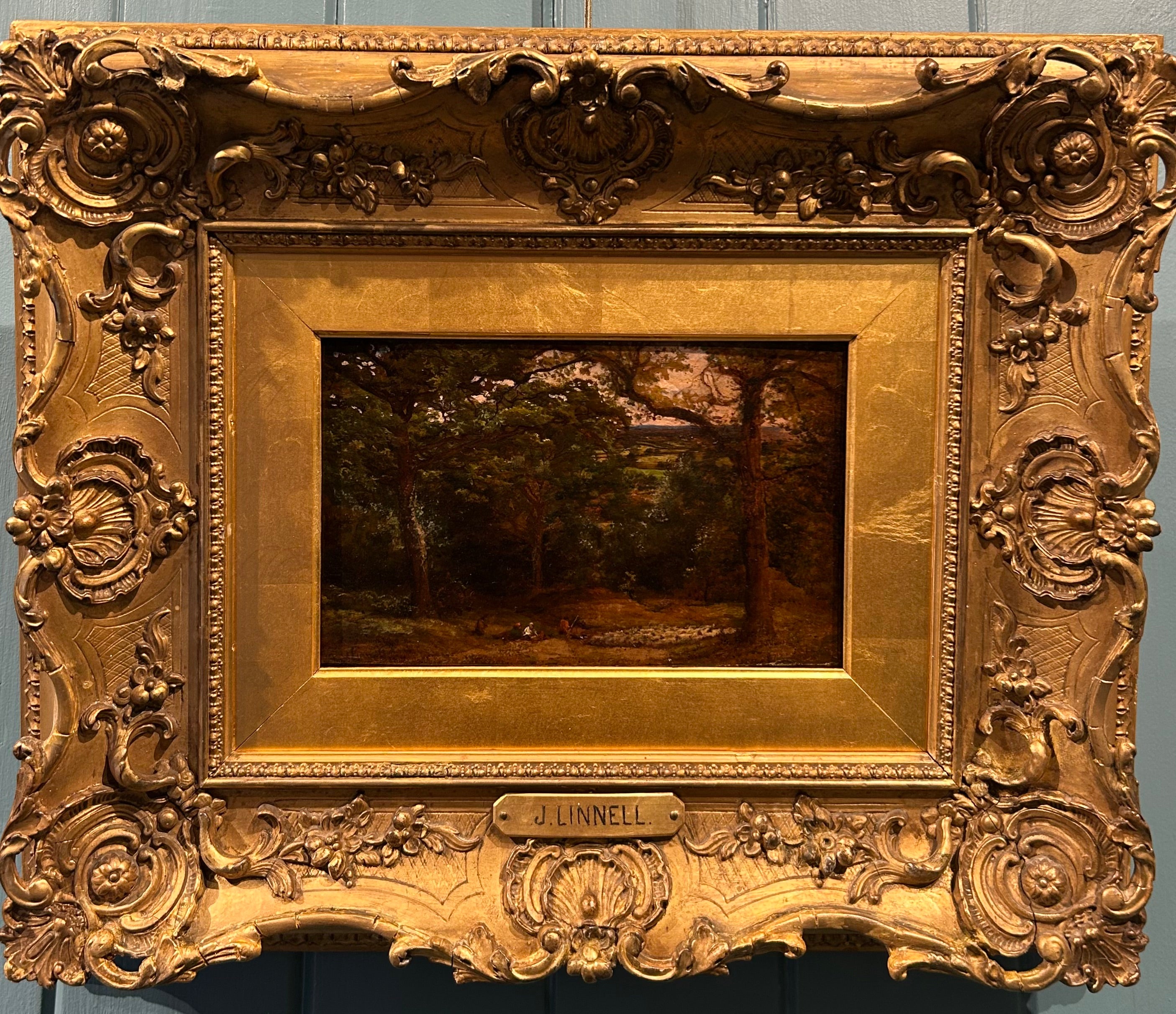
A Shaded Rural Idyll
Oil on paper on board, signed lower left
Image size: 9 1/2 x 6 inches (24 x 15 cm)
Original gilt frame
Exhibited No. 22 old label verso
Provenance
Private collection, England
There is a real sense of magnitude in this charming oil painting, with the figures of the shepherds and their flock being dwarfed by the luscious trees that surround them as they rest in a glade. The figures occupy only a minute area of the composition, with the rest taken up by the natural world. Through the trees, in the upper section of the painting, a patchwork assembly of fields can be made out - a reference to England’s strong rural tradition of the 19th century. A quintessentially British artwork, one might say.
Apart from its endearing subject matter, this landscape is technically majestic and truly demonstrates why Linnell was perceived as a rival by John Constable. The leaves of the trees are picked out in minute detail, as are a smattering of white flowers trailing up the trunk of the tree to the far left.
The diminutive size of the figures does not reduce their level of detail, with each shepherd sporting a unique outfit and a herding crook. The sheep herd is truly wonderful, with paint applied in such a way that their wooly coats are almost tangible. The fields in the background, however, are one of the most touching aspects of the painting, with a variety of greens and yellows representing crops that recede into the distance, darkening in colour as they do so.
John Linnell
John Linnell was born in 1792 in Bloomsbury as the son of a wood-carver and gilder. He grew up as an artist, with his father capitalising on his abilities by encouraging his son to make and sell copies of Morland’s works. He was introduced to Benjamin West, who in turn introduced him to John Varley - Varley was able to convince Linnell’s father to offer the boy formal artistic training. Linnell became a student of Varley’s before, at the age of 15, entering into the Royal Academy school in 1805. Here, Linnell met William Henry Hunt and William Mulready. He won the life drawing medal in 1807, and exhibited his first work at the Academy that same year.
This would mark a long relationship between Linnell and exhibiting at the Academy - by 1847, he had exhibited over a hundred portraits. He also exhibited at the British Institution from 1808 and won a 50 guinea prize in 1809 with a landscape. Between 1811 and 1815, Linnell created a number of watercolour sketches of London parks, all whilst being employed as a draughtsman by Pugin. His main sources of income were from teaching, and portrait commissions - his miniatures were especially popular with nobility and gentry. Linell was also known to engrave his own portraits, and charged a hefty sum for his commissions. Despite this, Linnell’s true artistic love was landscapes, a few of which he incorporated themes from the Bible within, as he was a devout Christian himself.
Linnell became a member of the Society of Painters in Oil and Watercolours in 1812 and contributed over 50 works to their exhibitions between 1813 and 1820, eventually becoming the Society’s treasurer in 1817. Linnell’s preferred medium was oil, however, and so he was forced to withdraw from the Society in 1820 when it changed to focus solely on watercolour works.
In 1818, Linnell was introduced to William Blake and the two became close friends, with Linnell introducing Blake to a number of other artists and patrons. When Blake was struggling financially, Linnell is known to have commissioned two expensive series of plates and drawings to help support him. As well as Blake, Linnell is known to have patronised and supported many young pre-Raphaelites, despite their initial unpopularity, as well as a young Samuel Palmer.
In the late 1840s, Linnell abandoned portrait painting, having profited enough from it, and turned to painting his beloved landscapes. He often depicted scenes of Surrey, as well as imagined landscapes from Bible stories. With his profits he was also able to build a house in Redhill, Surrey, where he entertained many prominent and up-and-coming artists of the time. His daughter married watercolourist Samuel Palmer, although Linnell eventually fell out with Palmer.
Despite his popularity and skill, Linnell never became a Royal Academician - he put his name down for election to associate in 1821, but withdrew it 20 years later. It is believed that John Constable, jealous of Linnell’s skill as a landscape artist, spread malicious rumours that prevented Linnell’s appointment to the Academy. This feud became a public scandal and prompted the Academy to repeatedly invite Linnell to become an associate, but he declined and instead published a scathing pamphlet decrying the insular and exclusive nature of the institution.
Linnell passed away in 1882. By the time of his death, he had exhibited almost two hundred works at the Royal Academy, and almost a hundred at the British Institution. A collection of his works was shown at the Royal Academy in 1883 to commemorate him. Three of Linnell’s sons also went on to become artists themselves. His works can be found in many private collections, as well as the National Portrait Gallery and the Louvre.