Derek Davis
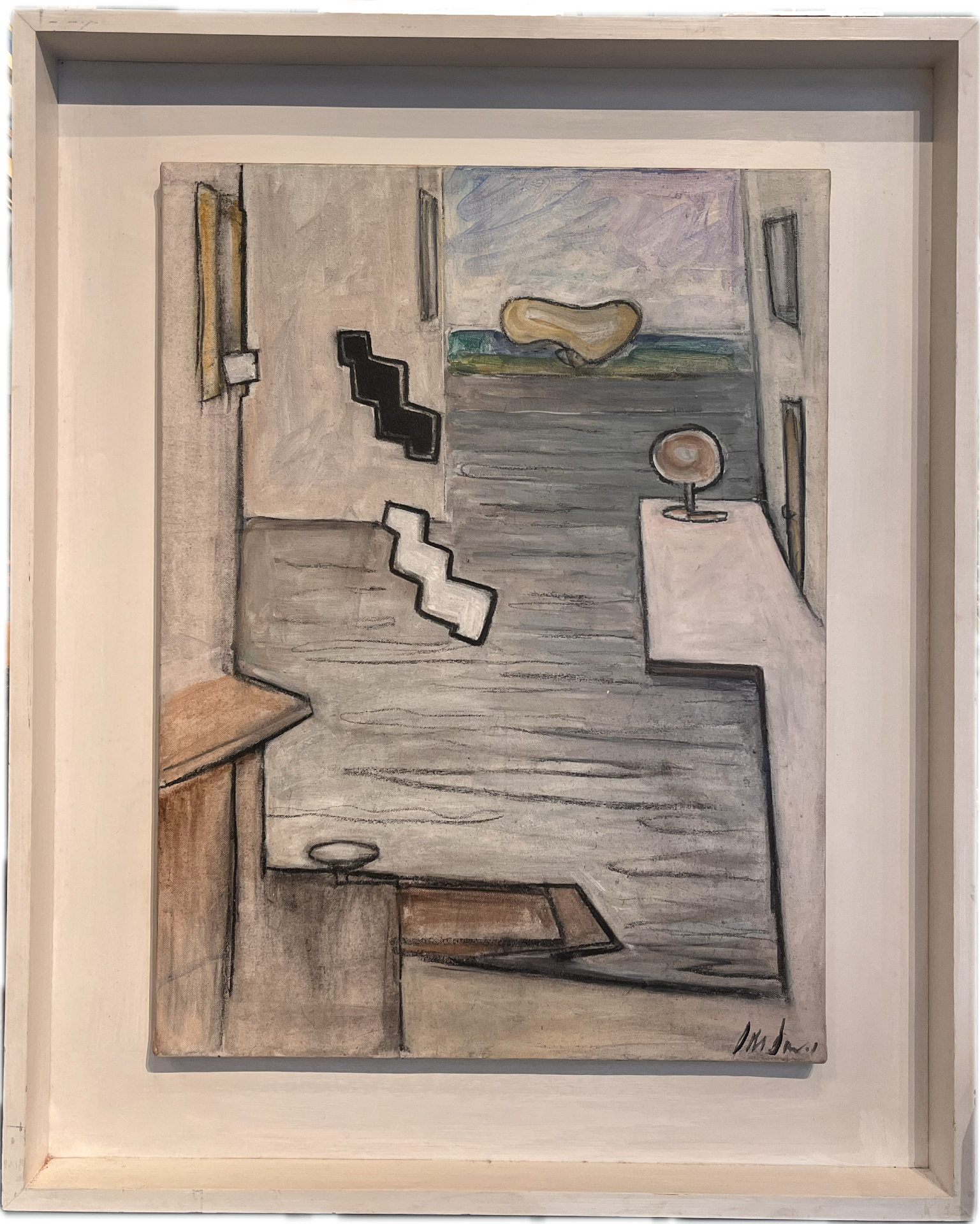
Abstraction in Grey
Oil on canvas, signed lower right
Image size: 24 x 18 inches (60.7 x 45.6 cm)
Original box frame
Derek Davis
Derek Maynard Davis was born in 1926 in Wandsworth, London. During the Second World War, he joined the King’s Royal Rifle Corps - after demobilisation, he then entered the Central School of Arts and Crafts to study painting and sculpture. He befriended ceramicist Eric James Mellon, with whom he opened a pottery workshop in Buckinghamshire after realising that painting was not a viable way of making a living. Alongside John Clarke, Ruth Lambert, Martina Thomas and Mary Mansfield, they became the Hillesden Group.
Davis’ focus on crafts and pottery was very relevant to the times. The Crafts Centre of Great Britain had opened in 1948, and the Craftsmen Potters Association was founded ten years later to promote the work of studio potters. The 50s marked a renaissance of crafts, allowing Davis to reach great acclaim.
Davis was a self taught ceramicist, allowing him to develop several innovative techniques. He joined the Arts and Crafts Exhibition Society in 1960 and exhibited terracotta works at the Victoria and Albert Museum, before beginning to concentrate on stoneware and developing new glazes. Davis was the artist in residence at Sussex University in 1967. As his reputation grew, Davis began to exhibit his works at home and around the world, including in Europe, the USA and Japan. In 1976, Sir Roy Strong - the director of the V&A at the time - selected Davis to represent the ‘Spirit of the 70s’ for an exhibition at the V&A.
After an eye operation in 1994, Davis was unable to look through the hole of his pottery kiln and instead focused on painting. His works focused on being immediately expressive and were often abstract - figuration was highly stylised and non-naturalistic.
Davis passed away in late 2008. His pottery is part of the Barbican and V&A collections, and features in a number of British embassies. He is heralded as one of the most important ceramicists of the 20th century, and his ability to bridge the gap between pottery and painting demonstrates that he never lost sight of his fine art training at the Central School of Arts and Crafts.