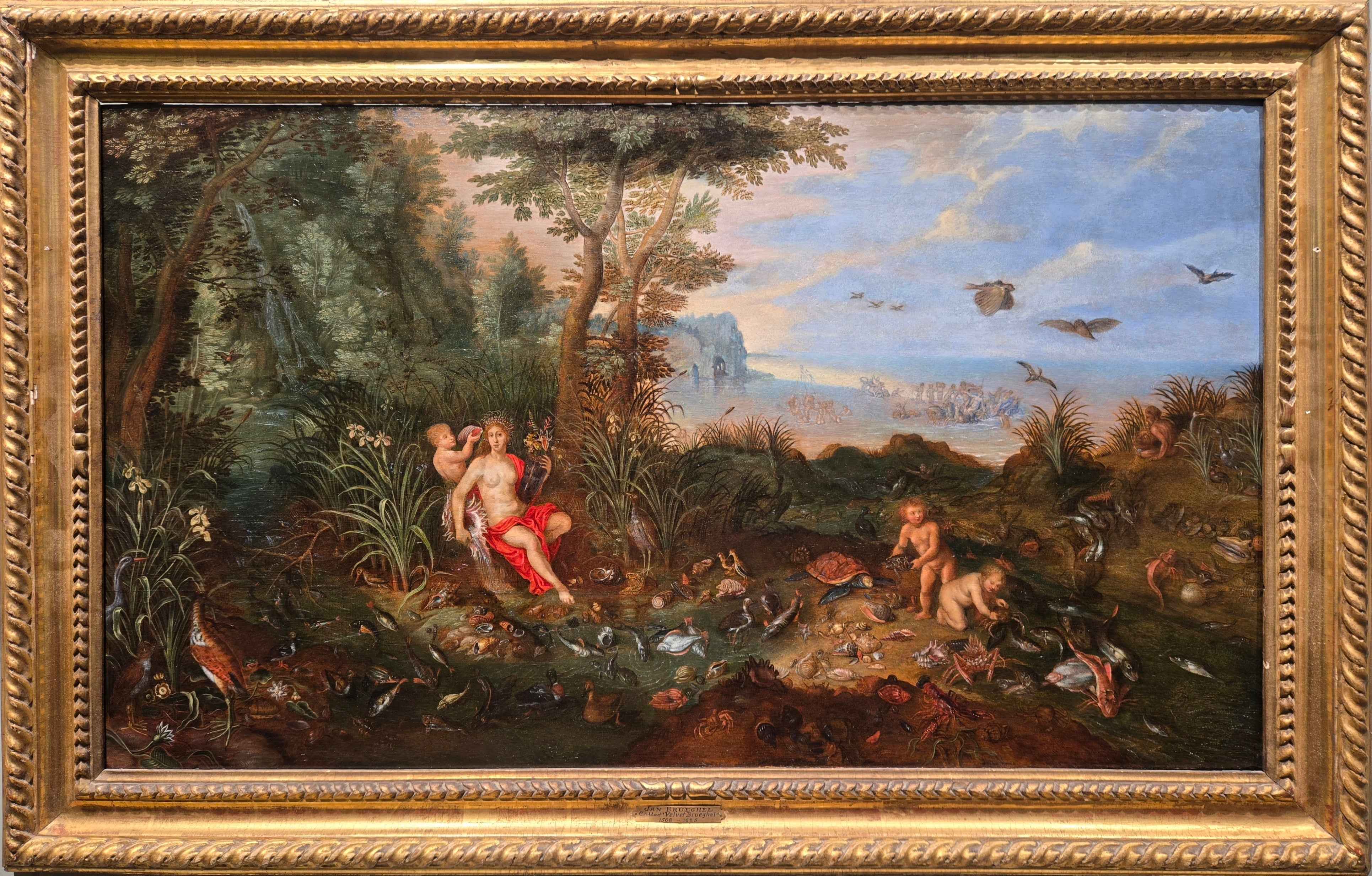
Studio of Jan Brueghel the Elder
Allegory of Water
Oil on cradled panel, exhibition label verso
Image size: 37 2/5 x 21 4/5 inches (95 x 55.5 cm)
Early carved giltwood frame
Exhibited:
'Landscape Painting from Patinir to Hubert Robert', Johns Hopkins University, 1941
Literature:
Klaus Ertz, Jan Brueghel the Elder: The Paintings with a Critical Catalogue Raisonné (1979)
Bettina Werche, Hendrick van Balen: An Antwerp Cabinet Painter of the Rubens Era (2004)
Klaus Ertz, Jan Brueghel the Elder: Critical Catalogue of Paintings (2008-10)
One of Jan Brueghel the Elder’s best known series of paintings was his Four Elements allegorical paintings - this work is one such painting, executed by his studio during his lifetime, and depicts the Allegory of Water. Brueghel’s best known Four Elements set is housed at the Museum of Fine Arts in Lyon - this set took six years to produce, being completed in 1611, and is the result of a collaboration between Brueghel and his contemporary Hendrick van Balen. Brueghel is known to have completed a number of similar sets, with versions held in the Galleria Doria Pamphilj in Rome, a private collection in Germany, and a lost version from the Königs Wusterhausen Palace in Berlin.
The high level of intricate detail in this work is exquisite. Whilst the narrative of the scene is the relationship between the Greek deities of the sea, Poseidon (depicted in the background with his hippocampi chariot) and his wife Amphitrite (in the foreground, clutching two large shells), the outstanding feature of this work is the supreme level of intricate detail that provides the viewer with a distinct visual lexicon that simultaneously represents ‘water’ whilst reflecting 17th century Netherlandish ideologies. Surrounding Amphitrite are hundreds of exquisitely rendered sea creatures, from fish and turtles to molluscs and seabirds. This variety of species represents the sea’s ecology, as well as the 17th century Counter-Reformation and the growth of natural sciences.
The Counter-Reformation was prominent in the Spanish Netherlands, with one of the movement’s central beliefs being that the earth, people and creatures were reflections of God. Given Brueghel’s patronage from two Italian cardinals, it is certain that the detailed depictions of sea creatures in this work is intended as a celebratory depiction of God’s creations. At the same time, growing interest in natural sciences was spreading across Europe, leading to the birth of encyclopaedic traditions, with scholars intricately recording the world’s flora and fauna in grand volumes. These volumes - as well as specimens, both living and dead - were collected by nobles across Europe, including those in the Brussels court that Brueghel worked for. Brueghel’s depiction of such a variety of creatures is undoubtedly inspired by this taste for the encyclopaedic, and transforms the work into its own miniature wunderkammer.
Jan Brueghel the Elder
Known as ‘Velvet Brueghel’, Jan Brueghel was born in 1568 in Brussels to the Flemish Renaissance painter Pieter Bruegel the Elder and Marie Coecke van Aelst, daughter of the artist Pieter Coecke van Aelst. Unfortunately, his parents passed away when he was very young, so Brueghel and his siblings went to live with their grandmother, who became their first art teacher. Brueghel, alongside his brother, studied oil painting in antwerp under the art dealer Peter Goetkint.
As with many of his contemporaries, Brueghal travelled to Italy to complete his artistic studies. He worked in Venice, before travelling to Naples, where he executed architectural drawings and worked producing cabinet paintings for the local nobleman Don Francesco Caracciolo. Brueghel then travelled to Rome and produced landscapes with Paul and Mathijs Bril. In Rome, he also became acquainted with Cardinal Ascanio Colonna and Cardinal Frederico Borromeo, the latter of whom became one of Brueghel’s most important patrons. Upon Borromeo’s appointment as archbishop of Milan in 1595, Brueghel travelled to Milan with him and stayed for a year before returning to Antwerp, where he stayed for the remainder of his life. Borromeo’s patronage allowed Brueghel to access the private art collections of the upper echelons of Italy’s noble circles, exposing the artist to Mannerist styles that undoubtedly influenced his artistic output. The Archbishop is said to have considered Brueghel supreme in his representation of God’s wisdom and creativity.
In 1598, Brueghel was admitted as a Free Master to Antwerp’s Guild of St Luke and, upon becoming a burgher in 1601, was elected dean of the Guild. He briefly visited Prague in 1604 to paint for nobles of the Holy Roman Empire, and it was here that he met the Archduke and Duchess Albert VII and Isabella of the Spanish Netherlands - he would become their court painter in 1606. In 1618, Brueghel was chosen to lead a group of twelve of the most talented Antwerp painters to produce a series of paintings for the Archduke and Duchess. For this, he worked alongside Rubens, Snyders, de Momper, van Balen and Vrancx. Sadly, this series of works was destroyed in a fire in 1713.
Brueghel was accomplished in multiple genres - history paintings, still lifes, allegory and mythology - and innovated new subject matters, such as garland paintings, paradise landscapes and gallery paintings. He avoided painting large figures, instead collaborating with other artists - Brueghel would paint the landscape, whilst another artist would paint the figures. Brughel’s best known series of collaborations was with Peter Paul Rubens, with the two producing a renowned allegorical series depicting the senses. Brueghel is known to have operated a large workshop and taught his son - Jan Brueghel the Younger - as well as Daniel Seghers. Brueghel mostly worked for a select clientele of nobles and collectors, rather than for the wider art market.
Jan Brueghel died in January 1625 as a result of the cholera epidemic in Antwerp. His works are featured in renowned collections across the world, such as the Louvre, the Prado, the National Gallery in London, and the Metropolitan Museum of Art.