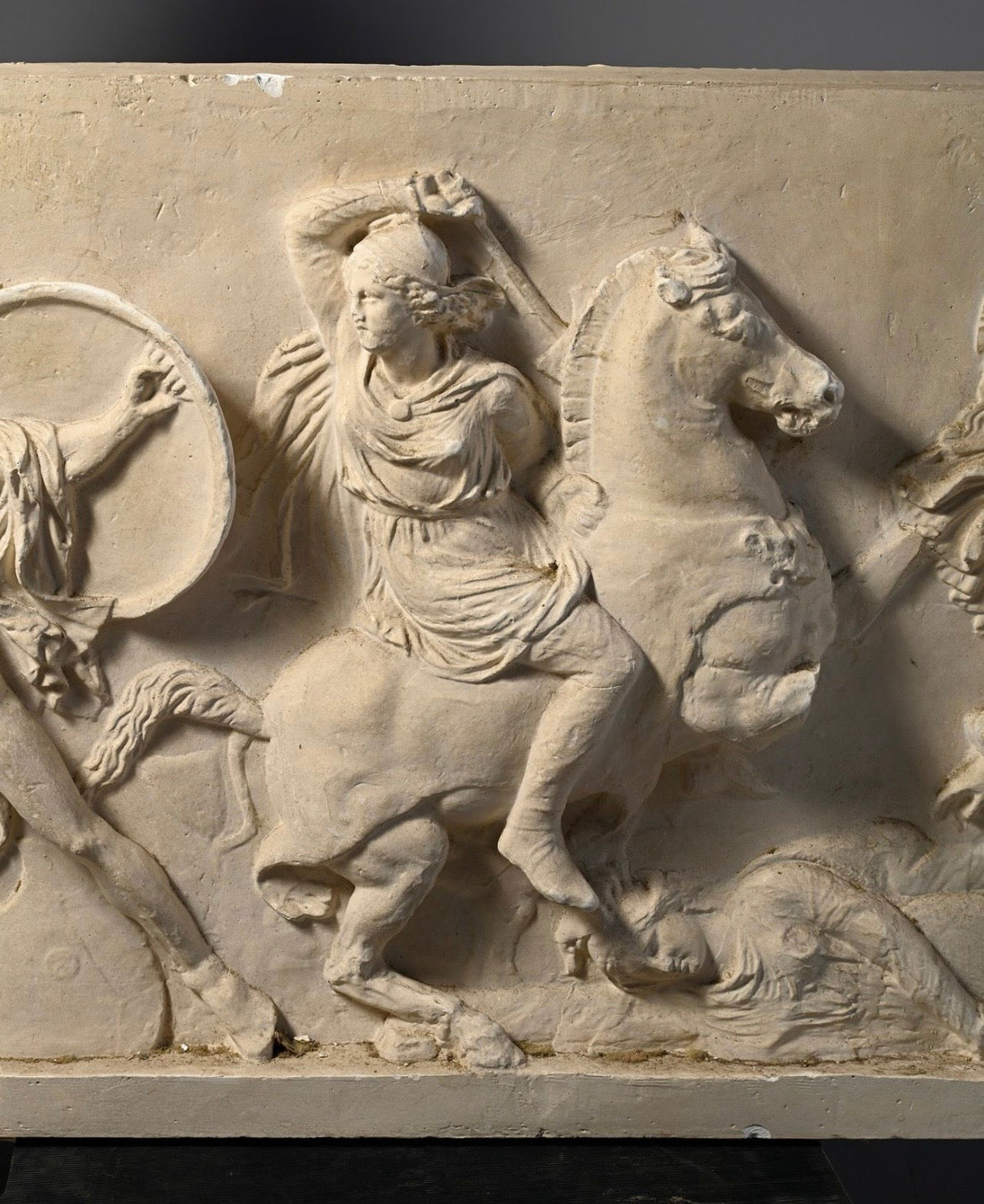
19th century French School
The Amazonamachy
Plaster freize relief
Size: 32 2/3 x 100 3/4 inches (83 x 256 cm)
Amazonomachy represents the Greek ideal of civilization. The Amazons were portrayed as a savage and barbaric race, while the Greeks were portrayed as a civilized race of human progress.
The original Roman marble sarcophagus, dating from 330-310BC, from which this cast is taken, was excavated in 1557 in the ancient royal city of Soloi, Cyprus. It was taken the following year to Venice. In 1567 it was acquired by the Fugger family and then in the 1st half of the 17th century purchased by the Hapsburgs.
According to Bruno Snell’s view of Amazonomachy:
“For the Greeks, the Titanomachy and the battle against the giants remained symbols of the victory which their own world had won over a strange universe; along with the battles against the Amazons and Centaurs they continue to signalize the Greek conquest of everything barbarous, of all monstrosity and grossness.”
Amazonomachy is also seen as the rise of feminism in Greek culture. In Quintus Smyrnaeus’s The Fall of Troy, Penthesilea, an Amazonian queen, who joined on the side of the Trojans during the Trojan war, was quoted at Troy, saying:
Not in strength are we inferior to men; the same our eyes, our limbs the same; one common light we see, one air we breathe; nor different is the food we eat. What then denied to us hath heaven on man bestowed?
According to Josine Blok, Amazonachy provides two different contexts in defining a Greek hero. Either the Amazons are one of the disasters from which the hero rids the country after his victory over a monster; or they are an expression of the underlying Attis motif, in which the hero shuns human sexuality in marriage and procreation.
“In the 5th century, the Achaemenid Empire of Persia began a series of invasions against Ancient Greece. Because of this, some scholars believe that on most 5th-century Greek art, the Persians were shown allegorically, through the figure of centaurs and Amazons.”
The west metopes of the Parthenon depict a battle between Greeks and Amazons. Despite its mutilated state, scholars generally concur that the scene represents the Amazon invasion of Attica. The Bassae Frieze in the Temple of Apollo has different types of Amazonomachy depicted – Trojan/ Heraclean etc. – as does the Mausoleum at Halicarnassus. (Source: Wiki)