Muriel Jackson
At the Old Vic
Tempera on board
Image size: 23 x 31 inches (58.5 x 79 cm)
Contemporary-style hand-made frame
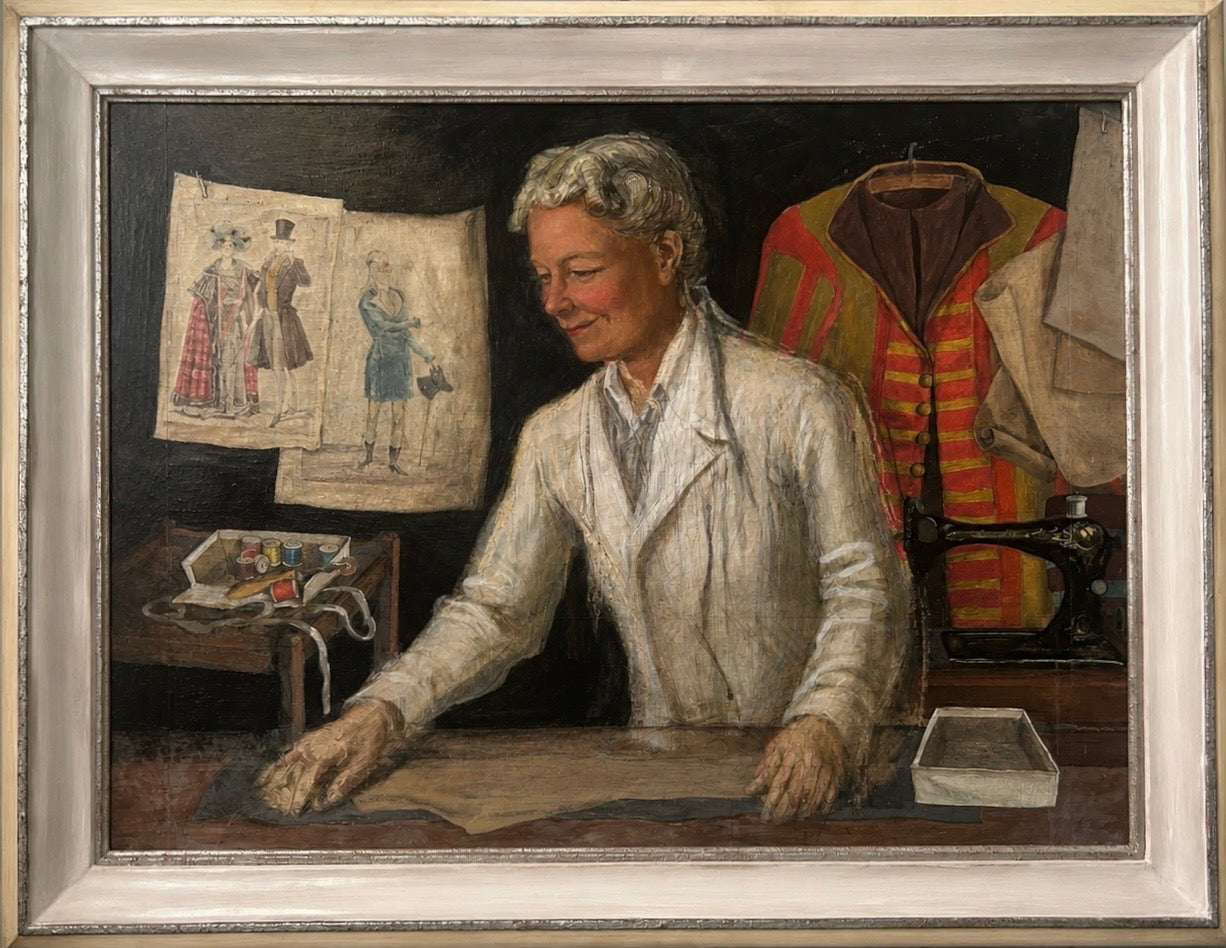
At the Old Vic depicts the artist’s sister, Mary Susannah Blomfield Jackson (b. 1898), working on a costume for a performance at the titular theatre. The background and Susannah’s face are finished in exquisite detail: she looks down at the fabric, the faint smile playing on her lips implying a sense of pride and joy in her work. Behind Susannah, we see a beautifully detailed black and gold Singer sewing machine, above which hangs a vibrant red and yellow jacket - another costume for another production. To the left of Susannah, hanging by paperclips, are two drawings of costume designs depicting a dandy in a blue coat and a well-dressed couple. Below, a box of brightly coloured thread and fabric cutter sit atop a counter. Susannah herself remains unfinished - the roughly sketched outlines of her body and overlayed drafts of hand positions give a sense of dynamism, capturing the sense of movement as Susannah works.
Muriel and Susannah’s father worked as an architect specialising in theatre design, possibly influencing Susannah’s own choice of career. Seamstressing had traditionally been considered one of the few professions acceptable for a woman, with many ladies in this profession creating costumes for theatre productions. However, there remained a difference between costume designers and costume makers (or drapers). While women like Susannah dominated the manual labour of production, the creative aspect of design tended to remain in the hands of men. In the early 1900s men such as Léon Bakst, Charles Ricketts and C. Wilhelm dominated stage and costume design in theatres, though an increasing number of pioneering women, such as Alice Comyns-Carr, began to break the norm. Though Susannah was able to make a living through being a costumier at the Old Vic, she remained constrained by traditional views of a woman’s place in the workforce, able to produce but not create.
Muriel Jackson
Muriel Blomfield Jackson was an English painter and wood engraver. Born in London in 1901, she was the daughter of acclaimed theatre architect Arthur Blomfield Jackson, who contributed to the design of iconic venues such as the Savoy Theatre and His Majesty’s Theatre. Her sister Susannah worked at the Old Vic Theatre as a costumier. Jackson was educated at Hampstead Day School and later studied at the Central School of Arts and Crafts in London between 1917 and 1922. It was here that she was learned the techniques of wood-engraving from the artist Noel Rooke and how to use tempera for painting from F. Ernest Jackson. In 1928, Jackson married Francis Courtenay Mason, a surgeon on Harley Street, with the couple later having two children- a son and a daughter. Though Muriel took her husband’s name upon marriage, she continued to work under her maiden name.
Jackson frequently exhibited with the Society of Wood Engravers from 1923 until 1940, and was elected as an associate of the society in 1925. In the same year, Jackson was a finalist for the British Prix de Rome scholarship competition. Throughout her career, she completed a number of public commissions for murals, most notably for St Peter’s Church at Limestone House in East London. She also exhibited at the New English Art Club, as well as the Royal Academy in London between 1927 and 1966. As was the case with many women artists in the 1920s, Jackson worked with transport companies and designed the ‘Happy Days at the Zoo’ travel poster for London County Council Tramways. In 1931, Jackson received the Logan Medal of the Arts at the International Exhibition of Lithography and Wood Engraving in Chicago for her print Wagon on the Heath. As a result, a large body of her work is represented in the collection of the Art Institute of Chicago. She travelled widely, returning to Italy where she was evacuated as a child, as well as visiting parts of Russia and Central Asia.
From 1920, Jackson specialised in recording traveller caravans on Hampstead Heath near her home in Well Walk. It was at the Heath Fairs that she met and befriended Leonard and Ivy Buckland, a travelling show couple of Romani decent. The Bucklands had commissioned an ornate caravan from Dunton and Sons on the occasion of their marriage and this caravan features in several of Jackson’s works. In 1938, after the Bucklands had retired from travelling, they sold the caravan to Jackson, who kept it in the family garden until she presented it to London County Council in 1948. Today, the Buckland caravan can be seen on display in the Kenwood Coach House at Kenwood House, Hampstead Heath.