Jules Marie Auguste Leroux
Self Portrait, in a White Shirt
Oil on canvas, signed and dedicated "à l'ami Blaise" lower left
Image size: 18 1/2 x 22 inches (46.8 x 55.7 cm)
Contemporary-style frame
This self portrait shows the artist in a relaxed, forward-leaning posture, clad in a casual white shirt and black waistcoat, looking towards the viewer with a calm expression.
The broad brushstrokes create a hazy and nostalgic atmosphere, as if Leroux has forever immortalised himself in a casual setting. The most masterful element of the painting is the distinct lighting, shining onto the sitter from the upper left, casting half of Leroux's face in shadow whilst illuminating the skin closest to the light source.
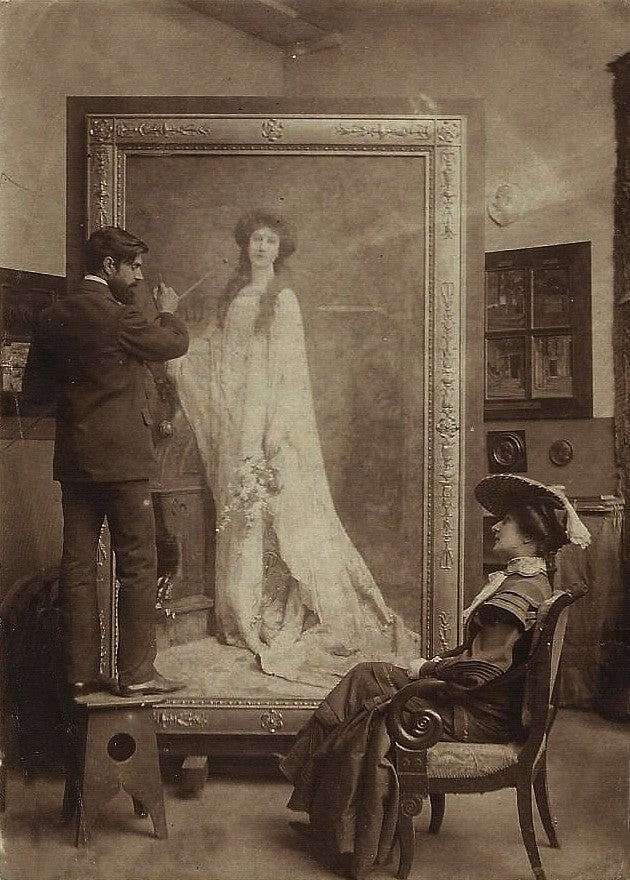
The photograph shows Leroux in his atelier.
Jules Marie Auguste Leroux
Auguste Leroux was born in Paris in 1871, as the son of a print publisher. He began his artistic studies at the School of Decorative Arts, drawing nude studies from life models and the works of academicians, before being forced to work on fashion drawings and children’s illustrations.
In 1892, he was admitted as a student at the Ecole des Beaux arts and was part of the studio of Leon Bonnat. Leroux won many prizes for drawing, despite the interruption of his studies by mandatory military service. In June of 1894, Leroux won the coveted Grand Prix de Rome with a painting of Judith and Holofernes.
With this funding, he left to study at the Villa Medici in Rome for three years between 1895 and 1898, accompanied by painter Adolphe Dechenaud and musician Henri Rabaud. During this period in Italy, Leroux formed a strong friendship with the musician Henri Busser.
Upon his return to France, Leroux began to exhibit at the Paris Salon, eventually becoming a member in 1904. He also earned a bronze medal at the Exposition Universale in 1900, as well as exhibiting at several acclaimed French galleries of his time.
Aside from his painting, Leroux was also well known for illustrating acclaimed European books, and was also a Professor at the Ecole des Beaux Arts between 1906 and 1939. Leroux was also responsible for executing the plans for several public buildings, notably mosaics of Saints in the iconic Sacre-Coeur Church. For his contribution to arts, he was awarded the status of a Knight of the Legion d’Honneur.
Leroux had married his wife Clotilde Morel in 1908 and had moved with her to a large house in the outskirts of Paris. He used the entire top floor of this house as his workshop for the rest of his life, where he gave his three children their first foray into artistic education. All three of his children - two daughters and a son - became respected artists in their own right.
Auguste Leroux passed away in March of 1954. His workshop house bears a decorative plaque to symbolise its cultural importance. Leroux’s memory was celebrated by a major retrospective exhibition at the Grand Palais shortly after the first anniversary of his passing.