


Alfred Egerton Cooper
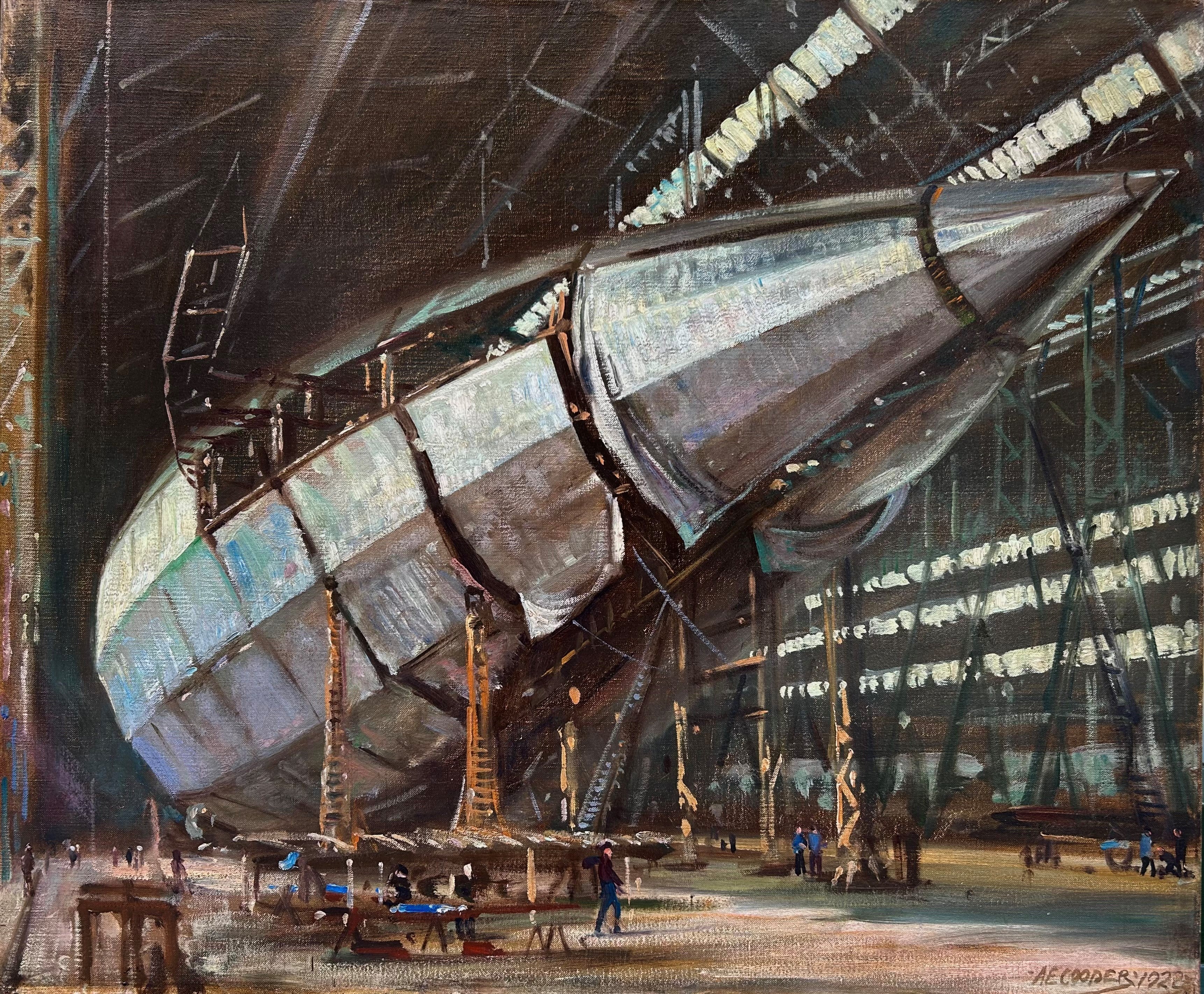
Covering the R100 in Howden
Oil on canvas, signed and dated lower right
Image size: 25 x 30 ⅓ inches
Hand made giltwood frame
Provenance: Sir Barnes Wallis thence by descent.
Note: The painting was reproduced in full colour in The Sphere, 28 September 1929, p. 26.
Bourlet label verso
The painting shows the enormous keel of the R100 airship, surrounded by scaffolding and ladders as its cover is put in place. The figures of the workmen below are dwarfed by the massive structure which fills the space of its shed, which was over seventeen stories high and could house two 750ft airships. Cooper was a life-long friend of Wallis, lead designer for the craft, as well as having his own speciality in depicting aircraft. This connection lends a repentance to this work, Cooper celebrating the innovative achievements of Wallis.
The R100 was built as part of a two-ship competition to develop a commercial airship for use on British Empire routes as part of the Imperial Airship scheme. The aim was to provide passenger and mail transport between Britain and the countries of the British Empire, including India, Australia and Canada. Though the project would prove to be the United Kingdom’s final attempt at developing rigid airships, the competition was popular with the press and the public. The competition was rigged against the R100 team from the start: the other ship, the R101 was built by the British Air Ministry while the R100 was created by the privately owned Vickers-Armstrong, with Barnes Waillis heading up the design team. Though both were funded by the Government, the R100 was given a budget, while the R101 had unlimited funds. The R101 team was also able to use the Royal Airship Works at Cardigan, ensuring easy access to skilled labourers and subcontractors, whilst the R100 team were given the abandoned airship base in Howden. The local workforce had to be trained and aluminium girders had to be manufactured on site, such were the difficulties of transportation. Cooper’s painting does not show the poor conditions faced by the workers carrying out construction in the airship’s shed: the roof leaked, ice formed on the girders in winter and condensation caused corrosion of the ship’s structure meaning that the girders had to be varnished.
The covering of the R100 proved to be an issue in its design. Both the R100 and R101 used fewer longitudinal girders resulting in larger areas of unsupported fabric. German built Zeppelins used an outer cover that was attached and then doped into place. Both the R100 and the R101 designers decided to reverse this process, pre-doping the cover material, and then applying it to the hull, aiming for a lighter and cheaper craft. It is the process of applying this pre-doped cover that Cooper has depicted. However, flight trials proved the R100’s covering was barely adequate and improvement was needed. It was also unsatisfactory on the R101, possibly contributing to its ultimate fate.
The R100 first flew in December 1929, making a series of trial flights and a successful return crossing of the Atlantic to Canada. However, following the crash of the R101 in October 1930, possibly influenced by competitive desire to not fall behind their rivals, the Imperial Airship Scheme was terminated and the R100 broken up for scrap.
The painting can be seen prominently displayed on the wall of Barnes Wallis's office in the 1955 film The Dambusters, one of the best-known and most beloved British war films, and appears in several publicity photographs of Barnes Wallis, including Roger George Clark's portrait of Sir Barnes Wallis at his desk, now in the collection of the National Portrait Gallery.
Alfred Egerton Cooper
Alfred Ernest Egerton Cooper was a British painter of portraits, landscapes and other figurative work, notable for his time as an official artist to the RAF during, and beyond, the First World War.
From modest origins, he began painting china before receiving any formal art training. He then attended art school in the West Midlands and Bilston School of Art, before continuing his training at the Royal School of Art and then the Royal College of Art. During this time as a student Cooper won a prize judged by John Singer Sargent, who was so impressed by the young artist’s work that he offered him a job as his studio assistant. Cooper spent twelve months in Sargent’s studio filling in details and backgrounds of the artist’s works.
During the First World War Cooper served in the Artists Rifles (28th County of London Battalion) and was then commissioned as a captain on the staff of the RAF. The Artists Rifles was originally raised in London in 1859 as a volunteer light infantry and during the Second World War was used as an officer training unit. The group was set up by Edward Sterling, an art student, and was comprised of various professional painters, musicians, actors and other creatives, a profile it strived to maintain with Frederic Leighton one of its first commanders. Whilst serving, Cooper lost sight in his right eye following a chlorine gas attack, though he was still able to draw and differentiate colours. After his injury he became an official war artist, specialising in portraits of members of the armed forces and recording airships and the views seen from them. His images highlighted the engineering detail and monumental presence of these airships, both in flight and in their sheds. He undertook numerous perilous missions where he would hang suspended from an airship whilst holding his painting equipment to accurately capture the view from the air. This led to Cooper becoming an expert in the art and technique of large-scale aerial camouflage; which combination of paint, colour and pattern could best disguise each of the different aircraft from the enemy.
It was whilst serving in the Artists Rifles that Cooper met Sir Barnes Wallis, best known for his invention the ‘bouncing bomb’, with the two becoming lifelong friends. Whilst Wallis specialised in inventing airships, Cooper specialised in painting them. Cooper painted Wallis several times and the latter served as best man at the former’s wedding in 1920.
During the Second World War, Cooper produced newspaper illustrations of the theatres of war, taking his information from contemporary photographs.
In 1948 Cooper competed at the London Summer Olympics in the arts competition, depicting salmon rivers and horse racing, though it is not known where he placed.
During his career he painted five portraits of Winston Churchill, including the last that Churchill sat for which was completed three days before the politician suffered his final stroke. Cooper recalled in an interview how the notoriously difficult to please Churchill had insisted on observing every brushstroke via a mirror set up behind the artist. Cooper also produced portraits of King George VI, Queen Elizabeth II, ‘countless earls’, three Lord Mayors of London and the official portraits of various British military personnel.
Cooper was described by The Times as ‘a generous man of great charm’ and, according to his son Peter, also an artist, ‘generally looked more like a retired British colonel than an artist, and always dressed to the nines, even in his studio’. He was unashamedly old-fashioned, preferring figurative art, shunning abstraction and modernism. His studio was based in Glebe Pace, Chelsea from 1920 and he continued to work there until almost the end of his life aged 90.