

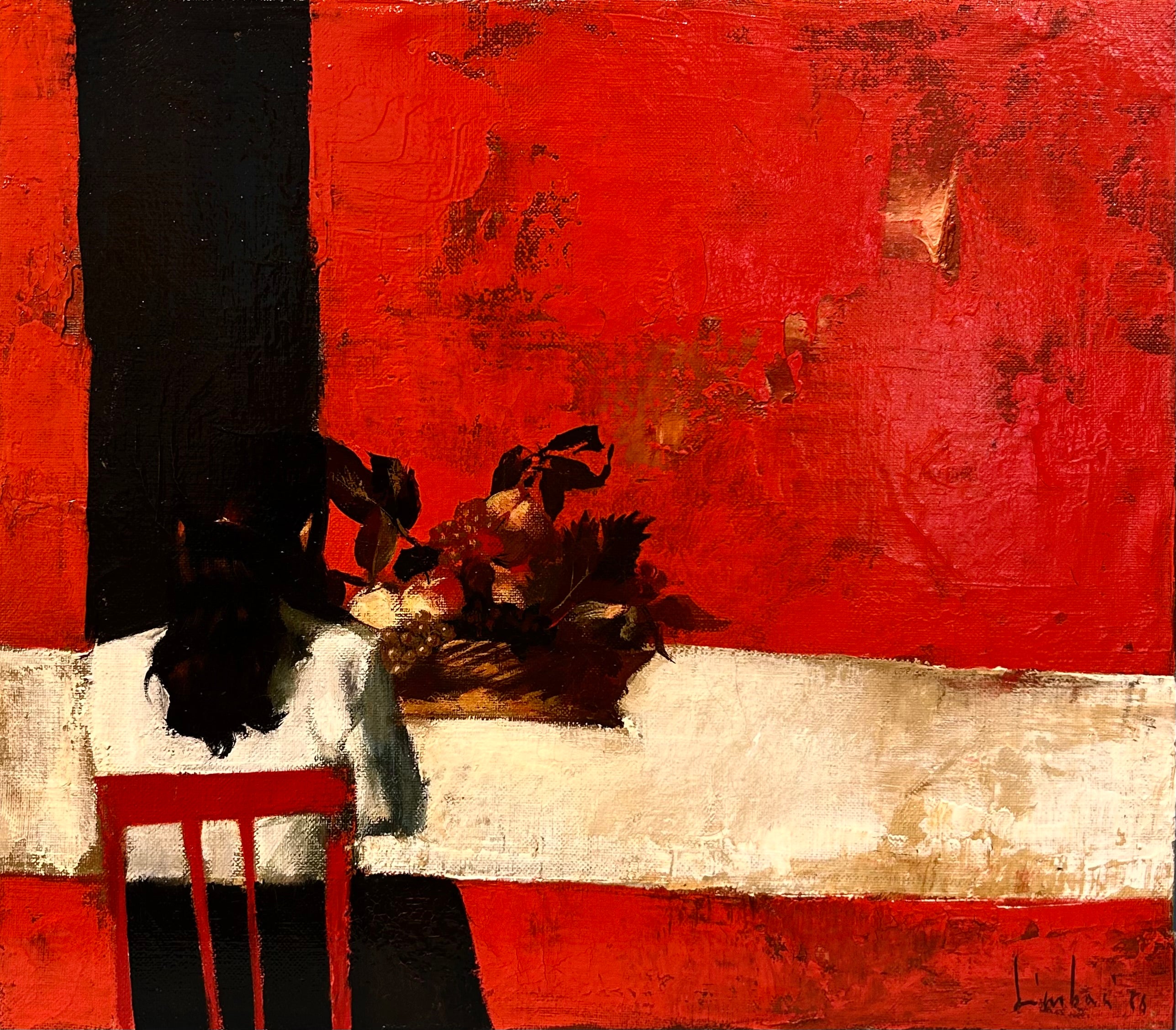

Nicola Simbari
Five O'Clock
Oil on canvas, signed and dated (19)'58'lower right
Image size: 15 1/2 x 13 3/8 inches (39.2 x 34 cm)
Giltwood frame
Provenance
Collection of Adolph Kroll Esq.
Exhibited
Arthur Jeffress, Catalogue 21, 1958
In this minimalist but evocative work we see a woman seated at a table, her back turned, with a basket of fruit and leaves on the table in front of her. The bright, arresting red that dominates the canvas is broken by a bold vertical line of black running through the left of the canvas and the horizontal line of white representing the table. The black and white are mirrored in this woman's outfit- her white top blends into the table and her black skirt and hair into the vertical line. This makes the woman almost invisible within the composition at first glance. The viewer's eye is first drawn to the basket of fruit, the element of the painting rendered in the most detail, before spotting the woman, whose position turned away from the viewer keeps her anonymous. This, along with the title Five O' Clock, creates the sense that she is awaiting the arrival of a companion who has forgotten about their meeting.
The vivid colours, use of palette knives and sparse brushwork in the work are all distinctive of Nicola Simbari's unique artistic style.
Nicola Simbari
Born in San Lucido, Calabria in July 1927, Italian artist Nicola Simbari was raised in Rome where his father worked as an architect for the Vatican. The masterpieces of Rome made an impression on the young Nicola and, by the age of 13, he enrolled to study at the Accademia di Belle Arti di Roma before devoting himself to painting in a studio at Via del Babuino in central Rome in the 1940s.
Nicola's father's profession as an architect had a lasting impact on the young artist. He incorporated geometric forms and architectural structures into almost all of his paintings. His birth town of San Lucido was also a deeply rooted influence- the arresting blues of the Calabrian ocean and sky, the bright hues of the flowers led Nicola to use a bold and striking colour palette throughout his career. He was inspired by the works of Georges Braque and Joan Miro and developed a distinct style, known as Simbaresco, stemming from impressions of life, nature and the Mediterranean, impressions which abstractly reflect themselves in vivid and passionate colours. His subjects were usually Mediterranean landscapes and contemporary European life.
Nicola's originality and commercial appeal brought him success almost immediately. He brought his art to exhibitions in London and New York in the 1950s, solidifying an international reputation. A one-man show in London led to a commission to paint murals for the Italian Pavilion at the 1958 World's Fair in Brussels.
Nicola's works can be found in museums as well as private and corporate collections across the world, including the Bank of Tokyo, the Christian Dior Collection in Paris, Italian State Railways in Rome, Liberty Company in London, Tulsa Bank of Commerce, Cincinnati Fine Arts Department, Exxon Corporation, General Mills Corporation and Pepsico in America.
Nicola Simbari passed away in December 2012.