Hazel Bruce Dunlop
Green Line
Gouache
Image size: 20 × 13 inches (51 × 33 cm)
Hand made frame
Provenance
Commissioned by Green Line 1938
Private Collection
Green Line originated as part of the network of coaches established by the London General Omnibus Company in the 1920s and 1930s, running coach services to towns and villages outside of London. Services were paused during World War II and when operations resumed it became part of London Transport.
At its peak, ridership reached 36 million passenger journeys a year between 1957 and 1960, with routes stretching as far as Windsor and Tunbridge Wells. By the 1970s, the combination of increasing car use and more efficient parallel rail services saw use of the Green Line decline and in 1986 ownership of the network was privatised with only a few routes surviving. Today, only one Green Line route remains: the 757 running from Luton Airport to London Victoria.
Dunlop’s poster is one of a number of Green Line posters commissioned by London Transport from the 1930s to 1950s. When Frank Pick took over London Transport’s publicity in 1908 he took a progressive approach to commissioning works. At a time when the male-dominated advertising industry saw women as suitable only for depicting ‘feminine’ subjects and illustrating children’s books, Pick chose artists irrespective of gender. Though male artists continued to be paid more and achieved higher levels of recognition, female artists such as Dunlop were able to jump-start their careers with these high-profile poster commissions.
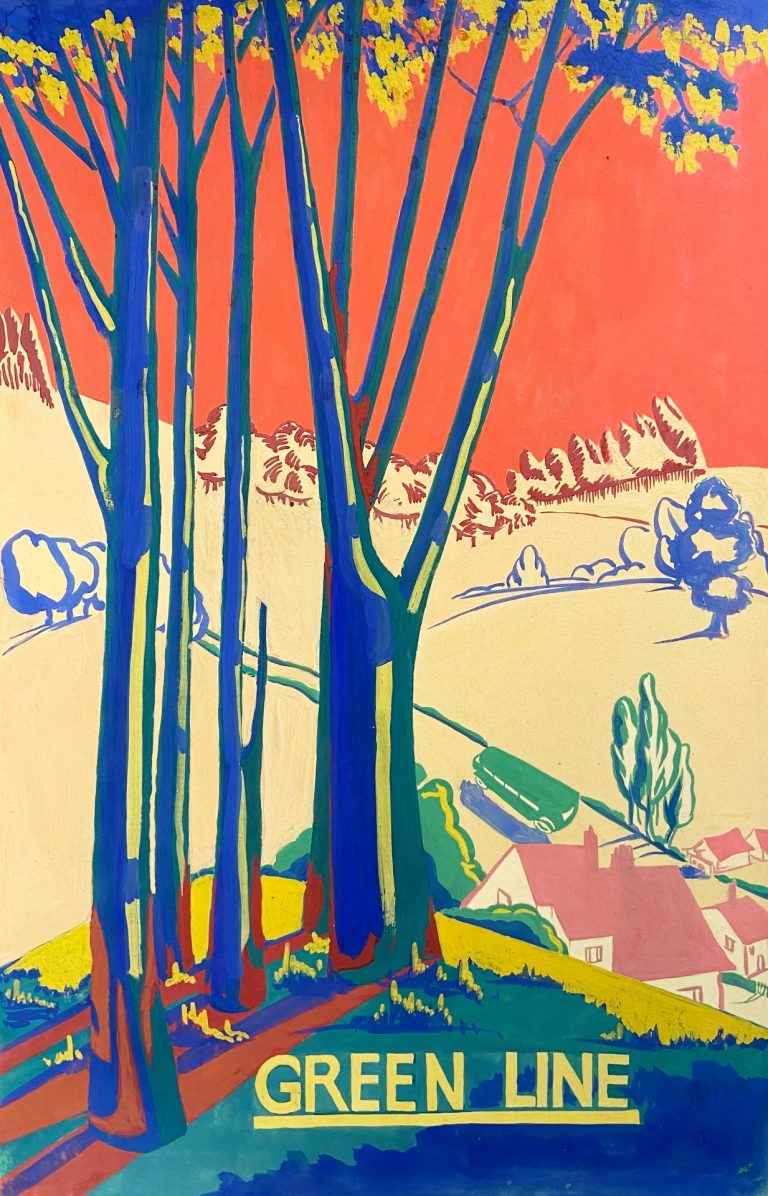
Designed to promote travel to the rural areas, market towns and other areas outside of London that the Green Line made accessible, Dunlop’s poster depicts a small group of tall trees at the crest of a hill, overlooking a rural valley through which a Green Line bus makes its way. The long shadows and red sky evoke feelings of a journey home after a long summer’s day spent enjoying the English countryside. In keeping with London Transport’s advertising to promote the Green Line as modern and scenic, Dunlop’s work is stylised and vibrant. Using a limited palette of predominantly primary colours and bold outlines, Dunlop elevates the humble poster to a striking and distinctive work of art in its own right.
Hazel Bruce Dunlop
Hazel Bruce Dunlop was a contemporary post-war artist who mainly painted portraits, along with oil paintings and abstract art. She was born into a military family in British North Borneo and studied at the Slade School of Fine Art with Henry Tonks, Philip Wilson Steer and Randolph Schwabe. Her first husband was artist Francis Edwin Hodge and, following his death in 1949, Dunlop then went on to marry Sir Eric Wilfred Fish in 1950.
Green Line reflects how Dunlop was required to depart from her usual figurative works in the medium of oil painting to create a work in gouache to gain a lucrative and high-profile commission to further her career.
Dunlop was a member of the United Society of Artists, with which she showed, in addition to the Society of Women Artists, Royal Institute of Oil Painters, Royal Academy of Arts and Paris Salon. She lived in London.