Henrietta Rae
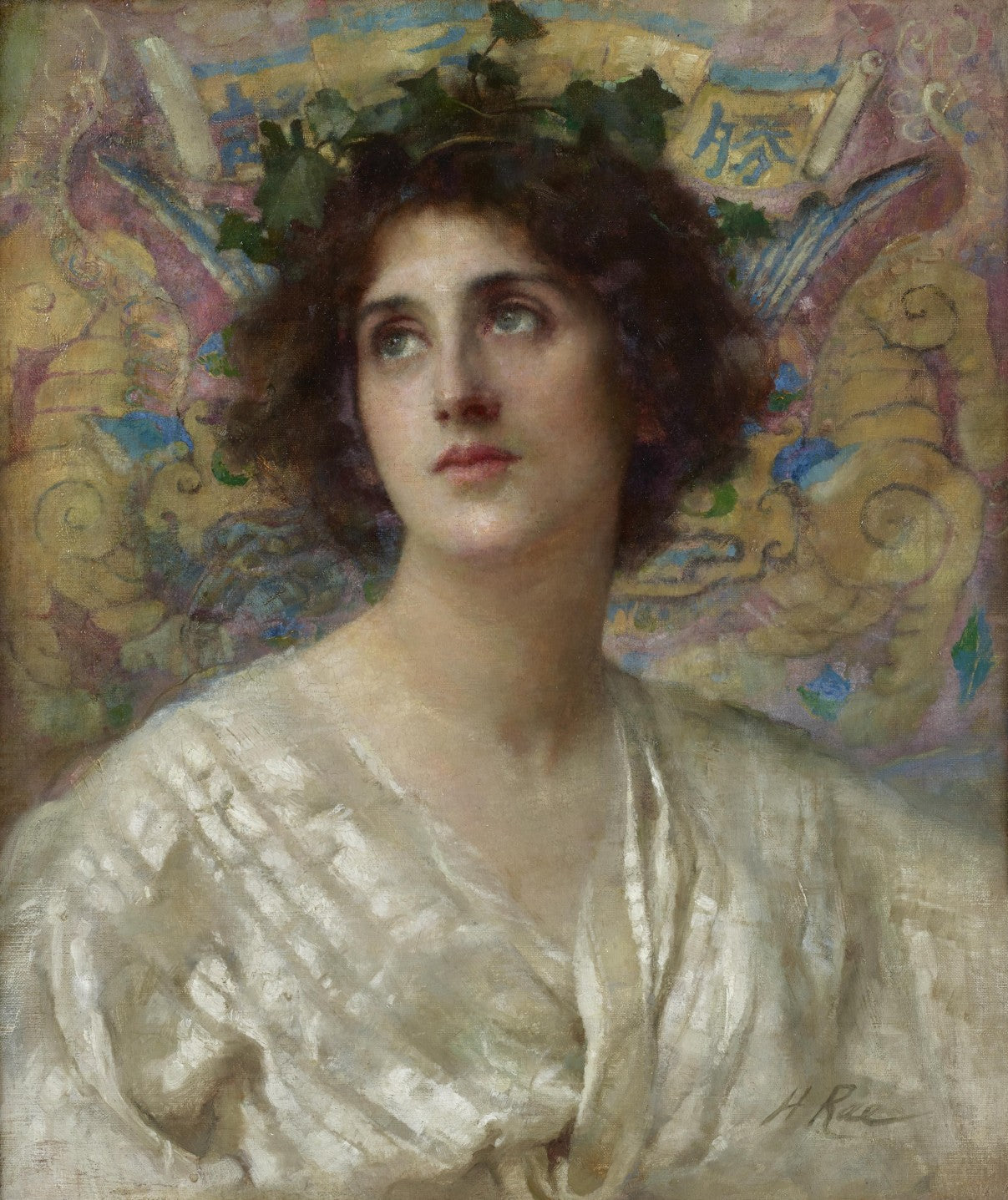
Her Eyes are Homes of Silent Prayer
Oil on canvas, signed lower right
Image size: 24 x 20 inches (61 x 51cm)
Original gilt frame
Literature
Fish, Arthur. Henrietta Rae (Mrs. Ernest Normand). Cassell and Company, 1905.
Henrietta Rae’s painting Her Eyes are Homes of Silent Prayer takes its title from a famous line in Section XXXII of Alfred, Lord Tennyson's elegiac poem In Memoriam A.H.H. (1850). It describes Mary of Bethany's profound faith and love for Jesus, highlighting her silent, intense devotion after her brother Lazarus's resurrection. The line signifies deep love surpassing words, focusing on inner spirituality and divine reverence.
The work depicts the head and shoulders of a woman in a white Kimono, turning to look gently up top left of the canvas, her head crowned with ivy and set against a background of Chinese-style inspired motifs. The serene and pensive expression on the woman’s face reflects the subject of devotion described by Tennyson’s poem. Rae often depicted literary figures and this is not the only work by Rae that drew inspiration from Tennyson, with her painting Elaine Guarding the Shield of Lancelot based on the poem Lancelot and Elaine. However, other than the title and the sitter being lost in thought, there is little to identify the subject as one from literature. Victorian art frequently merged with literature to highlight moral, social and emotional themes, however, artists such as Leighton, with whom Rae was acquainted, chose to move away from narrative and design works based purely on aesthetic appeal. Here we see the same focus on beauty over the narrative of religious devotion on which Tennyson’s poem is based.
But as a female artist she perhaps makes a point to the art establishment who made her life so hard, the Chinese characters stand for Victory, win or success. It took Rae five attempts to gain entry to the Royal Academy, as a woman artist.
The background of the work is based on Chinese paintings with auspicious clouds (Xiangyun 祥云; 祥雲) scrolls with Chinese-esque characters and two Chinese lion dogs (shíshī 石獅) flanking the woman’s head. In keeping with Chinese tradition, the shíshī are painted as a pair, symbolising the harmony of Yin and Yang. Chinese art had a significant impact on Victorian art, developing from the 18th Century ‘Chinoiserie’. Here, this is combined with ‘Japonisme’, a trend that had been growing from the 1850s, with its influence from Japanese woodblock prints in the flat pattern and vibrant colours. Rae was also influenced by Chinese and Japanese in her earlier work Azaleas (1895), similarly showing the head and shoulders of a woman, gazing up to the left, dressed in a kimono and holding a fan, against a background of an embroidered Chinese dragon.
Henrietta Rae (1856 - 1928)
Henrietta Rae was born 30th December 1856 in Hammersmith, London, to a civil servant father and musician mother as the youngest of seven children. Though her mother had trained her as a professional concert singer to ensure her future financial self-sufficiency, she began formally studying art aged 13 at the Queen Square School of Art before becoming Heatherley’s School of Art’s first female pupil. After at least five attempts she was awarded a seven-year scholarship to the Royal Academy of Arts and it was there that she met her husband, fellow painter and Academy student Ernest Normand. Unusually for the time Henrietta kept her maiden name, as she had already begun to establish her reputation as an artist, having been a frequent exhibitor at the Royal Academy since 1881.
Rae and Normand became part of the artistic community in Holland Park, dominated by the likes of Leighton, Watts and Millais. However, Rae was often reminded of her status as a ‘woman’ artist, suffering through the overbearing attitudes and conduct of the more senior, male artists. She wrote how, on one occasion, Val Prinsep dipped his thumb in some cobalt blue paint and marked up one of her pictures uninvited. Rae ‘accidentally’ burned his hat on her stove in retaliation.
Following a three year stint in Paris where both Rae and Normand studied at the Académie Julian, the couple moved away from the claustrophobic world of Holland Park to Norwood. It was here that the couple had two children, a son and a daughter, at the height of Rae’s artistic career which remained remarkably undamaged by the addition of motherhood.
She was awarded an honourable mention at the 1889 Paris Exposition Universelle and a gold medal at the 1893 Chicago World’s Fair for Eurydice Sinking Back to Hades. These accolades meant that Rae’s status was deemed high enough to allow her to serve on the Hanging Committee at the Liverpool Autumn Exhibition in 1893, the first time a woman had achieved this distinction at a major public exhibition.
She was an avid supporter of feminism and the women’s suffrage movement. She organised an exhibition showcasing the work of women artists in 1897 as part of Queen Victoria’s Jubilee celebrations, the first comprehensive display of British women’s art.
Throughout her career, Rae specialised in classical, allegorical and literary subjects, frequently depicting the female nude. Until 1894 women were banned from Royal Academy life-drawing classes so Rae attended independent sessions organised by Margaret Dicksee in the Fitzroy Square studio of Sir Francis Dicksee. The classical nude was considered one of the highest genres of painting in the Victorian era, however, modern art historical studies often view such depictions of the idealised female nude as problematic and solely for the male gaze. In the hands of a woman artist like Rae, the issue becomes much more nuanced and complex, reflecting her determination to never compromise her work for the sake of the label ‘woman’.