

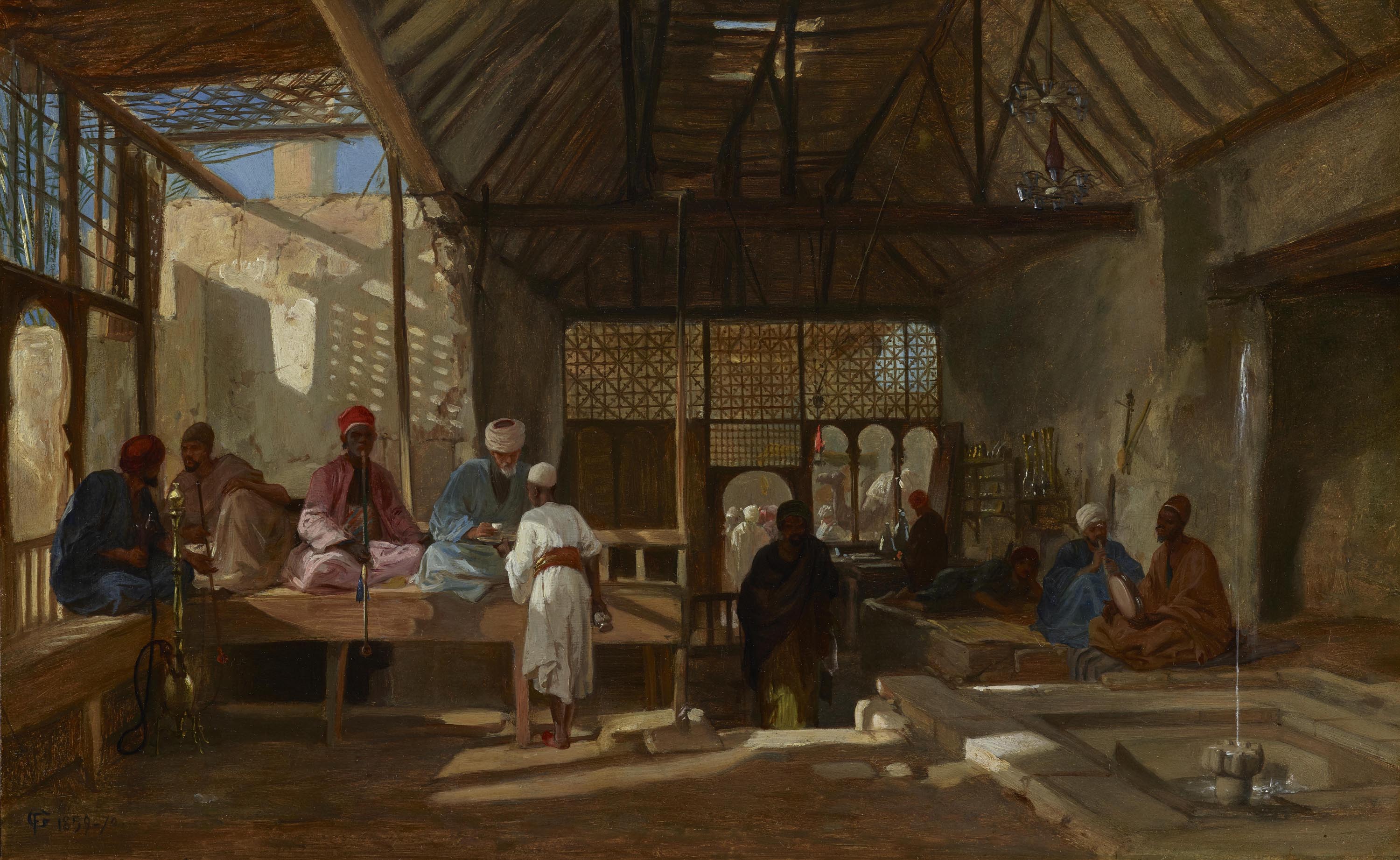

Frederick Goodall RA
A Coffee Shop: Citadel of Cairo
Oil on paper, laid down on canvas, signed with monogram and dated 'FG / 1859-70' (lower left)
Image size: 13 ¾ x 21 5⁄8 inches (35 x 55 cm)
Hand made giltwood frame
Exhibited
The Royal Academy, London, 1883 (no. 322)
This oil was undoubtedly painted in situ, during the decade that Goodall lived in Cairo. The work depicts the interior of an ahwa - a traditional Egyptian coffee shop with a strong community presence, where customers met to smoke shisha and play dominoes and backgammon. The painting beautifully encapsulates these elements of Egyptian culture: to the left, a group of men smoke shisha; on the right, two men make music with a ney flute and a riq tambourine; in the background, a solitary figure drinks coffee whilst looking out onto a busy street.
Goodall’s knowledge of and appreciation for Egyptian culture is well on display in this work, where he has taken great care to accurately depict the variety of clothing as well as the ahwa’s architectural details. The most outstanding feature, however, is the masterful depiction of light and shadow. Goodall uses richer, warmer colours for the interior of the ahwa to contrast with the brightness of the external wall and vivid blue sky, demonstrating the shade that the coffee shop provides against the harsh sun. The sunlight that dapples the floor and external wall is truly magnificent, as the areas cast in light reflect the unique shapes of Egyptian architecture.
Frederick Goodall
Goodall was born in London in 1822 as the son of a steel line engraver who had crucial connections with acclaimed artists such as Turner, Ruskin, Pugin and David Roberts. He was educated at the Wellington Road Academy, before leaving school to learn oil painting with his father at St Martin’s Lane Academy. At the age of 14, he was commissioned to produce watercolours of Willesden Church and Lambeth Palace, with the final products being exhibited at the Society of Artists. By sheer chance, Goodall caught the attention of Isambard Brunel, who commissioned him to produce six watercolours of the Thames Tunnel.
Four of the watercolours were exhibited at the Royal Academy, marking the beginning of Goodall’s long tenure as an exhibitor at the Academy. Between 1838 and 1859, Goodall exhibited at the Academy 27 times and won a silver medal with his first oil painting. In 1852, he was elected as an Associate and received his full Academician status in 1863. His early works focused on historical subjects, but this was to change when he visited the Middle East.
Goodall visited Egypt in 1858 and 1870, travelling alongside Bedouin tribesmen. In 1858, he was accompanied by fellow artist Carl Haag - the two often sketched together, particularly in Cairo. In 1870, Goodall stayed in Saqqara and focused specifically on sketching Bedouin traditions and culture. Upon his return to England, Goodall painted many Orientalist works inspired by his sketches - 170 of these paintings were exhibited at the Royal Academy, to great success. With the backing of key Orientalist artists Edwin Landseer and David Roberts, Goodall began to gain a reputation as a master of Oriental scenes. He attracted the attention of art dealer Ernest Gambart, who began to sell Goodall’s sketches and paintings for great prices.
Despite this success, Goodall’s income began to dwindle as he aged and the tastes of the art market changed. He was still exhibiting at the Royal Academy two years before his passing as well as at the 1900 Exposition Universelle in Paris, but was nonetheless bankrupt when he died in 1904. Goodall is buried in Highgate Cemetery, in a family vault.