Henri Lebasque
La Lecture
Oil on canvas, signed lower right
Image size: 20 3/4 x 25 inches (52.7 x 63.5 cm)
Giltwood frame
Provenance:
M.F. Manaut
Vente Loudmer, 1969
Middendorf Gallery, Washington
Hammer Galleries, New York
Florida estate
Exhibitions:
1927 Galeries Georges Petit, Paris (No.55)
Literature:
Bazetoux, Denise. HENRI LEBASQUE: CATALOGUE RAISONNE (Vol I), p.202, fig.714 (Illustrated)
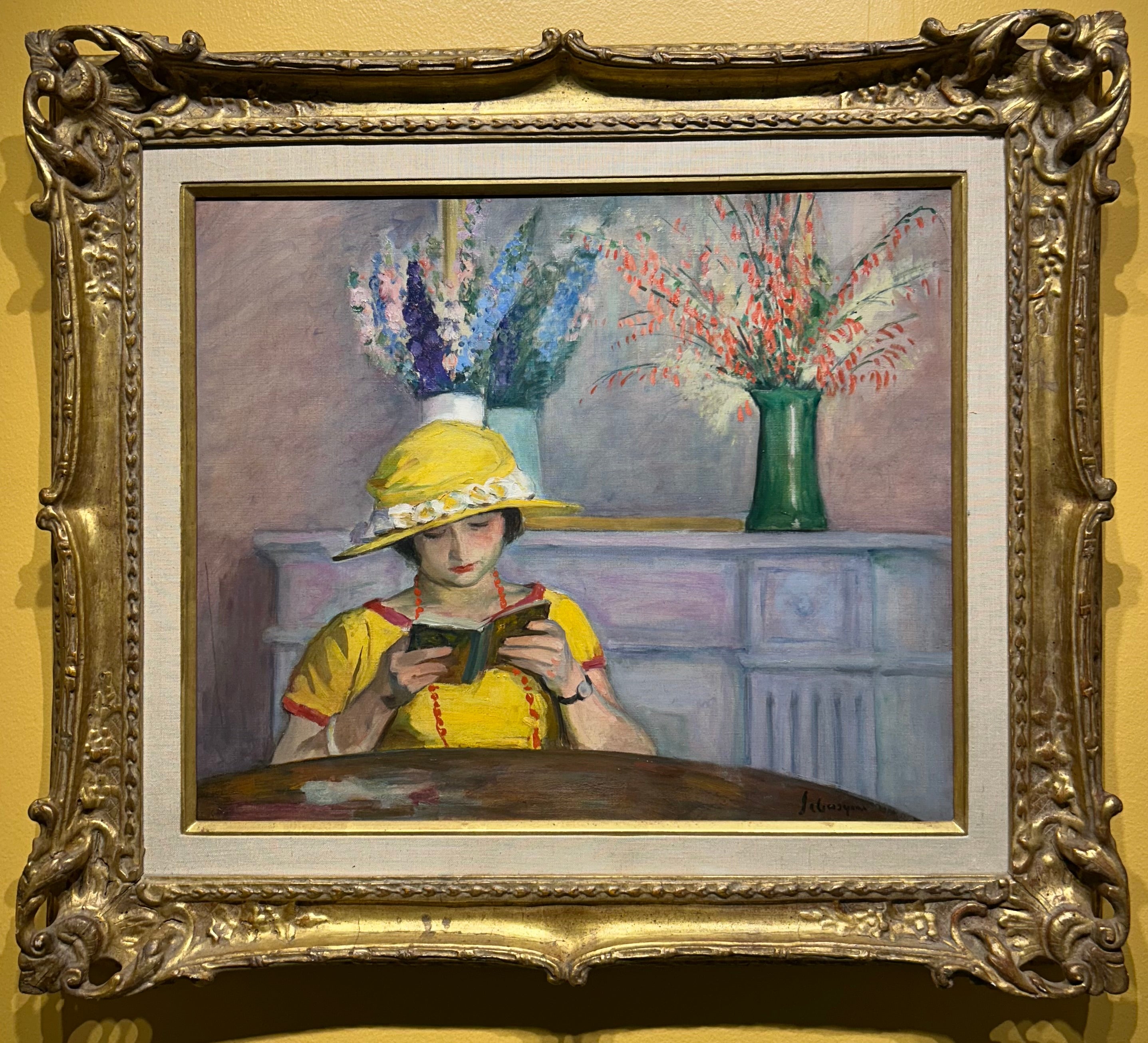
In this work from 1921, Lebasque depicts his 21-year-old daughter Nono as she focuses intently on the book in front of her. Behind her, two vases full of vibrant flowers adorn a carved mantlepiece. The image is one of sentimental domesticity and epitomises Lebasque’s association with the Intimist movement, which sought to depict ordinary and yet intimate scenes of domestic interiors.
Intimist artists would often employ exaggerated colour palettes to reflect the moods of their works, as is noticeable in this painting. The warmth and vibrancy of Nono’s yellow dress and the bright blue and red flowers creates an atmosphere of vitality, a sentiment only accentuated by Nono’s young age. Combined with the painting’s intimacy, this work becomes a representation of a father’s love for his youngest daughter and his wish to immortalise her youthfulness through brushstrokes.
The vibrancy of these colours is emphasised by the choice of a muted background of pale blues and pinks, demonstrating Lebasque’s understanding of colour theory as developed by his Post-Impressionist contemporaries, Seurat and Signac. As is typical of his other works, Lebasque’s focus on texture is evident here, with masterful depictions of the folds of fabric in Nono’s dress and hat, as well as the accurate reflection of light in the green vase on the mantlepiece.
Henri Lebasque
Henri Lebasque, born in Champigné, France, in 1865, left behind a vibrant artistic legacy. Inspired by fellow painters Édouard Vuillard and Pierre Bonnard, Lebasque’s work reflects the influence of Les Nabis, a group of Intimist artists. His time in the sun-soaked landscapes of the South of France transformed his colour palette, leading him to fully embrace the vibrant Fauvist style.
Lebasque was acknowledged as an outstanding artist at Parisian galleries and annual salon exhibitions, he studied with the great academic masters of the Ecole des Beaux-Arts, receiving tutelage at the atelier of the renowned Leon Bonnart, official portraitist to many important figures of the Third Republic, and a painter of a brilliant portrait of Victor Hugo. As a young man entering the Parisian art world, Lebasque’s arrival coincided with the acceptance of Impressionism with the public and critics, creating an atmosphere of exciting innovations in painting such as those from artists like Cezanne.
Throughout his career, Lebasque painted serene family scenes, landscapes, and domestic interiors, capturing moments of quiet beauty. These scenes of intimacy within the domestic sphere in Lebasque’s subject matter convey the universal familiarity of home and family similar to that realised by Bonnard and Vuillard. There is also a sense of calm infused in Lebasque’s painting which celebrates the fullness and richness of life.
At the studio where Lebasque first studied, Leon Bonnart’s emphasis upon draughtsmanship and mural decorations found inspiration in Lebasque’s own approach to painting. He was an excellent draughtsman, but he chose a looser form of expression more akin to his peers than to his academic masters. Lebasque absorbed fresh ideas from Vuillard and Bonnard, founders of the ‘Nabi’ group, who saw themselves as harbingers of a new painting style.
While Lebasque was absorbing the new painting styles of his peers, he was also studying classical forms of painting, taking lessons from Camille Pissarro, the aging Impressionist master, who later praised Lebasque’s work at the Salon des Independants in 1902. Lebasque also extracted much from formal technique examination, as practiced by Georges Seurat. Seurat developed techniques later labelled Divisionism and Pointillism, which were highly intellectual approaches to the arrangements of colours and paint on the canvas. Seurats’s main contribution, and the most lasting in terms of the development of Lebasque’s personal style, was an understanding of the colour theories devised in the late 1830’s by the artist Chevreul, stressing the use of complementary colours in shading. Lebasque’s first exposure to these theories was most likely from conversations with his friend Paul Signac, a pupil of Seurat’s.
Critics celebrated his unique fusion of form and colour, setting him apart from other Fauvists. As a founding member of the Salon d’Automne in 1903, alongside his friend Henri Matisse, Lebasque exhibited at the Salon des Indépendants. Notably, Georges Rouault, André Derain, Henri Ottmann, Édouard Vuillard, and Matisse also participated in that exhibition.
Often hailed as “the painter of joy and light,” Lebasque skilfully portrayed the sun-dappled landscapes and opulent interiors of the French Riviera. His compositions, bridging Impressionism and Fauvism, reveal a keen sensitivity to shifting natural light and an unapologetic embrace of expressive colours and gestures, evoking powerful emotions.