Sir Alfred East
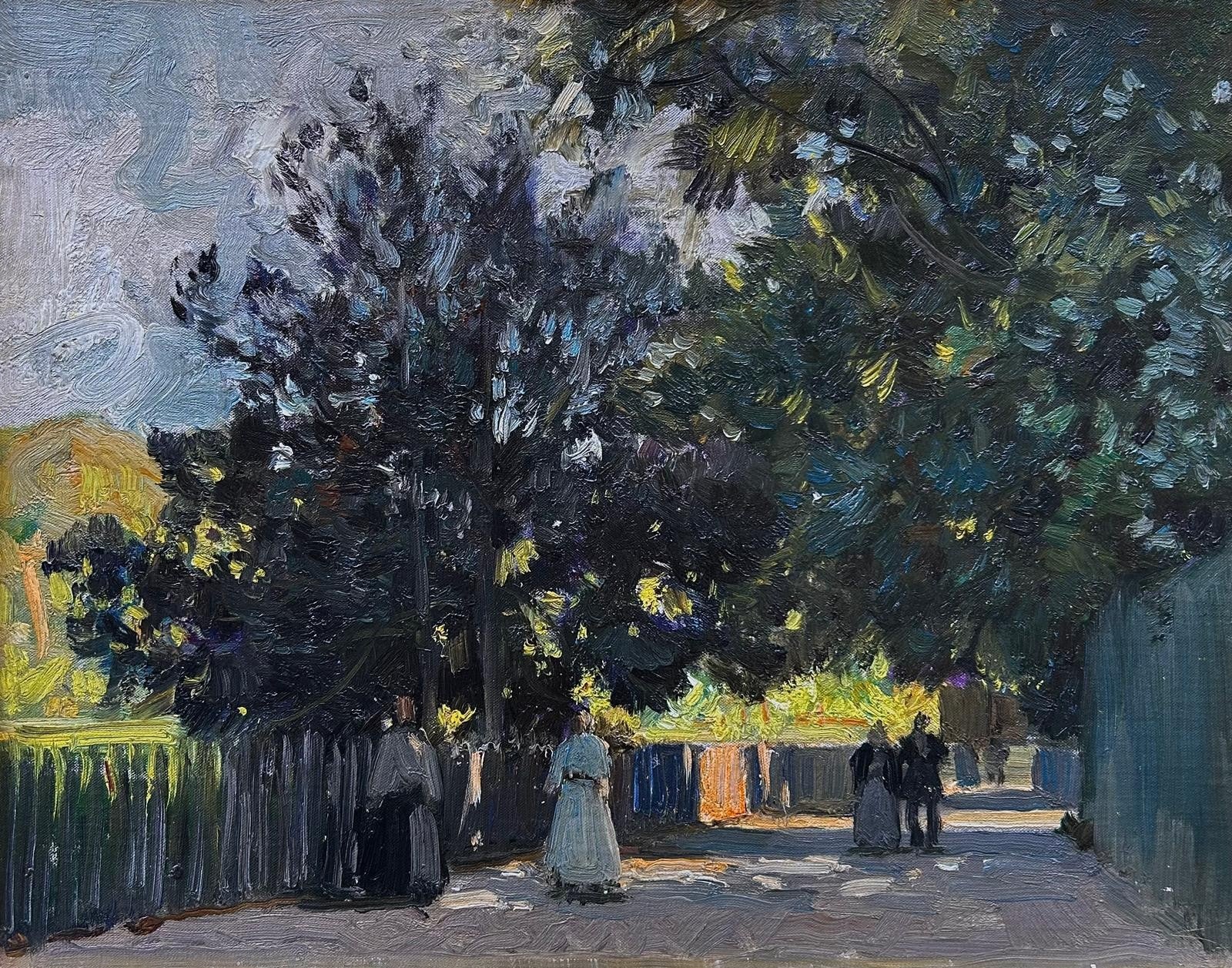
Morning Stroll, Marble Hill River Path
Oil on board
Image size: 14 1/2 x 18 1/2 inches (37 x 47 cm)
Period gilt frame
This charming scene demonstrates perfectly the influence of the Barbizon school on not only Alfred East, but the infancy of the Impressionist movement. The Barbizon school were drawn together by their passion and desire to elevate landscape painting as a response to the Academic elevation of historical and mythological themes, and functioned as a precursor to the emerging Impressionist movement. The influence of the school is readily apparent in the landscape composition - there are figures in the foreground, but the predominant focus remains the park scenery that they are situated in.
Particularly remarkable in this work is East’s depiction of light and perspective. The sunlight filters through the trees and pools, dappled, on the sandy floor. The fencing and the path are cast in areas of darkness and light, according to how the shadow of the trees fall. Whilst the foreground remains dark, falling under the shadow of the branches above, the luminosity of the background is clearly visible. The work is a beautiful representation of summer sunshine along the Marble Hill River Path, painted in a proto-Impressionist manner.
East adopted a well established three-stage-technique that made great use of the under-painting, a second layer concerned with the correction of values, and a final stage for the addition of details; all painted with lean oil paint. As can be seen in the work, during this process East practically repainted the entire canvas after the first layer and then proceeded to pick out isolated sections that required further reworking and detail.
Alfred East
Alfred Edward East was born in December of 1844 in Kettering, Northamptonshire. As a young man, he was noted for his artistic skill and was commissioned to make a set of illustrations of prehistoric creatures.
He began his formal artistic education much later at the Glasgow School of Art, having travelled there initially to work as a sales representative for his brother’s company. He attended evening classes in art and decided to become a professional artist well into his thirties. He began to exhibit with the Royal Scottish Academy in the 1870s. In 1882, East travelled to Paris to study at the Academie Julian and the Ecole des Beaux Arts, where he became well acquainted with the works of the Barbizon School. In 1883, East made his debut at the Royal Academy and Royal Society of British Artists.
In 1884, East and his family travelled from Glasgow to live in North London. Shortly after, he was part of a joint exhibition at the Fine Art Society, which resulted in the institution commissioning him to travel to Japan and paint scenes of life there. East produced 104 paintings from his time in Japan - the works were exhibited at the Fine Art Society in 1890 to great success. East was the first artist to make such in-depth painted studies of Japan and its landscapes and inhabitants, and shortly after became one of the founding members of the Japan Society. He continued to travel, painting regularly in France, Spain, Italy and North Africa.
East became an Associate of the Royal Academy in 1899 and was elected to full membership in 1913. In 1906, he was elected President of the Royal Society of British Artists and was afforded a Knighthood four years later. He was a member of the New English Art Club, the Royal Society of Painter-Etchers and Engravers (1885), the Royal Institute of Painters in Watercolours (1887), and the Royal Institute of Oil Painters (1888). He also sat for acclaimed portraitist Philip de Laszlo.
Shortly before his passing, The Alfred East Art Gallery opened in Kettering, and is Northamptonshire’s oldest purpose-built art gallery. In fact, East’s body lay in state in his eponymous gallery, surrounded by the artworks he had presented to the town.
East continuously exhibited at a number of important art galleries, including over a hundred works at the Royal Academy and Fine Art Society. He also exhibited at the Royal Society of Artists in Birmingham, the Walker Art Gallery, Leicester Art Gallery, Glasgow Institute of Fine Arts, the Royal Society of British Artists, the Royal Scottish Academy and Manchester City Art Gallery. His works can be found in many prominent museum collections, such as the Alfred East Gallery, the Lady Lever Gallery, the Lain Gallery, the National Museum of Wales, the Royal Academy, and even as far away as museums in Luxembourg, Venice and Budapest.