Lena Gurr
Night Work
Oil on Canvas, signed lower right, signed and titled verso
Image size: 25 x 21 inches (63.5 x 53.5cm)
Contemporary frame
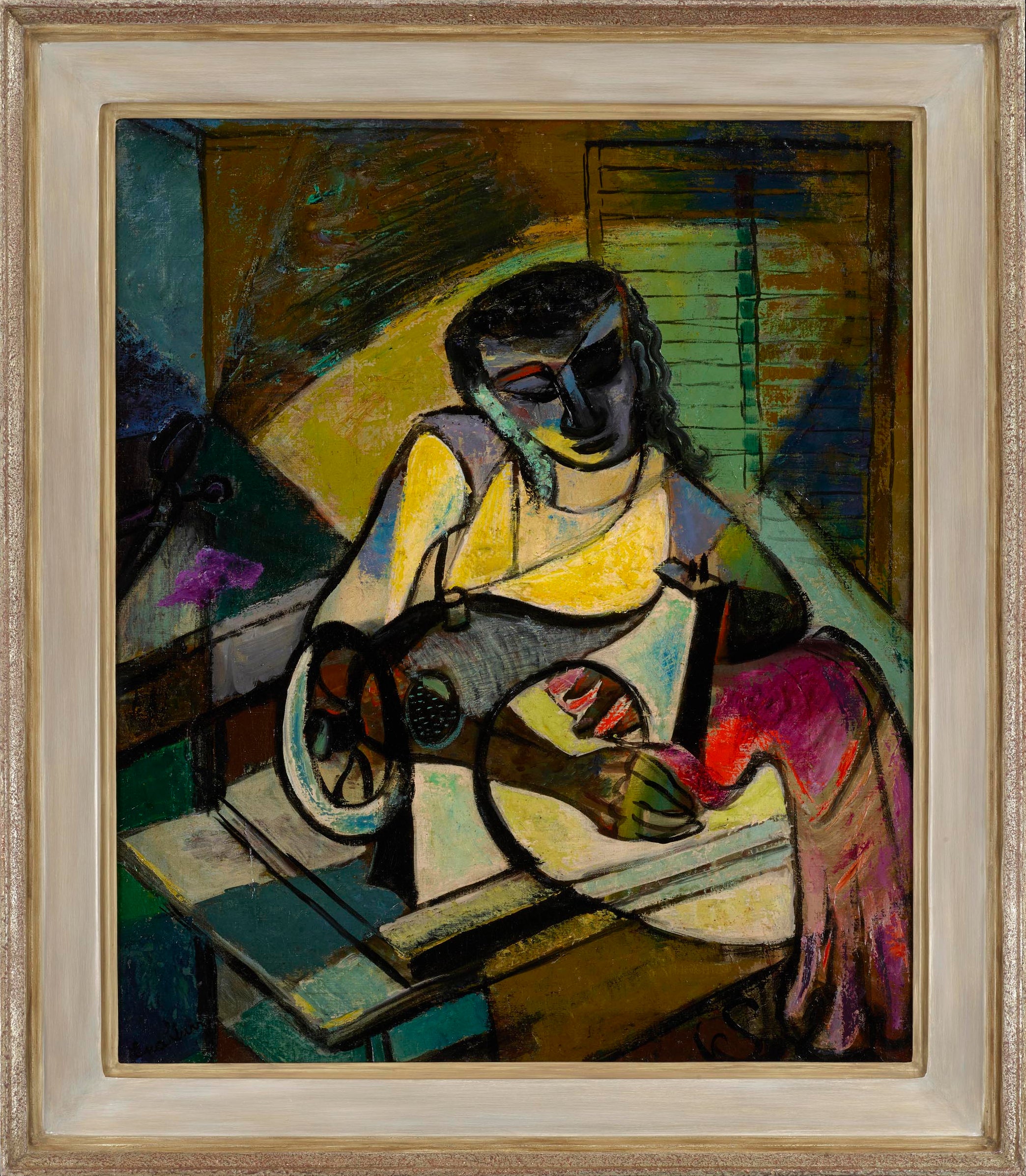
Night Work depicts a lonely seamstress at her sewing machine, her work illuminated by a single spotlight. On the right side of the canvas the shutters are closed and a pair of scissors with an off-cut of fabric sit on the workbench behind her. The woman’s head bends to the left as she concentrates on sewing the seam of the purple dress in her hands.
The painting reflects Gurr’s move away from representative, semi-abstract art towards a more Cubist technique. The composition is made up of blocks of colour used to emphasise the contrast between the illuminated workspace and the surrounding darkness. Thicker brushstrokes of striking yellow and red light up the smock worn by the woman and the dress in her hands. The subject matter, a presumably working-class woman working late into the night, either to earn enough to make ends meet or repairing a much-loved garment she cannot afford to replace, is in keeping with Gurr’s interest in depicting modern urban life and poverty. Her feminism and social activism combine in this painting to capture the isolation and loneliness of being a working-class woman in the years following the Great Depression.
Lena Gurr (1897 - 1992)
Lena Gurr was born into a Russian-Jewish immigrant family in Brooklyn in 1897. She began studying art at a young age, joining her high school’s art club. She studied at the Brooklyn Training School for Teachers, ensuring art was a component of the teacher training she received here. In 1919 she studied painting and print-making at the Educational Alliance Art School and, between 1920 and 1922, she was awarded a scholarship to the Arts Students League with John Sloan, and with Maurice Sterne in Paris as well as in Mentone and Nice, France. It was whilst studying at the Arts Students League that Gurr met her future husband, fellow artist Joseph Biel.
Gurr was one of a number of women artists from an immigrant background who studied at the Arts Students League in the early 20th century. An increasing number of women artists had come to study and work at the League from the late 1890s onwards with many of them taking on key roles within the institution. Opportunities were growing for women artists and it was becoming more socially acceptable for women to have a successful career as an independent artist. Many of her colleagues were WPA artists, though Gurr was not involved in the project herself, including Dorothy Block and Minna Harkavy. WPA artists were painters, sculptors, photographers and muralists employed by the Federal Art Project (1935 1943) during the Great Depression which aimed to provide relief to artists and create iconic, socially realistic works celebrating American labour and life. They, like Gurr, also tended to be from an immigrant background and had a strong social consciousness. This clearly influenced Gur’s choice of subject matter, frequently depicting subjects within this theme, depicting city scenes and the realities of poverty in urban life.
Gurr’s feminism and social activism was reflected in the societies to which she belonged. She was a member of the Artists League of America, the National Association of Women Artists, the New York Society of Women Artists, the Brooklyn Society of Artists, Audubon Artists and the American Artists Congress. She exhibited in numerous exhibitions held by these organisations as well as the Whitney Studio Club, National Academy of Design, Virginia Museum of Fine Arts, Brooklyn Museum, and the 1939 World’s Fair.
During her artistic career Gurr created works in a variety of mediums, ranging from easel art in oil and casein, lithographic and silk screen prints, watercolours and drawings. Over the years her style developed from representative and semi-abstract, towards a much more abstract and semi-cubist technique.
Her work is included in the collections of the Biro-Bidjan Museum, Russia and the Library of Congress, where she has been selected as a “Curator’s Choice” in the Smithsonian Archives of American Art. In addition to her career as a painter, lithographer and serigrapher, she also taught art in the New York City public school system. She had three solo exhibitions at the ACA Gallery in 1935, 1939 and 1945, and a retrospective in 1963.