Sir William Blake Richmond
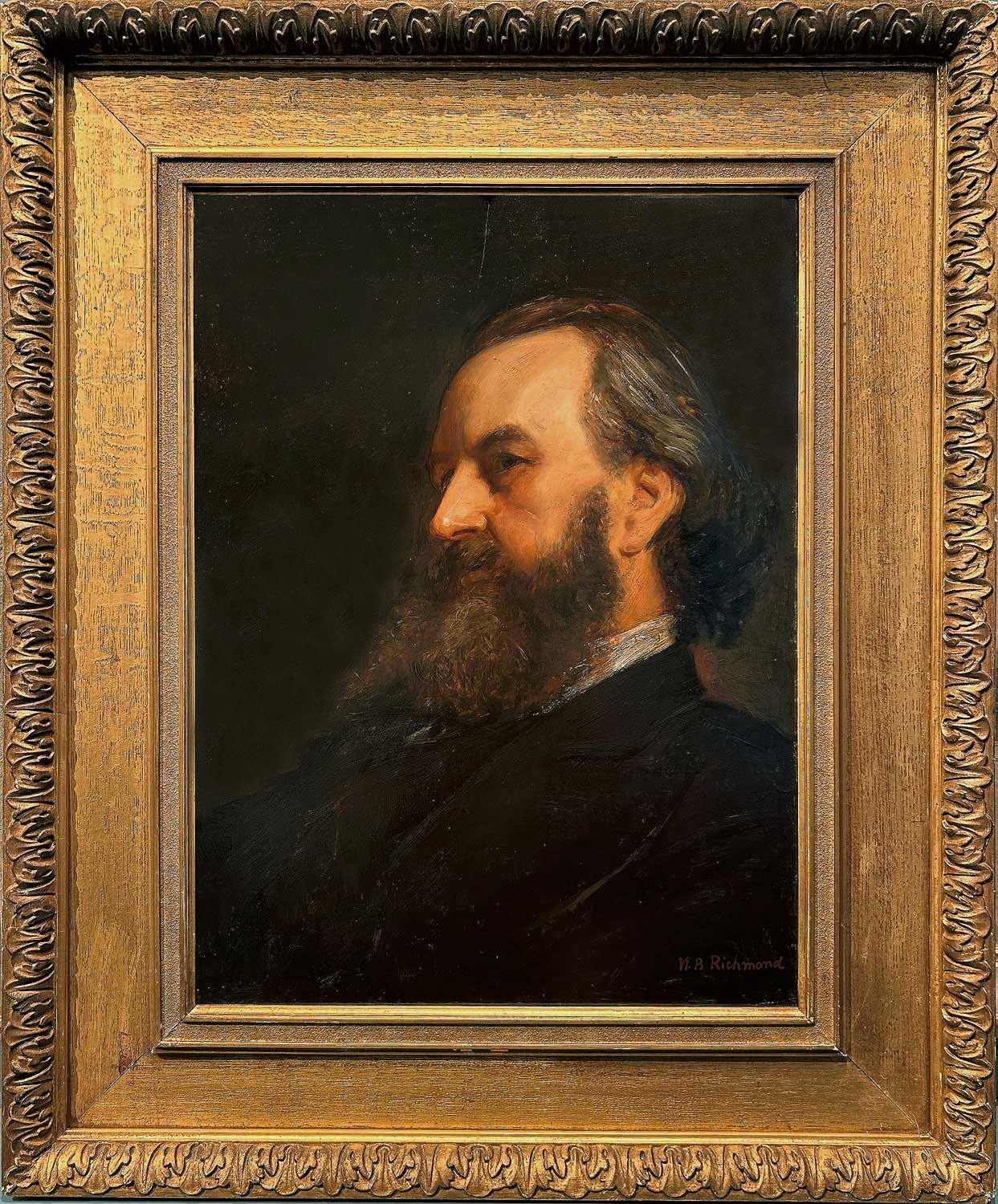
Portrait of a Gentleman
Oil on panel, signed lower right
Image size: 17 ½ x 23 ¾ inches (44.7 x 60.6 cm)
Original Watts frame
Although his identity is unknown, the sitter of this portrait has a remarkable presence. Dressed in a smart black jacket with his hair neatly combed back, he has the air of a distinguished, upper class gentleman. After all, only someone of immense wealth or importance would have been able to afford such a large commissioned portrait. Richmond had represented his sitter with immense detail, with each individual hair on his head and beard being distinct - even a few white and grey hairs are apparent. Additionally, the texture of the hair is incredibly accurate - compare the wiry texture of the sitter's beards with the smooth, glossy representation of his hair. Richmond demonstrates a masterful approach to depicting light, an aspect particularly noticeable in regard to the sitter's skin. Different areas are cast in shade and in light, with Richmond using different tints of skin coloured paint to accurately render how skin would reflect low light levels.
William Blake Richmond
Sir William Blake Richmond KCB, RA, PPRBSA was an English portrait painter, sculptor and a designer of stained glass and mosaic. He is best known for his portrait work and decorative mosaics in St Paul's Cathedral in London.
He was the son of the portraitist George Richmond RA and studied at the Royal Academy Schools in the early 1860s. Influenced by his father and by Sir John Everett Millais, he is best known for his mosaic decorations below the dome and in the apse of St Paul's Cathedral in London. His father, George Richmond, was one of 'the Ancients' who were a group of artists who formed around the visionary artist and poet William Blake. Samuel Palmer was an other of the ancients and a close friend of the family.
Richmond was influential in the early stages of the Arts and Crafts Movement in his selection of bold colours and materials for the mosaics in St. Paul's Cathedral and in his collaboration with James Powell and Sons, glass makers. This new material expanded the glassmaker's palette and was favored by artists of the Arts and Crafts Movement, primarily in the creation of stained glass windows and decorative art work. Richmond was the Slade Professor of Fine Art at the University of Oxford from 1878 to 1883, succeeding his friend and mentor John Ruskin.