

Johan Zoffany
Portrait of a Gentleman
Oil on canvas
Image size: 29 1/2 x 24 1/2 inches (75 x 62 cm)
Original gilt frame
Provenance:
Scott & Fowles, New York
Private Collection
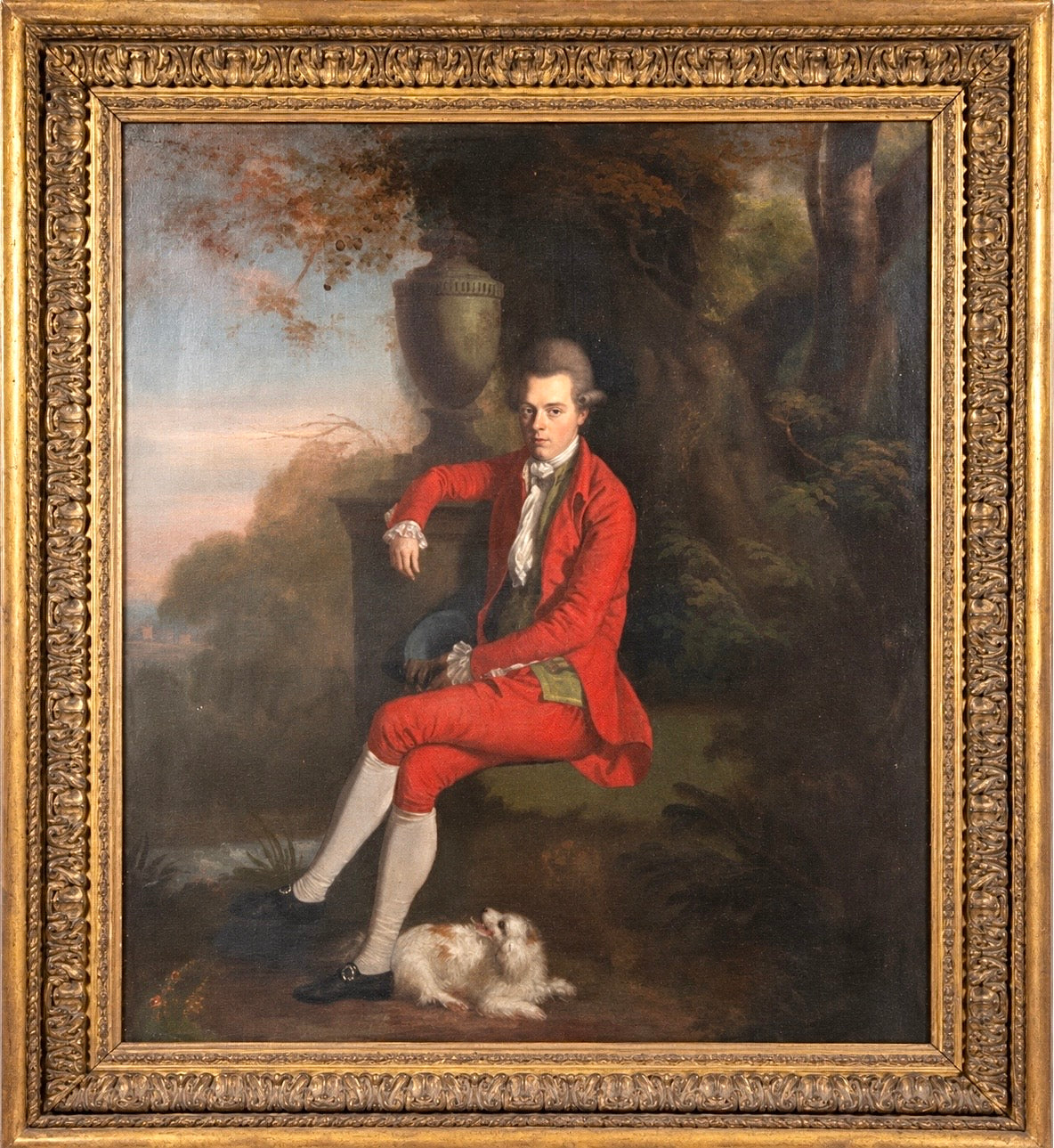
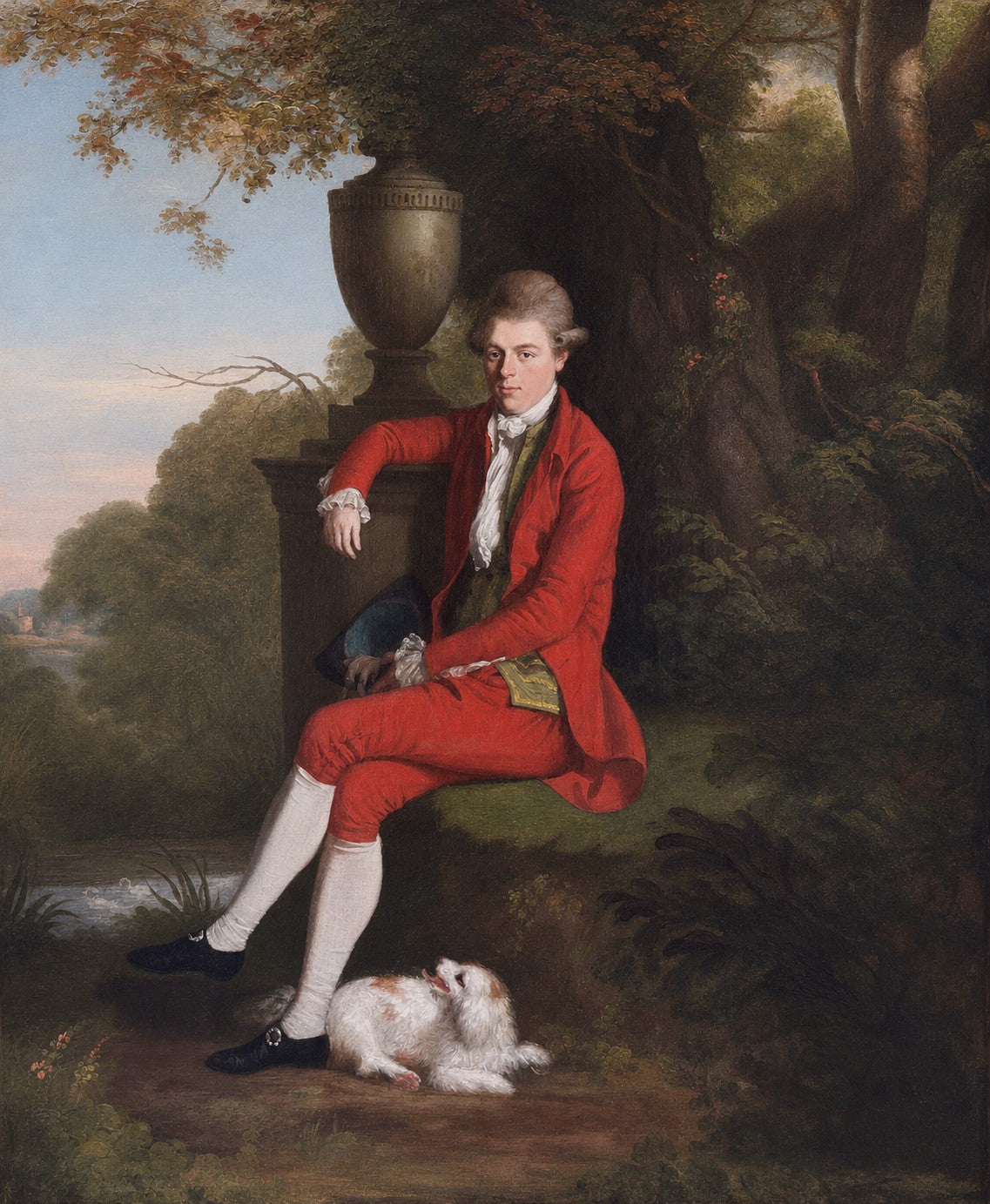
Here we see a finely painted English gentleman, dressed in a crimson suit which boldly stands out against the more muted greens of the garden setting, along with a fashionable wig. Depicted seated with one arm resting on a classical half-column topped with a vase, the other holding his hat and gloved, the gentleman's dog lays at his feet, looking up at his master adoringly.
Zoffany often included his sitters' four-legged friends in his portraits. Dogs were synonymous with high social status and wealth, as only such people could afford to lavish such attention on a pet. Zoffany has depicted the dog with care, detailing his shaggy fur and tongue sticking out.
The gentleman's status is further indicated by his vast estate visible behind him, extending into the distance. Two swans can be seen on a lake and, similarly to the dog, act as potent symbols of wealth, aristocratic privilege, and purity. Because the birds were heavily regulated, expensive to maintain and steeped in classical mythology, their presence further emphasises the subject’s social standing and elevated taste.
The classical half-column next to the man further attests to his education and good taste. A classical education and Grand Tour around Europe are implied through the inclusion of this architectural detail.
Johan Zoffany
Born near Frankfurt in 1733, Zoffany was of noble Hungarian and Bohemian decent. Son of a cabinet maker and architect in the court of Alexander Ferdinand, 3rd Prince of Thurn and Taxis he initially studied in a sculptor's workshop before travelling to Rome to join the studio of Agostino Masucci.
In 1760 Zoffany travelled to England where he first worked painting decorative designs for clocks before quickly gaining a reputation as an artist, enjoying the patronage of King George III and Queen Charlotte within four years.
Zoffany was one of the founding members of the Royal Academy and enjoyed great popularity with his society and theatrical portraits. He was a master of the 'conversation piece', an informal group portrait, often of a family group of circle of friends. Later in life these developed into huge portraits with large casts of people and works of art, all readily recognisable by their contemporaries.
Zoffany fell out of favour with his royal patrons and spent the years 1783 to 1789 in India where he painted portraits of notable figures such as the Governor-Gnneral of Bengal, Warren Hastings. On his return to England, he was shipwrecked off the Andaman Islands. The survivors held a lottery in which the loser (a sailor) was eaten. Zoffany has been described as being 'the first and last Royal Academician to have become a cannibal'.
Zoffany died in his home at Strand-on-the-Green in Chiswick in 1810 and was buried in St Anne's Church, Kew.