Circle of Corneille de Lyon
Portrait of a Noblewoman
Oil on panel
Image size: 8 x 8 ¾ inches (20.5 x 21.5 cm)
Contemporary-style hand-made frame
Provenance:
Private Estate
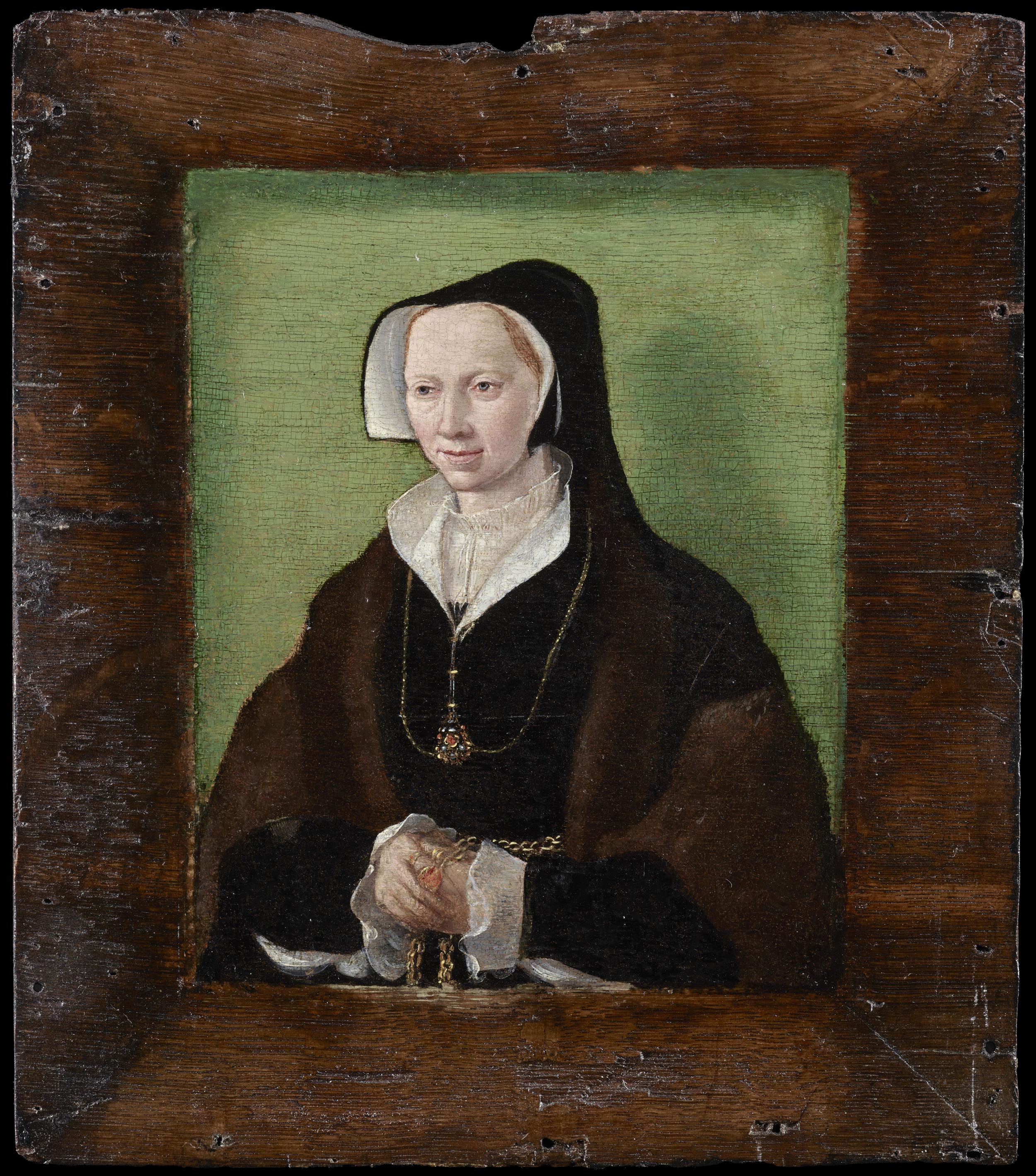
We have been unable to identify the sitter in this portrait which shows a noblewoman dressed in mourning, wearing black with a brown fur outer layer and black velvet attifet head covering lined with white chiffon with a veil of the same velvet. It was customary for widows to wear a attifet even after they remarried. Her hands are clasped in front holding an intricately painted gold chain of office, whilst another jewelled pendant hangs around her neck. The clothing indicates that the woman is unlikely to be from the French court. The style of the pendant suggests that she may have belonged to the Tudor court and the chains of office in her hands denote a high office, making the sitter likely to be a member of Mary Queen of Scots’ court. It is known that King Henry II of France spent time in England during his reign, bringing the Royal Court with him. As Corneille was court painter at this time it is likely he, and his associates, would have travelled to England with King Henry and painted the portraits of English noblemen and women.
The green background, use of oil on wood panel, fine detailing of the face, half-length pose of the sitter and smaller scale of the work are all characteristic of Corneille de Lyon’s style. As with many of his works, the tight frame creates a sense of intimacy with the sitter, less a statement of wealth and power and more a finely tuned observation, as if the viewer has caught this woman in a fleeting moment of self-reflection.
Corneille de Lyon
Corneille de Lyon, or Corneille de La Haye as he is still known in the Netherlands on account of his birthplace, The Hague, was a portrait painter. Almost nothing is known about the Dutch painter until he moved to Lyon, France, where he was active from 1533 until his death in 1575. His naturalistic modelling indicated the influence of Flemish painting and that he most likely trained in Antwerp, Holland. Corneille first worked for Leonor of Austria, the second wife of François I when he moved to Lyon and by 1541, he was in the service of the Dauphin, the future Henry II. When Henry was crowned King of France in 1547 Corneille obtained French citizenship and was appointed court painter and valet de chambre to the new monarch the following year. Corneille painted a number of royal commissions, including a portrait of Madeleine of France, Queen of Scotland who, at the time was being courted by James V Scotland.
Corneille’s reputation continued to grow during his tenure in the French Court, with poet Eustorge de Beaulieu devoting a rondeau to the painter in 1544: ‘To produce a fine likeness from life / no one in France compares to Corneille’ (cited in A. Dubois de Groër, op. cit., p. 19). In 1564 Catherine de Médicis visited the artist for acommission and was struck by the lifelike quality of the portrait he painted of her.
Corneille portraits are distinctive in style. Almost all of them are miniature in scale and rendered in oil on wood panel, with his sitters either bust-length or half-length set against a thickly painted green background. He would paint his sitters’ heads in great detail, while the clothing worn tends to be less so.
One of the last known facts about Corneille is that he rejected Protestantism to become a Roman Catholic in 1569. He passed away and was buried in 1575.