

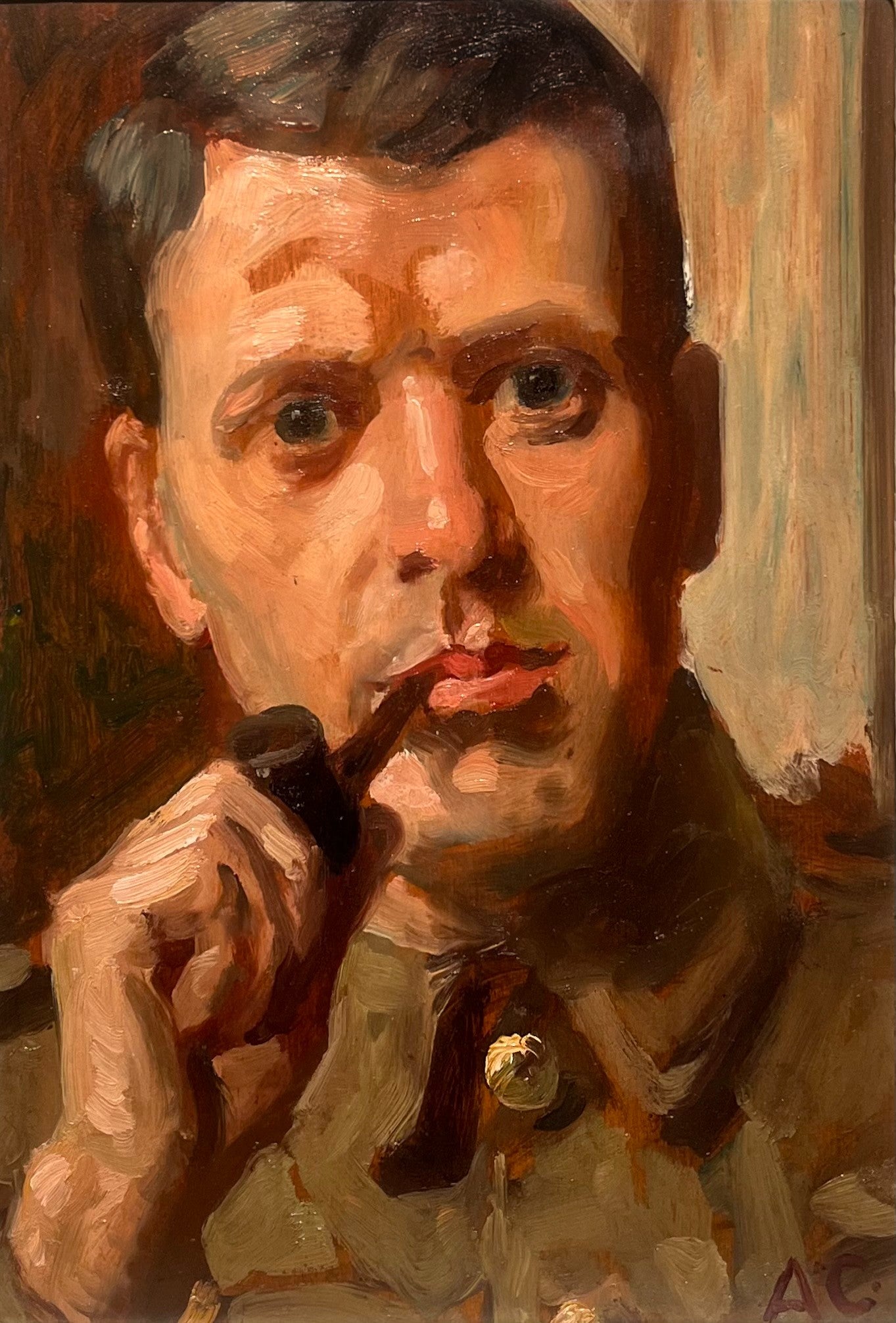

Alfred Egerton Cooper
Portrait of Barnes Wallis in Uniform
Oil on panel, initialled bottom right
Image size: 12 ½ x 9 inches
Hand made frame
Provenance: Sir Barnes Wallis and thence by descent
Most likely painted in 1915 while Cooper and Wallis served in the Artist Rifles, the portrait depicts Wallis in his army uniform, head tilted to the left and smoking a pipe. Cooper’s specialty in painting airships and their views and Wallis’ occupation designing them intertwined the works of both men. The artist and sitter remained good friends beyond their time in the armed forces with Cooper painting Wallis on several other occasions. His 1942 portrait is currently on display at the National Portrait Gallery, London, whilst a later, undated portrait, is in the collection of Christ’s Hospital, Horsham. There is also a piece from the 1950s depicting Wallis at work carving a wooden portrait of his wife Molly. Wallis served as Cooper’s best man, even returning to the artist’s studio in 1973 to celebrate the couple’s golden wedding anniversary.
Sir Barnes Wallis was born in 1887 and is best known for inventing the ‘bouncing bomb’ used by the Royal Air Force during the ‘Dambusters’ raid. He was born in Ripley, Derbyshire though the family moved to New Cross in South London after 1893. Initially working for Thames Engineering Works at Blackheath and then changing to an apprenticeship with J. Samuel White’s shipbuilding company, Wallis was presented with an opportunity to become an aircraft designer in 1913. He joined Vickers (which became part of Vickers-Armstrongs and then part of the British Aircraft Corporation) and remained with them until his retirement in 1971. The R80 was the first aircraft entirely of his own design, flying in the early 1920s. It incorporated a number of technical innovations, one of the most lasting of which was the first use ever of colour-coded wiring for the electrical systems of an aircraft.
In 1922 Wallis met his cousin-in-law Molly Bloxam at a family gathering. Due to their age difference (he was 34, she was 17), Molly’s father forbade them from courting. The couple remained in correspondence until Wallis proposed on her 20th birthday. They were married in 1925 and remained so until his death in 1979. They had four children together, and adopted Molly’s nephews when their parents were killed in an air raid.
During the Second World War, Wallis saw a need for strategic bombing to destroy the enemy’s ability to wage war, using larger bombs that could destroy infrastructure such as factories. His first super-large bomb design came out as far heavier than any existing bomber plane could carry. However, rather than abandon the idea, he designed the Victory Bomber, a plane that could carry it.
Skipping stones in his garden gave Wallis the idea for the bouncing bomb, the crucial innovation being having the bomb spin. It was fellow Vickers designer and cricketer George Edwards’ suggestion to use backspin to reduce the risk of damage to the aircraft, increase the bomb’s range and prevent it from moving away from the target as it sank in the water. After initial scepticism, the Air Force agreed to use Wallis’ bouncing bomb for Operation Chastise in 1943, the attack on the Möhne, Eder and Sorpe dams in the Ruhr area. The raid was immortalised in Paul Brickhill’s 1951 book The Dam Busters and the 1955 film of the same name.
After the war, Wallis continued to work and develop many futuristic aerospace projects. Following the high death toll of the crews involved in the Dambusters raid, he made the conscious decision to never endanger the lives of his test pilots again. His designs were exclusively tested in model form and he became a pioneer in remote control aircraft. This grief at the loss of lives during Dambusters also led him to donate the £10,000 he was awarded for his war work from the Royal Commission on Awards to Inventors to his alma mater Christ’s Hospital School. With the funds, Christ’s Hospital School set up the RAF Foundationers’ Trust, assisting the children of RAF personnel killed or injured in action to attend the school.
Wallis passed away in 1979 and is buried, together with his wife, at St Lawrence Church in Effingham, Surrey. His epitaph in Latin reads "Spernit Humum Fugiente Penna" (Severed from the earth with fleeting wing), a quotation from Horace Ode III.2.
Alfred Egerton Cooper
Alfred Ernest Egerton Cooper was a British painter of portraits, landscapes and other figurative work, notable for his time as an official artist to the RAF during, and beyond, the First World War.
From modest origins, he began painting china before receiving any formal art training. He then attended art school in the West Midlands and Bilston School of Art, before continuing his training at the Royal School of Art and then the Royal College of Art. During this time as a student Cooper won a prize judged by John Singer Sargent, who was so impressed by the young artist’s work that he offered him a job as his studio assistant. Cooper spent twelve months in Sargent’s studio filling in details and backgrounds of the artist’s works.
During the First World War Cooper served in the Artists Rifles (28th County of London Battalion) and was then commissioned as a captain on the staff of the RAF. The Artists Rifles was originally raised in London in 1859 as a volunteer light infantry and during the Second World War was used as an officer training unit. The group was set up by Edward Sterling, an art student, and was comprised of various professional painters, musicians, actors and other creatives, a profile it strived to maintain with Frederic Leighton one of its first commanders. Whilst serving, Cooper lost sight in his right eye following a chlorine gas attack, though he was still able to draw and differentiate colours. After his injury he became an official war artist, specialising in portraits of members of the armed forces and recording airships and the views seen from them. His images highlighted the engineering detail and monumental presence of these airships, both in flight and in their sheds. He undertook numerous perilous missions where he would hang suspended from an airship whilst holding his painting equipment to accurately capture the view from the air. This led to Cooper becoming an expert in the art and technique of large-scale aerial camouflage; which combination of paint, colour and pattern could best disguise each of the different aircraft from the enemy.
It was whilst serving in the Artists Rifles that Cooper met Sir Barnes Wallis, best known for his invention the ‘bouncing bomb’, with the two becoming lifelong friends. Whilst Wallis specialised in inventing airships, Cooper specialised in painting them. Cooper painted Wallis several times and the latter served as best man at the former’s wedding in 1920.
During the Second World War, Cooper produced newspaper illustrations of the theatres of war, taking his information from contemporary photographs.
In 1948 Cooper competed at the London Summer Olympics in the arts competition, depicting salmon rivers and horse racing, though it is not known where he placed.
During his career he painted five portraits of Winston Churchill, including the last that Churchill sat for which was completed three days before the politician suffered his final stroke. Cooper recalled in an interview how the notoriously difficult to please Churchill had insisted on observing every brushstroke via a mirror set up behind the artist. Cooper also produced portraits of King George VI, Queen Elizabeth II, ‘countless earls’, three Lord Mayors of London and the official portraits of various British military personnel.
Cooper was described by The Times as ‘a generous man of great charm’ and, according to his son Peter, also an artist, ‘generally looked more like a retired British colonel than an artist, and always dressed to the nines, even in his studio’. He was unashamedly old-fashioned, preferring figurative art, shunning abstraction and modernism. His studio was based in Glebe Pace, Chelsea from 1920 and he continued to work there until almost the end of his life aged 90.