

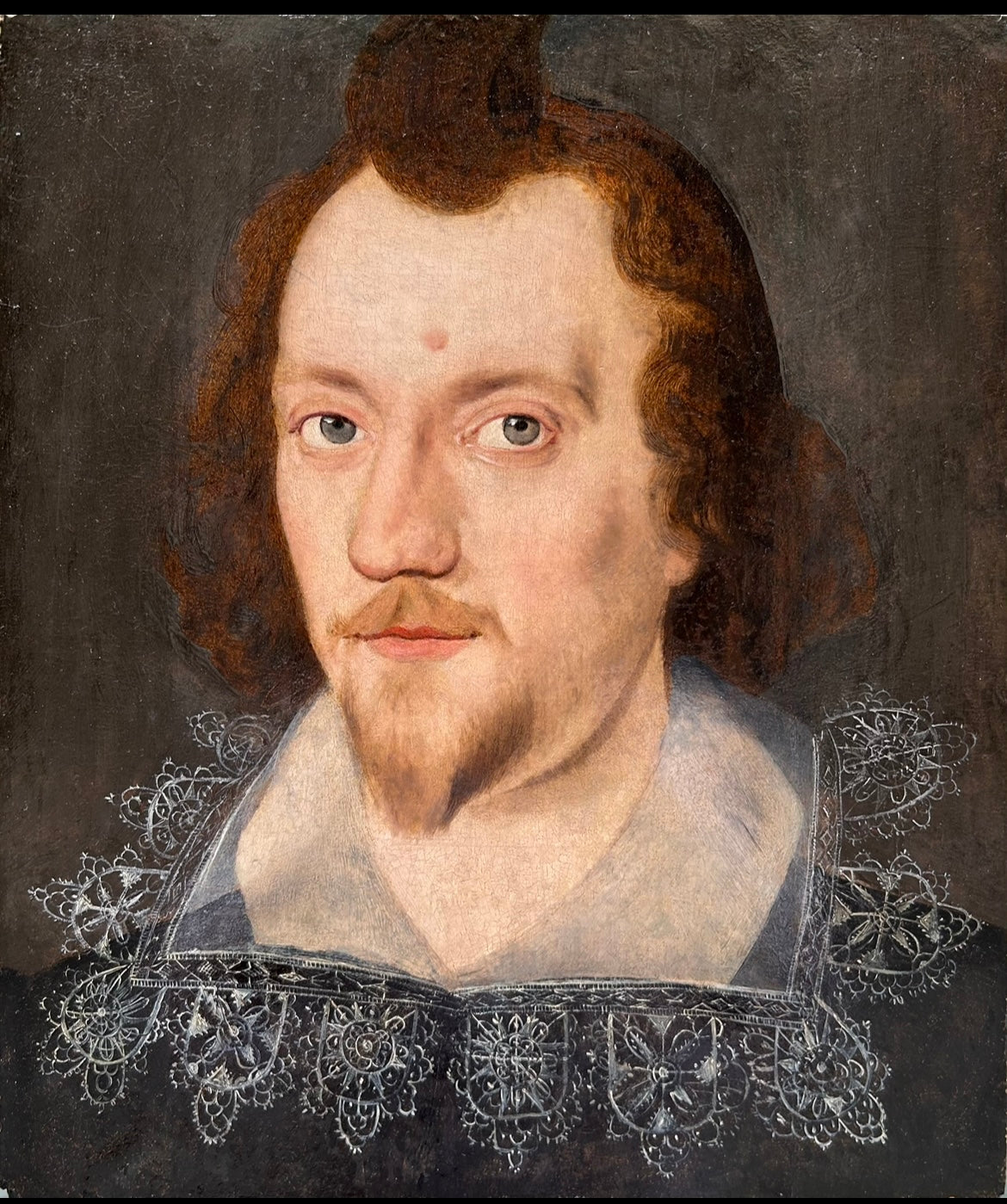

Attrib. Robert Peake
Portrait of Lord Strange, Ferdinando Stanley
Oil on oak panel
Image size: 12 2/5 x 14 1/2 inches (31.5 x 37 cm)
Contemporary-style hand-made frame
Provenance
Earl of Derby
Private Estate
Lord Strange, Ferdinando Stanley
1559 - April 16, 1594
Ferdinando Stanley, 5th Earl of Derby, also known as Lord Strange after his summoning to Parliament, was a prominent figure during the Elizabethan era. He was an ardent patron of the arts and supported many writers including Robert Greene, Christopher Marlowe, Edmund Spenser and William Shakespeare. It is believed that Shakespeare was employed as one of Lord Strange's men, a group of acrobats and tumblers who later performed with other groups such as the Admiral’s Men. They showcased their talents at The Theatre in Shoreditch, which was the first permanent theatre in England.
Following the death of his father in 1593, Ferdinando succeeded as the Earl of Derby. Consequently, his arts group was renamed Derby’s Men. It is widely believed that Shakespeare was part of this group as both a playwright and as an actor.
Ferdinando had potential claims to the English throne, as he was a descendent of King Henry VII and had a place in the line of succession to Elizabeth I according to the will of Henry VIII. However, his aspirations were cut short by his untimely murder/death under suspicious circumstances. There were fears of Catholic uprising at the time, and it was rumoured that Ferdinando was poisoned.
During his lifetime, Ferdinando remained circumspect about his true opinions on religion and other matters. The Jesuit writer Robert Parsons expressed frustration, stating that "diverse men" were not satisfied "with the course of this lord hitherto". Parsons hoped that the accession of the Stanleys to the English throne might aid the Catholic cause. However, he noted that "the Earl of Derby's religion is held to be doubtful, as some do think him to be of all three religions [Catholic; Episcopal Protestant; Puritan]
and others of none." He added that "no side will esteem or trust him" because of this.
Ferdinando Stanley died on 16 April 1594 at Lathom House, Lancashire. He had been ill for sixteen days and was buried at the neighbouring church of Ormskirk. It is thought he was poisoned, but rumours of witchcraft persisted.
As this extract from Camden’s history reflects:
"Ferdinand Stanley Earle of Darby… expired in the flowre of his youth, not without suspition of poyson, being tormented with cruell paynes by frequent vomitings of a darke colour like rusty yron. There was found in his chamber an Image of waxe, the belly pierced thorow with haires of the same colour that his were, put there, (as the wiser sort have judged, to remove the suspition of
poyson). The matter vomited up stayned the silver Basons in such sort, that by no art they could possibly be brought againe to their former brightnesse… No small suspicion lighted upon the Gentleman of his horse, who; as soone as the Earle tooke his bed, tooke his best horse, and fled”.
Various sources suggest different causes for death. Some mention poisonous mushrooms, while a writer in The Lancet speculates on an early use of arsenic. Regardless of the cause, the death of Ferdinando Stanley, 5th Earl of Derby remains shrouded in mystery and intrigue, reflecting the turbulent times he
lived in. This is a man who may have been King, who was a patron of Shakespeare, an important figure of the time.