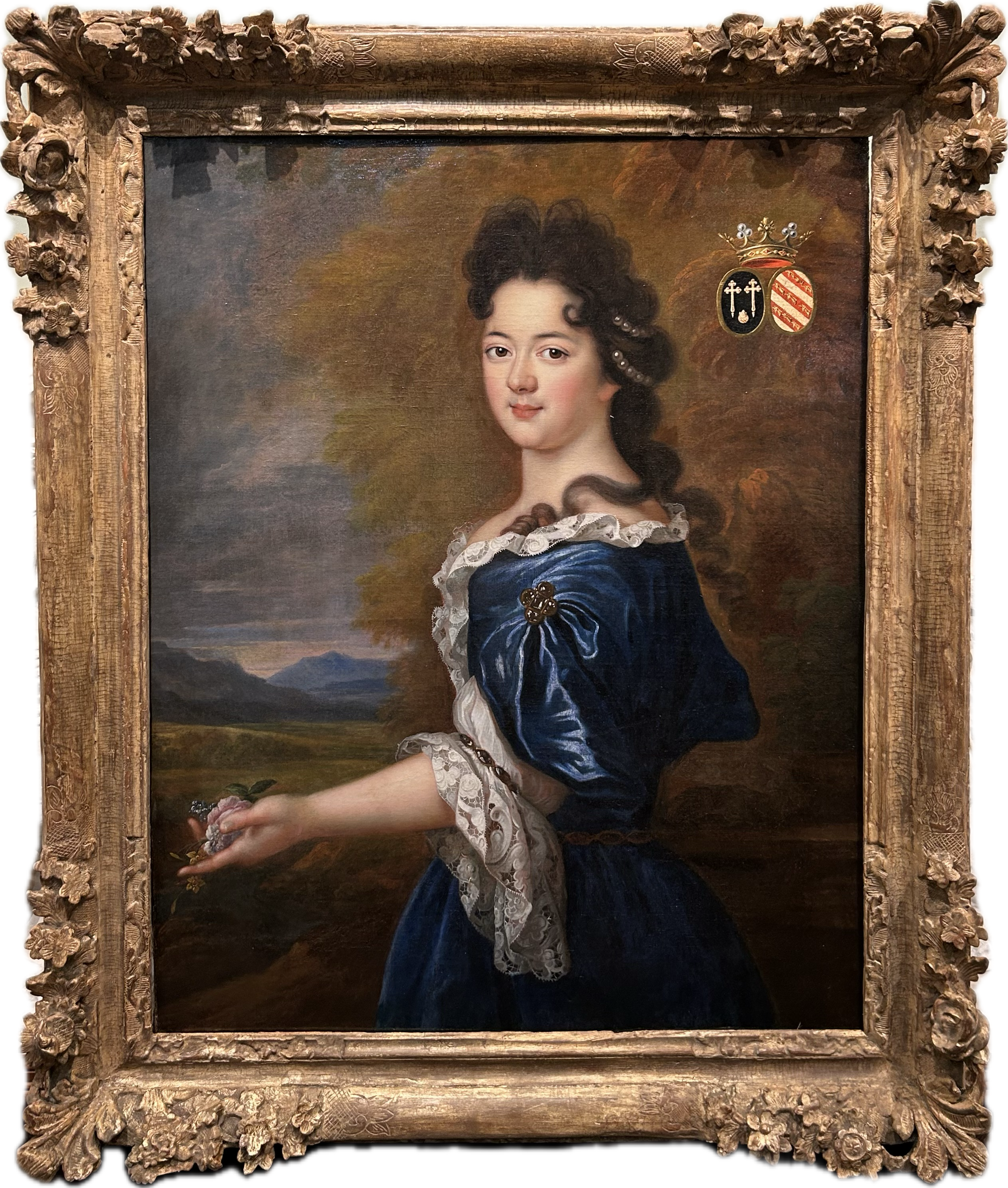
Pierre Mignard
Portrait of Marie Thérèse de Bourbon, Princess of Conti
Oil on canvas
Image size: 37 2/3 x 29 inches (95.5 x 73.5 cm)
Original gilt frame
Provenance:
Family descent, from the 17th century
This striking portrait bears a strong resemblance to a late 17th century works depicting Marie Thérèse de Bourbon, Princess of Conti (1666-1732) by Pierre Mignard. The work employs the same dress and pose, and the visage of the sitter is incredibly similar to the one in our collection. For this reason, we have identified the sitter as the Princess of Conti herself. The centrally seated and slightly turned figure was a common compositional choice in portraits known to be painted by Mignard. A late 17th century engraving by Nicholas de Larmessin attributes a strikingly similar portrait of Marie Thérèse de Bourbon to Mignard.
Marie Thérèse de Bourbon
Marie Thérèse de Bourbon was born on the 1st of February 1666 in Paris, the daughter of Henri-Jules de Bourbon, prince de Condé and the Duke of Bourbon, and Anne Henriette of the Palatinate. Her heritage found her a descendent of the House of Bourbon, English royalty, and the House of Nassau.
She was initially intended to marry the Italian Prince of Carignan, but instead was wed to François Louis, Prince of Conti, a prominent French aristocrat with ties to the French royal family. Whilst Marie Thérèse was known to be deeply enamored by her husband, it was also well-known around court that he had multiple affairs with both men and women.
Marie Thérèse was known for her quiet personality and had a strained relationship with her children. Many at court took pity upon her and the embarrassment her husband was seen as causing her. She lived quietly between the various Conti residences, and was a very pious Catholic.
After her husband was offered the Crown of Poland by King Louis XIV in 1697, Marie Thérèse became the presumed Queen of Poland. Her husband travelled to survey his potential new kingdom, only to find that the election had not fallen in his favour and that Augustus II had been elected King instead. He returned to France, and died a decade later of syphilis.
After her husband’s death, Marie Thérèse began to renovate the Parisian home of the Conti family. She also purchased land on the Rue de Bourbon to design a new hôtel particulier, but sold the half-built mansion to her sister in 1718.
Marie Thérèse passed away in February of 1732 at the Hôtel de Conti, likely as a result of syphilis contracted from her husband. Her children forged several alliances through marriage to prominent French noble families, eventually rendering Marie Thérèse related to Louis Phillipe, King of the French, as his great-great-grandmother. As a result, Marie Thérèse is an ancestor of many of Europe’s monarchs from the 19th and 20th centuries.
Pierre Mignard
Pierre Mignard was born in Troyes, France, in 1612, to a family of artisans. He trained under Jean Boucher in Bourges and copied Mannerist works from local noble houses. He then studied under Simon Vouet in the most acclaimed studio of the era, before leaving for Rome in 1635. He would stay here for over two decades, eventually becoming known as ‘Mignard le Romaine’.
Whilst in Rome, he worked on religious commissions, particularly altarpieces and paintings of the Madonna and Child. These depictions of the Madonna were so beloved that they eventually became known as ‘mignardises’. In Italy, he also developed an interest in portraiture and painted a number of portraits of popes, cardinals, and Italian nobles. As well as Rome, Mignard travelled to Bologna, Mantua, Venice, Parma and Florence. As his reputation grew, he was eventually summoned back to Paris in 1657 by Cardinal Mazarin, where he grew in popularity as a portraitist.
Mignard was favoured by King Louis XIV, and became a rival to the Premier Peintre du Roi, Charles Le Brun. A bitter rivalry ensued, with Mignard going as far as to refuse entry to the Royal Academy whilst Le Brun was its director, and instead founding a rival guild. Upon Le Brun’s death in 1690, Mignard succeeded him as Premier Peintre and as the Director of the Royal Academy. As one of the King’s favoured artists, Mignard enjoyed patronage from a number of prominent French nobles and intellectuals.
Mignard died in 1695 in Paris, just as he was about to begin work on the cupola of Les Invalides. His works can be found in the Courtauld, the Harvard University Art Museums, the Hermitage Museum, the Louvre, the National Portrait Gallery, Versailles, and the National Gallery. His most famous commission is undoubtedly the cupola for the Val-de-Grâce, a fresco representing Paradise - fresco technique was rare outside of Italy.