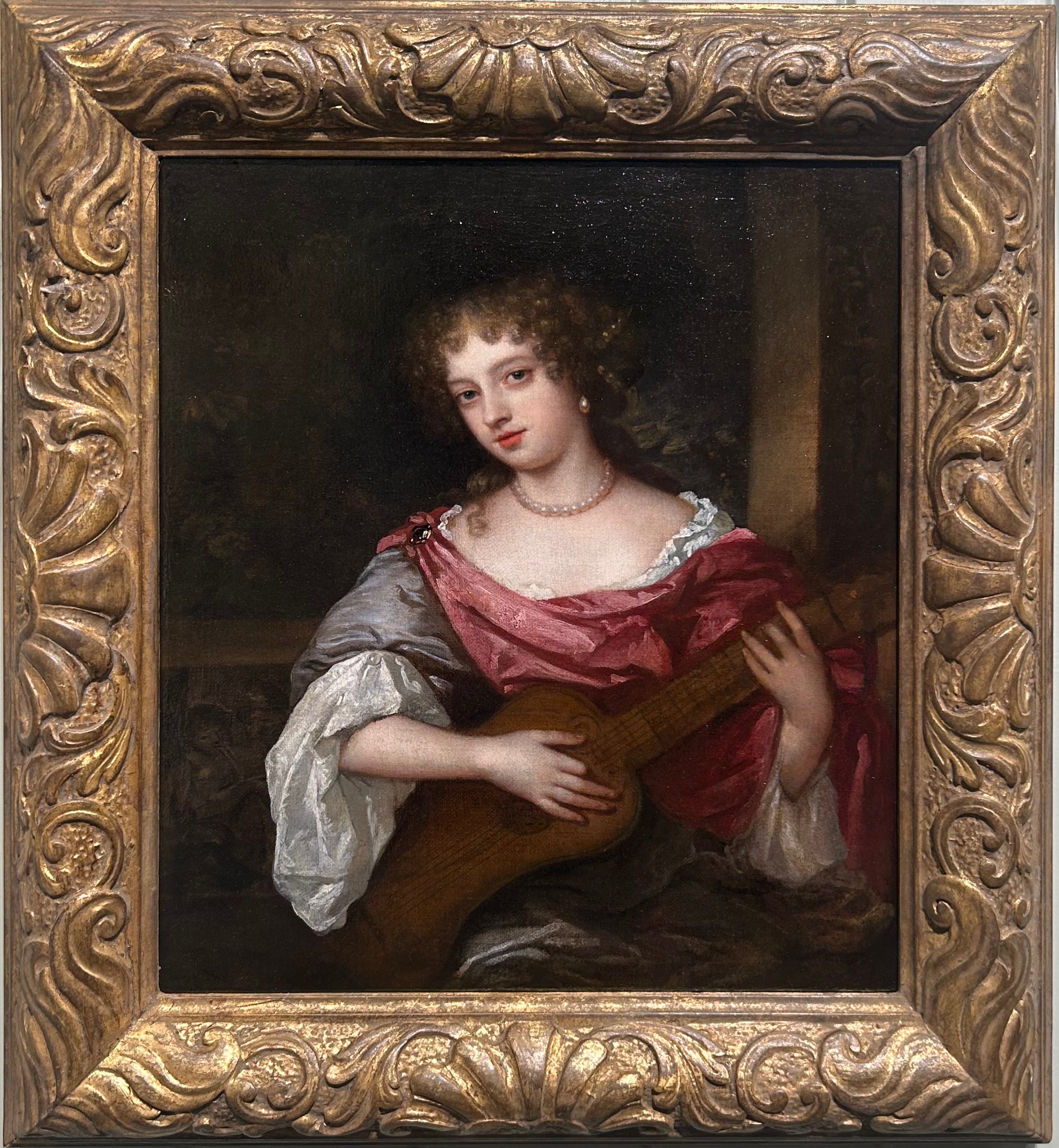
Mary Beale
Portrait of Nell Gwyn
Oil on canvas
Image size: 14 ¾ x 16 ½ inches
Hand carved gilt wood frame
Provenance
Private Estate
Beale’s portrait depicts a woman seated, head tilted to one side, eyes gazing out at the viewer with a guitar in her hands. The single string of pearls and off-the-shoulder white petticoat are often features of Beale’s portraits of women. The sitter is Nell Gwyn, a famed stage actress of the Restoration period and mistress to King Charles II. Beale had borrowed Sir Peter Lely’s Nell Gwyn with a Lamb in 1677 to study and copy and Gwyn lived near the Beales in Pall Mall, giving the artist an opportunity to paint her from life.
The details of Gwyn’s background are obscure, with her date of birth generally being given as 2nd February 1650, though some scholars have argued that she was born in 1642, and her place of birth being Hereford, Covent Garden or Oxford. Her father was not present for her childhood in London, and she was raised by her alcoholic mother, who reportedly ran a brothel.
Previously during the English Commonwealth era theatre had been banned but was reinstated by King Charles II, with one of his early acts as king being to license the formation of two acting companies and to legalise acting as a profession for women. Gwyn first became involved in the theatre as an ‘orange-girl’, selling oranges to theatre audiences and serving as a messenger between men in the audience and actresses backstage. Within a year Gwyn had joined the rank of actresses at Bridges Street when she was just 14. She was taught the craft at a school for young actors developed by Killigrew and the actor Charles Hart, with John Lacy teaching her to dance.
Though an exact date for her debut cannot be given, it is clear that Gwyn had become a prominent actress by 1665, where she is mentioned in Samuel Pepys’ diary. She became famed for her roles as the female half of ‘gay couples’, a pair of witty, antagonistic lovers, alongside her then lover and former teacher Charles Hart. She also took on a number of ‘breeches’ roles where actresses appeared in men’s clothes under various pretences. Gwyn’s love affair with King Charles II allegedly began in April 1668. Gwyn was attending a performance of George Etherege’s She Wou’d if She Cou’d in the box next to the King, who was reportedly more interested in flirting with Gwyn than watching the performance. The story goes that the King invited Gwyn to supper, along with her escort and the Duke of York, but, following the meal, discovered he had no money on him meaning Gwyn had to foot the bill. By mid-1668 her affair with the King was well-known and as her commitment to Charles increased, her acting career slowed. She gave birth to two of the King’s sons: Charles Beauclerk on 8th May 1670 and James Beauclerk on 25th December 1671. Both sons were granted titles by the King, the Earl of Burford (created especially for Gwyn’s eldest son) and Lord Beauclerc.
She moved to a townhouse in Pall Mall in 1671, where she may have crossed paths with the Beales. It was here that she passed away in March 1687 from apoplexy.
Though Gwyn was often caricatured as an empty-headed woman, it is clear that she possessed intelligence and wit to raise herself from obscure poverty to become one of the most celebrated women of her day. She was highly successful in her career as an actress, gained titles for both her sons and befriended the highest levels of English society. Though eyebrows may be raised at the means she used to gain her success, it can be argued that Gwyn simply leveraged the tools she had at her disposal to navigate the perils faced by a single, low-born woman in Restoration London to her strategic advantage.
Mary Beale
Mary Beale (née Cradock) (1633-1699) was an English Baroque portrait painter and one of England’s earliest professional female artists. Born in Barrow, Suffolk, she was the daughter of John Cradock, a church rector and amateur painter who supported his daughter's artistic pursuits. She received no formal training from an academy and had no connection to an artist guild, making her success even more noteworthy. It is likely that it was through her father that she was introduced to the artists Robert Walker and the court painter Sir Peter Lely, who are the two most likely candidates for Mary’s tutors, the latter with whom she worked closely and maintained a lifelong friendship. Lely reportedly visited her home to observe Mary and praise her work and lent her some of his Old Master paintings for her to copy.
When Mary first started painting professionally in the 1670s, she was careful in picking whom she would paint as it would have been easy to misconstrue the nature of strangers entering a women’s home for a business transaction, reflecting how the biases of contemporary society pushed against a woman looking to forge her own career. She used the praise of her circle of friends to build her reputation as a painter.
A firm believer in equality between men and women in marriage, she married Charles Beale in 1652, a minor civil servant who later managed her studio and business affairs. He fully supported her work which was the main source of income for their family and played a crucial role in her career, preparing her canvases and meticulously recording her paintings. Over the years he wrote thirty notebooks of observations, including how she painted, the transactions that took place and the praise she received, referring to Mary as ‘my dearest heart’. Her success as a portrait artist enabling her to support her family through her art was a noteworthy achievement for a woman in the 17th century.
Mary Beale's career flourished in the 1670s. Her highly regarded portraits captured the likenesses of many notable figures. Running a successful painting studio in London, she trained both male and female artists to work as her assistants. Unlike many of her contemporaries, Beale's works were often characterised by a warm, natural style that resonated with her clients and earned commendation from her contemporaries. Her paintings are often described as ‘masculine’, common praise for a woman’s work at that time, reflecting how men dominated the profession. Beale also wrote instructional manuscripts, sharing her knowledge about painting techniques and materials. Her writings, known as "Observations," were praised by scholars, including Sir William Sanderson in his 1658 book "Graphice", and was one of the first writings on oil painting instruction to come out of England from an author of either gender.
Her contributions to art extended beyond her own paintings, as she influenced future generations of artists with her detailed observations and practical advice. Other notable works by Beale include "Discourse on Friendship" from 1666, which offered a female scholarly perspective on the subject, as well as arguing for equality between the genders in matters of the home.
Mary Beale's legacy lives on through the many portraits that survive today, showcasing her skill and dedication to her craft. She remains a significant figure in the history of British art, remembered for her pioneering role as a female artist in a male-dominated field.
Museums
Victoria and Albert Museum, London
Tate Britain
Bodleian Library, Oxford
Christ's College, Cambridge