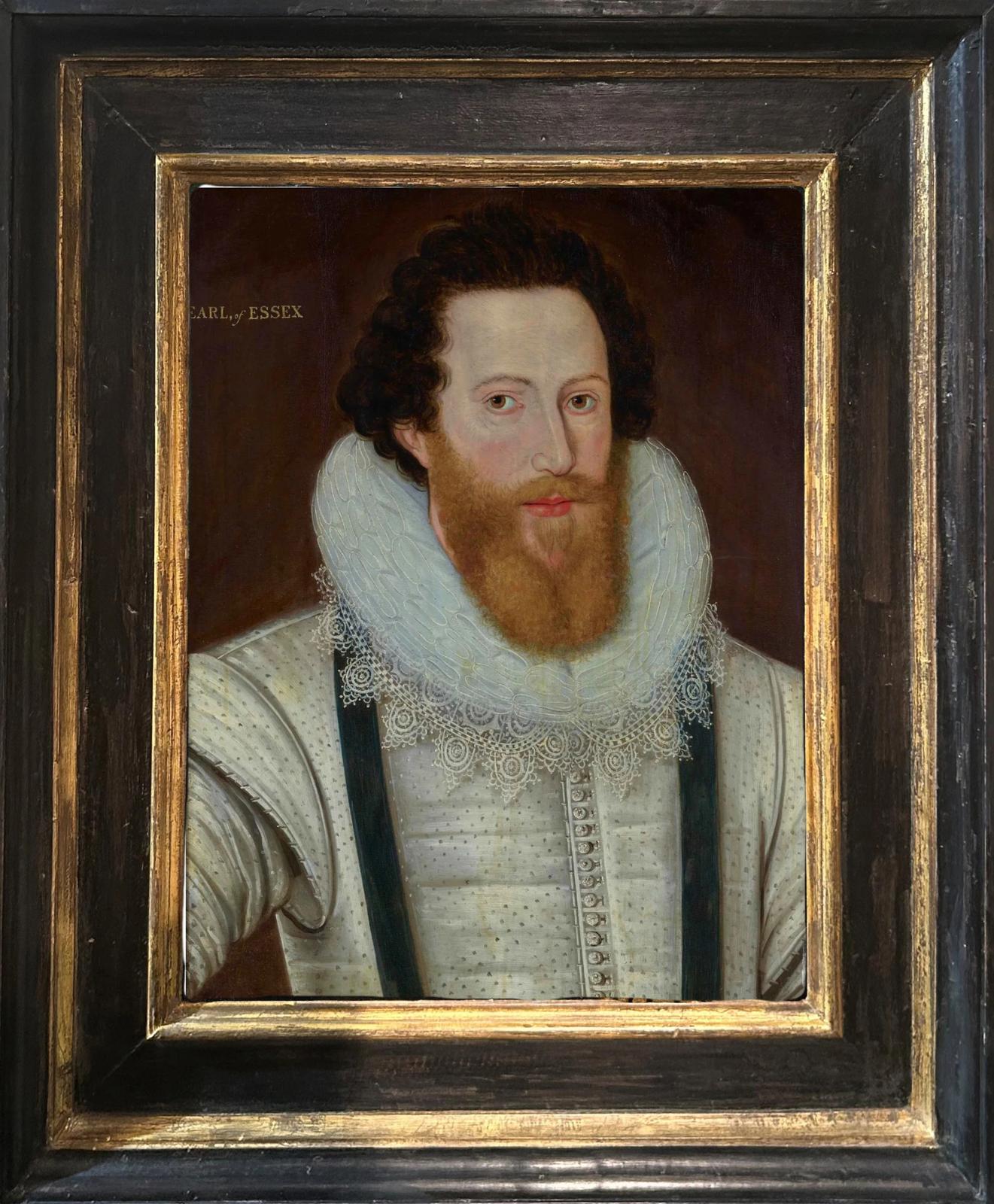
Studio of Marcus Gheeraerts the Younger
Portrait of Robert Devereux, 2nd Earl of Essex
Oil on oak panel, signed 'M Garrard' lower left
Image size: 16 1/2 x 22 inches (42 x 55.8 cm)
Hand made contemporary frame
This portrait of Robert Devereux, 2nd Earl of Essex, depicts the notorious courtier and soldier in a fashionable white costume and ruff, with the general composition of the work bearing striking resemblances to known portraits of the Earl by Marcus Gheeraerts and his studio. Gheeraerts was responsible for producing all full length portraits of the Earl of Essex in the latter part of the 16th century. The work is signed ‘M Garrard’, which was an anglicised version of Gheeraert’s name.
In our version, which most closely resembles a portrait held by Angelsey Abbey, Devereux’s outfit is slightly different, patterned with small black dots rather than stripes of alternating white fabric. The level of detail of his costume - especially the depiction of lace - is remarkable, demonstrating the masterfulness of the artist’s observational skills whilst also highlighting the importance of fashion as a social indicator in Elizabethan society. Devereux’s beard is also mesmerising, with a true tangibility to its wiry texture. His face is incredibly lifelike, with the artist having depicted his flushed cheeks and wrinkles around his eyes in the most minute of detail.
The portrait can be tentatively dated. The blue ribbon around Devereux’s neck is, as full length portraits reveal, part of the Knight of the Garter regalia - Devereux only became a Knight in 1588. Further narrowing the time scale is the fact that Devereux was only known to have grown a beard during his campaign in Cadiz in 1596. Given that he was imprisoned in 1600, the portrait is therefore likely to have been painted in the four years between 1596 and 1600.
Robert Devereux, 2nd Earl of Essex
Robert Devereux was born in November of 1565 in Herefordshire, and was closely associated with Queen Elizabeth I from birth. His mother, Lettice Knollys, was Elizabeth I’s Maid of the Privy Chamber as well as her cousin. Devereux was raised at the family seat in Chartley, Staffordshire, but rarely saw his father, who was involved in the colonisation of Ireland and spent most of his time there. When his father passed away in 1576, Devereux became the 2nd Earl of Essex and a ward of the Crown, with Lord Burghley, the Earl of Sussex and the Earl of Huntingdon leading his education and upbringing.
Devereux proved himself to be an intelligent young man, and he graduated Trinity College, Cambridge with a Master of Arts. After a four year sojourn around the British countryside, Devereux sought to establish himself as a courtier using the reputation of his stepfather - Robert Dudley, Earl of Leicester. Devereux remained unnoticed during this period due to Elizabeth I’s preoccupation with European conflicts, and instead accompanied Dudley on a military apprenticeship in the Spanish Netherlands. He was appointed colonel-general of the English cavalry and won a decisive battle against the Spanish, for which he was made knight-banneret.
Returning to England in 1586, Devereux became popular in court and was labelled a war hero. He quickly caught the attention of Elizabeth I and became one of her close companions, enjoying a certain level of protection that was not afforded to other courtiers. Robert Dudley used his stepson’s popularity to further his own motives against his rival, Walter Raleigh. Devereux was appointed Master of the Horse and elected a Knight of the Garter in 1588.
In the same year, Robert Dudley died, leaving Devereux in a precarious financial position whilst accentuating his rivalry with Raleigh. After inheriting Dudley’s monopoly on sweet wines, Devereux’s financial position improved. He was soon chosen to become a member of the Privy Council. Despite this, Devereux yearned for military service and saw this as the ultimate form of royal service and a way to earn the Queen’s favour. He also viewed himself as a more capable leader than Elizabeth I and sought to establish himself as her primary advisor.
In 1589, Devereux joined the English Armada against the Queen’s wishes. He repaired their relationship and was given an army to support King Henry of Navarre. He aided with the unsuccessful siege of Rouen, returning to the English Court in 1592. He later aided in the capture of Cadiz after once more defying Elizabeth I’s orders. As a result, when the Third Spanish Armada occurred, the English coast was undefended - despite a storm dispersing the fleet, the relationship between the Queen and Devereux continued to falter.
As the situation in Ireland became increasingly dire, Devereux made it clear that he did not want to lead the English administration there, going as far as to even argue with Elizabeth I. After this argument, Devereux refused to attend court until he was given a private audience with the Queen. Devereux was eventually appointed Lord Deputy of Ireland, with orders to crush Tyrone’s rebellion. After a series of poor strategic decisions, Devereux found his army dead and sick, his funds depleted, and multiple battles lost. He eventually engaged Tyrone in battle, but the latter noble refused to engage with an army of such little men and instead wished to negotiate, resulting in a truce.
Devereux left Ireland against the Queen’s wishes in 1599, arriving back in England before being interrogated for five hours by the plenary Council. The Council concluded that his truce with Tyrone was indefensible and was an act of desertion. He was confined to house arrest, with Elizabeth I apparently defending him in court and many courtiers justifying his return from Ireland. However, Cecil insisted on a trial and in June 1600, Devereux was convicted, deprived of public office, and confined to York House.
Devereux was freed in August but had lost his monopoly on sweet wines, forcing him into a precarious financial situation. As a result, he began to organize a rebellion and in February 1601, marched to the City of London to force an audience with the Queen. It was unsuccessful and Devereux was branded a traitor, surrendering after Crown forces attacked his seat. Later the same month, he was tried for treason for conspiring to depose the Queen and for holding the Privy Council hostage. Devereux was found guilty and sentenced to death. He was granted a private execution at the Tower of London and was beheaded on the 25th of February 1601.
Marcus Gheeraerts the Younger
Marcus Gheeraerts was born in Bruges in 1561 or 1562, and was brought to England in 1568 by his father, a painter whose works have sadly been lost to time. Trained by his father and perhaps also a pupil of Lucas de Heere, Marcus produced his first surviving inscribed portrait in 1593; by this date, however, he was already under the powerful patronage of the royal pageant master, Sir Henry Lee. In 1590 Gheeraerts married Magdalena, the sister of the painter John De Critz. The couple had six children, only two of whom seemed to have survived.
Gheeraerts was the most distinguished and most fashionable portraitist of the 1590s, and continued to be after Elizabeth’s death, becoming the favorite painter of James I’s queen, Anne of Denmark. He received a grant of naturalization in 1618, and was still the royal “picture drawer” in that year, when he received his last recorded payments for royal portraits. During the second half of the 1610s, however, Gheeraert’s position declined as the result of competition from a new generation of immigrants. For the last twenty years of his life he was supported chiefly by the lesser gentry and by academic sitters. Gheeraerts was a member of the Court of the Painter-Stainers’ Company in the 1620s and had an apprentice, Ferdinando Clifton, who was made free of the Company in 1627. Gheeraerts died on 19 January 1636.