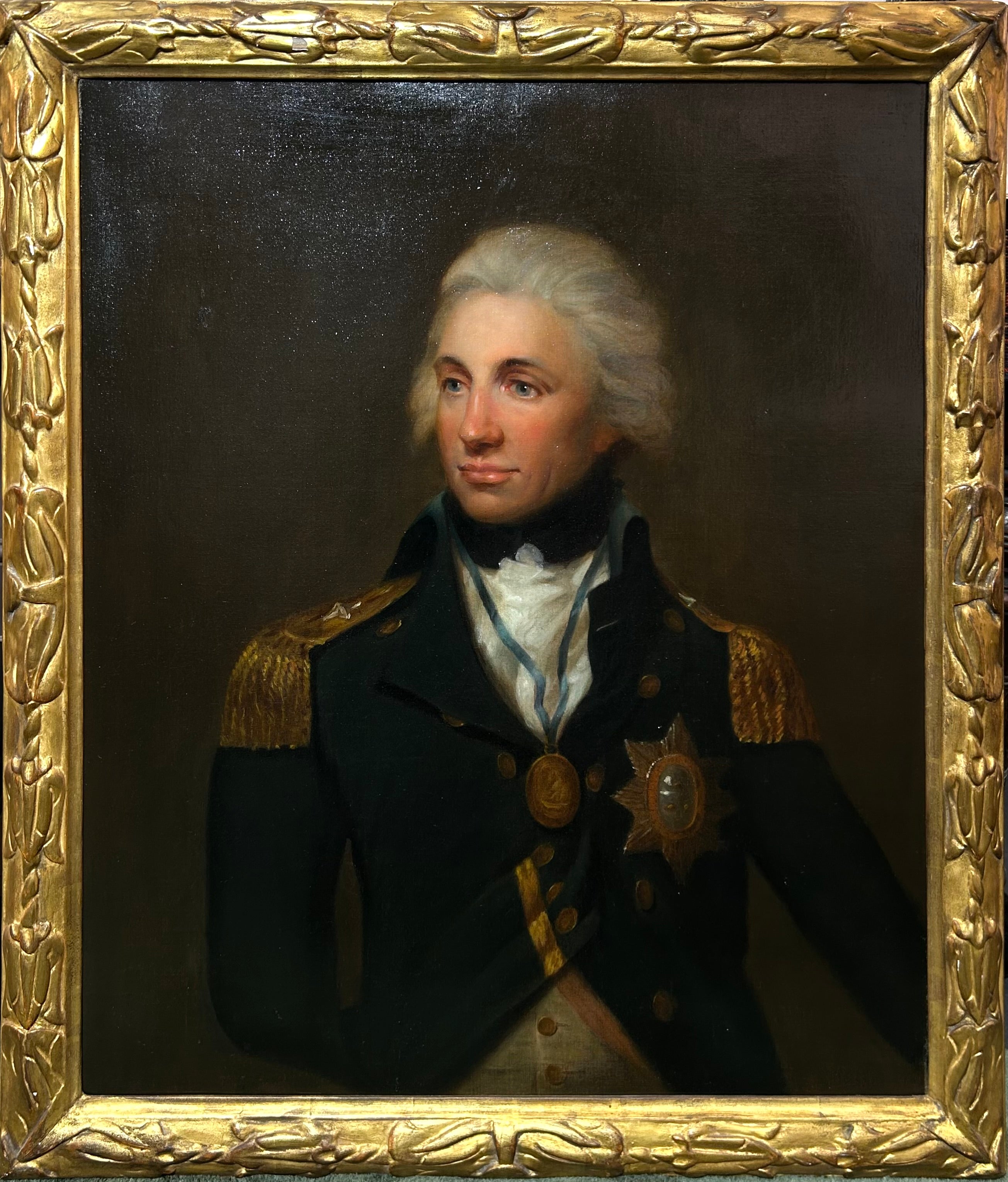
By and Studio of Lemuel Francis Abbott
Portrait of Horatio Nelson, in Rear-Admiral Uniform
Oil on canvas
Image size: 25 x 30 inches (63.4 x 76 cm)
Original giltwood frame
Provenance:
The Parker Gallery, 1960s
Private Collection
This portrait of the iconic British naval hero Horatio Nelson depicts him in his Rear-Admiral uniform after his promotion resulting from his success during the Battle of Cape St Vincent. Nelson also sports the Star of the Order of the Bath, whilst the Naval Gold Medal hangs from a blue ribbon around his neck. The work conveys a sense of pride, with Nelson’s gaze expressing stoicism and composure. There is, however, a sense of gentleness to the work, with the slight dimples and soft cheeks. Indeed, these qualities represent what is known of Nelson’s leadership style - his officers would speak of him as a firm and highly strategic commander, who cared greatly for his men and treated them with fairness and compassion.
The composition of the painting is a variation of Lemuel Francis Abbott’s portrait, which is widely recognised as the most circulated portrait of Nelson. Abbott was known to have produced as many as 40 variations of the painting as a result of its great success. Examples in the National Portrait Gallery, the Lady Lever Gallery and the National Maritime Museum show slight differences in facial structure and positioning of the epaulets. Abbott is known to have visited Nelson to make studies of him in 1797 and 1800, thereby accounting for such variations. After Abbott was declared insane in 1798, many of his unfinished works were completed by his studio.
Horatio Nelson
Horatio Nelson was born in Norfolk in 1758 and joined the British Navy in 1771, aged only 12, under the patronage of his uncle. He obtained his first command in 1778, and his novel tactics and unusual strategies helped him rise quickly through the ranks. His first command - the HMS Badger - patrolled the Caribbean and was part of several naval engagements during the American Revolutionary Wars. After peace was declared, Nelson returned to England and spent the next five years ferociously campaigning for a new command.
Nelson’s new command was the HMS Agamemnon, deployed in the Mediterranean during the French Revolutionary wars. He helped to capture Corsica, and distinguished himself in the 1797 Battle of Cape St Vincent, before losing his right arm on an attack at Santa Cruz de Tenerife - his return to duty at the Battle of the Nile was a decisive victory and cemented him as a British hero. During this time, Nelson was made a Knight of the Bath and was also promoted to the position of Rear Admiral. In 1801, Nelson helped to break up the Second League of Armed Neutrality in the Baltic Sea by defeating Danish forces during the Battle of Copenhagen, after which he was promoted to Commander-in-Chief of the Baltic fleet.
When the Napoleonic Wars broke out in 1803, Nelson commanded the British fleet blockading Toulon and later Cadiz. In October of 1805, the Franco-Spanish fleet came out of port at Cadiz and Nelson was able to engage them in battle, commanding his flagship HMS Victory. This conflict was a decisive victory, and became known as the Battle of Trafalgar - although the most critical of Nelson’s successes, he was fatally wounded by a French marksman. Taken below deck to be treated, Nelson continued to instruct the fleet until he died three hours after being shot.
Nelson’s body was returned to England and accorded a state funeral. To this day, Nelson is regarded as the greatest admiral in history and is considered a British national hero for breaking the tactical doctrines of previous naval engagement. His tactics contributed to the destruction of the French fleet during the Napoleonic Wars, and the continued supremacy of British naval power for at least the next century. Nelson’s Column in Trafalgar Square commemorates his life, and his tomb is an iconic feature of St Paul’s Cathedral.
Lemuel Francis Abbott
Born in Leicestershire in 1760, Lemuel Abbott was 14 when he became a pupil of Francis Hayman in London. After Hayman’s death in 1776, Abbott returned to Leicestershire, where it is rumoured that he studied under Joseph Wright of Derby. He was, however, largely a self-taught artist.
After marrying Anna Maria in 1780, Abbott returned to London. He exhibited regularly at the Royal Academy, but was never made an Academician. Abbott was a prominent portraitist, painting the likenesses of important figures of his day, including Horatio Nelson, William Herschel, William Cowper, John Wilkinson and Matthew Boulton. His portrait of Nelson is widely considered the most iconic portrait of the naval hero, and Abbott is also credited with producing one of the earliest portrayals of the game of golf as part of his portrait of Henry Callender, captain of the Blackheath Golf Club.
He was a troubled man, with overwork and domestic unhappiness contributing to him being declared insane in 1798. Abbott died in December 1803.