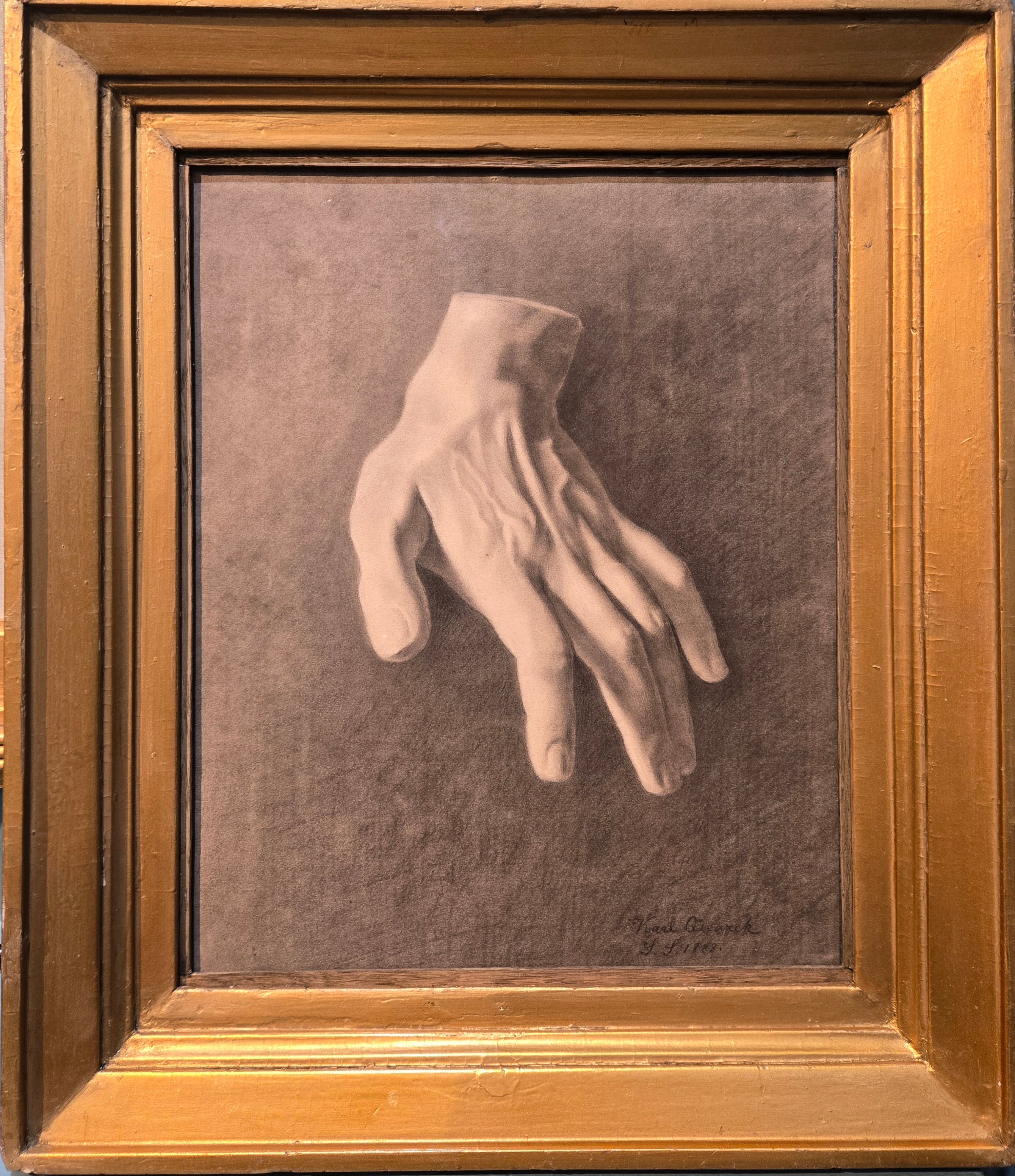
Karl Quarck
Study of a Hand
Graphite on paper, signed and dated '1888' lower right
Image size: 10 x 13 inches (25.5 x 33 cm)
Handmade gilt frame
Created towards the end of the artist's time at the Royal Academy of Fine Arts in Dresden, this masterful study depicts a human hand, positioned as if supporting the weight of its seated owner. This work is a stunning example of the 19th century academic atelier exercise of cast drawing where students would draw a stationary white plaster cast, such as a classical Greek or Roman sculpture or body part, under controlled, single-source lighting. The uniform, monochrome surface of the plaster removed skin tones, colour and texture, allowing students to focus purely on light, shadow and three dimensional forms. Many ateliers use the 'Sight-Size' method, whereby the artist places their easel and the cast side-by-side at a specific distance to observe and capture the subject on a one-to-one scale, and it is this technique that Quarck has chosen to employ. The life-size hand is beautifully detailed, from the soft curves of the short fingernails to the prominent veins, bones and sinews. This work is a truly exceptional example of the atelier practice and a masterclass in three dimensional modelling.
Karl Quarck (1869 - 1949)
Karl Quarck was the youngest of eight children, born in Rudolstadt to Henriette Köhler and Ferdinand Quarck. Upon the unexpected death of his father in 1880, Karl was raised by his older brother Max Quarck, a politician in the German SPD. Karl completed an apprenticeship as a decorative painter before studying at the School of Applied Arts in Leipzig. After completing military service in Dresden, Karl studies at the Royal Academy of Fine Arts in Dresden from 1894 to 1899 where he became a master student of Friedrich Preller the Younger, a German landscape and marine artist. Preller was responsible for gaining Karl's first commission, a mural for the Villa Wolfrum in Aussig, built by the prominent textile industrialist Carl Friedrich Wolfrum. Karl cultivated a long lasting friendship with his patron and spent many weeks at the villa each year following the commission. Karl mainly devoted himself to landscape painting.