


Charles Gordon Chaloner Olive
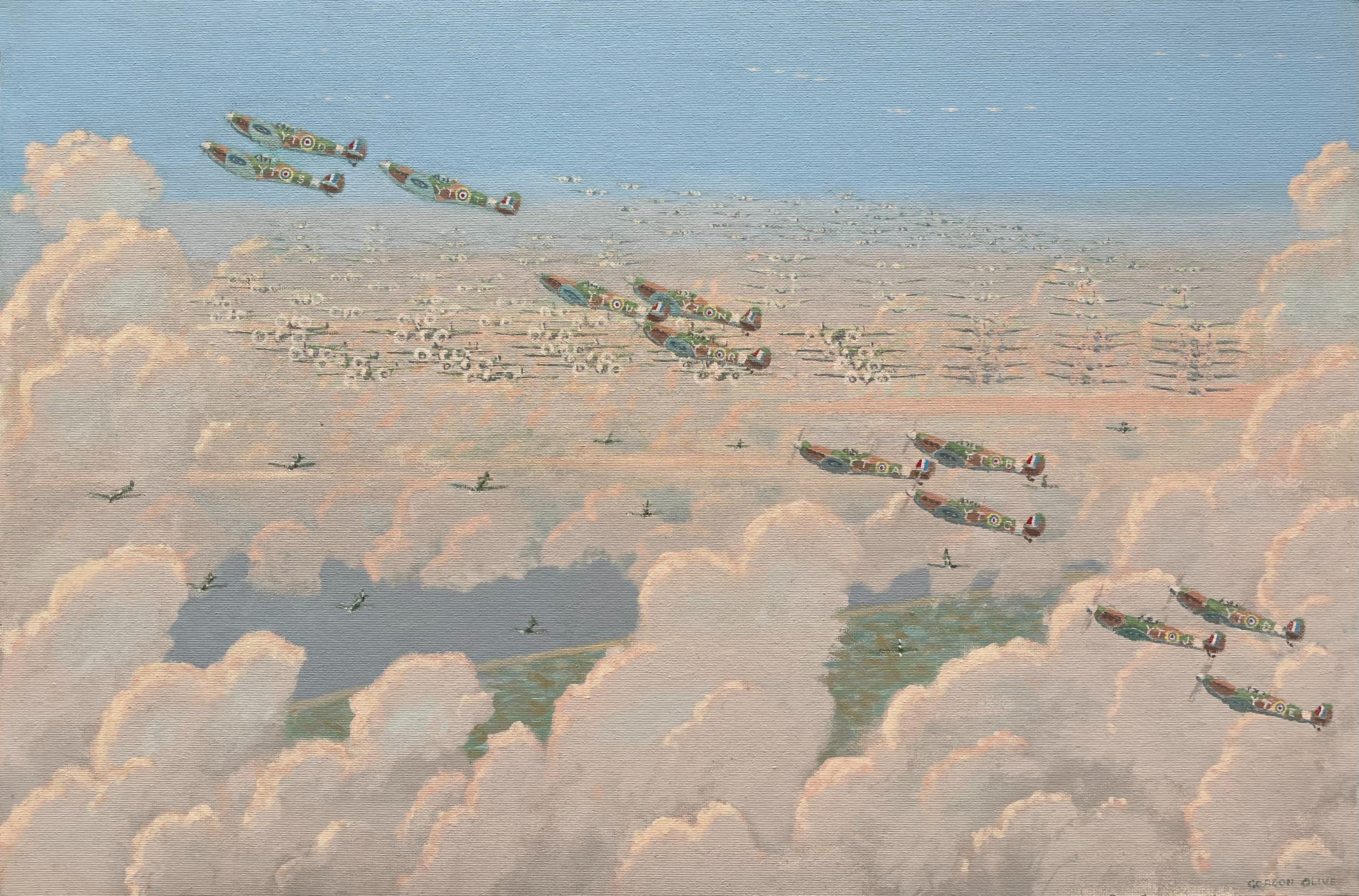
The Battle of Britiain: No. 65 Squadron
Oil on board, signed lower right
Image size: 36 x 24 inches (91.5 x 61 cm)
Handmade frame
Provenance:
Sotheby's Hendon: Historic Aircraft and Aeronautica, The Royal Flying Corps and Royal Air Force 1912-1990, 15 September 1990, lot 394.
Here we see the Supermarine Spitfires of the RAF's 65 squadron, ascending to attack during the Battle of Britain in the Second World War. The spitfires climb in a well drilled line from the bottom right of the canvas to the top left, behind them a mass of hundreds of other allied planes come to join them. Above them the sky is a calm blue, beneath them white clouds catch the sunlight and part to reveal glimpses of the British coastline below. With the benign weather, Olive creates a bright picture, imparting more of a sense of optimism at ending the War, rather than foreshadowing the destruction that is soon to come.
Olive has taken great pains to accurately depict the Supermarine Spitfires. On the side of the planes we see a 'YT' indicating the No. 65 Squadron, and the individual aircraft letters, the other side of the fuselage roundel (the RAF symbol of concentric red, white and blue discs). The RAF would change the squadron code if it ever thought that Germans had managed to link a particular squadron to a code. The Spitfires are shown with their characteristic brown and green camouflage on their upper surface and the roundels on the top of the wing, missing the white meaning the aircraft was less easy to see, particularity if it was on the ground.
The hundreds of unidentified aircraft behind the Spitfires are an imposing sight, rows of propellers and wings advancing towards the viewer, capturing the sheer operational scale of the Battle of Britain.
The No. 65 Squadron was formed in 1916 during the First World War and was based at RAF Hornchurch during the second. The squadron was active during the Battle of Britain, with at least one pilot, Bolesław Drobiński, shooting down at least seven enemy aircraft.
Charles Gordon Chaloner Olive
Charles Gordon Chaloner Olive was born in 1916 in Paddington, Brisbane. He attended Brisbane Grammar School and, briefly, the University of Queensland, before enlisting in the Royal Australian Air Force as a cadet in 1936 in Point Cook, Victoria. He became a pilot in 1936 and in January 1937 went to England on a commission with the Royal Air Force in England. He was transferred to the No. 65 Squadron's Hornchurch Wing and was promoted to flying officer in 1938 and flight commander at the breakout of the Second World War.
Olive piloted a Spitfire on 193 sorties over three tours of duty between September 1939 and March 1941. He destroyed at least five enemy aircraft during the Battle of Britain and in 1940 was promoted to flight lieutenant, winning the Distinguished Flying Cross that same year.
Olive shot down his sixth enemy aircraft in December 1940, and in June 1941 was appointed to command the No. 456 Squadron, Australia's first and only night-fighter squadron. He was promoted squadron leader on 18 January 1942 but was forced off active service due to ill health in March. In June 1943 he joined the Royal Australian Air Force officially, but he remained attached to the RAF.
He returned to Australia in 1944, joining RAAF Command and in 1945 was posted to Air Defence Headquarters in Morotai, Indonesia but was demobilised and transferred to the reserve the following year.
Olive was honorary aide-de-camp to the Queen in 1961 and stood for the seat of Petrie as a Country Party candidate in 1972. He was appointed Member of the Order of the British Empire in 1967 and Commander in 1978, before retiring in 1981.
He died at Boonah in 1987 and was survived by his wife and three of his four children.
Olive had written notes for a book about his wartime service, but did not finish it. Several years after his death, his estate arranged for writer Dennis Newton to edit these notes into a book, which was published in 2015 under the title Spitfire Ace.