

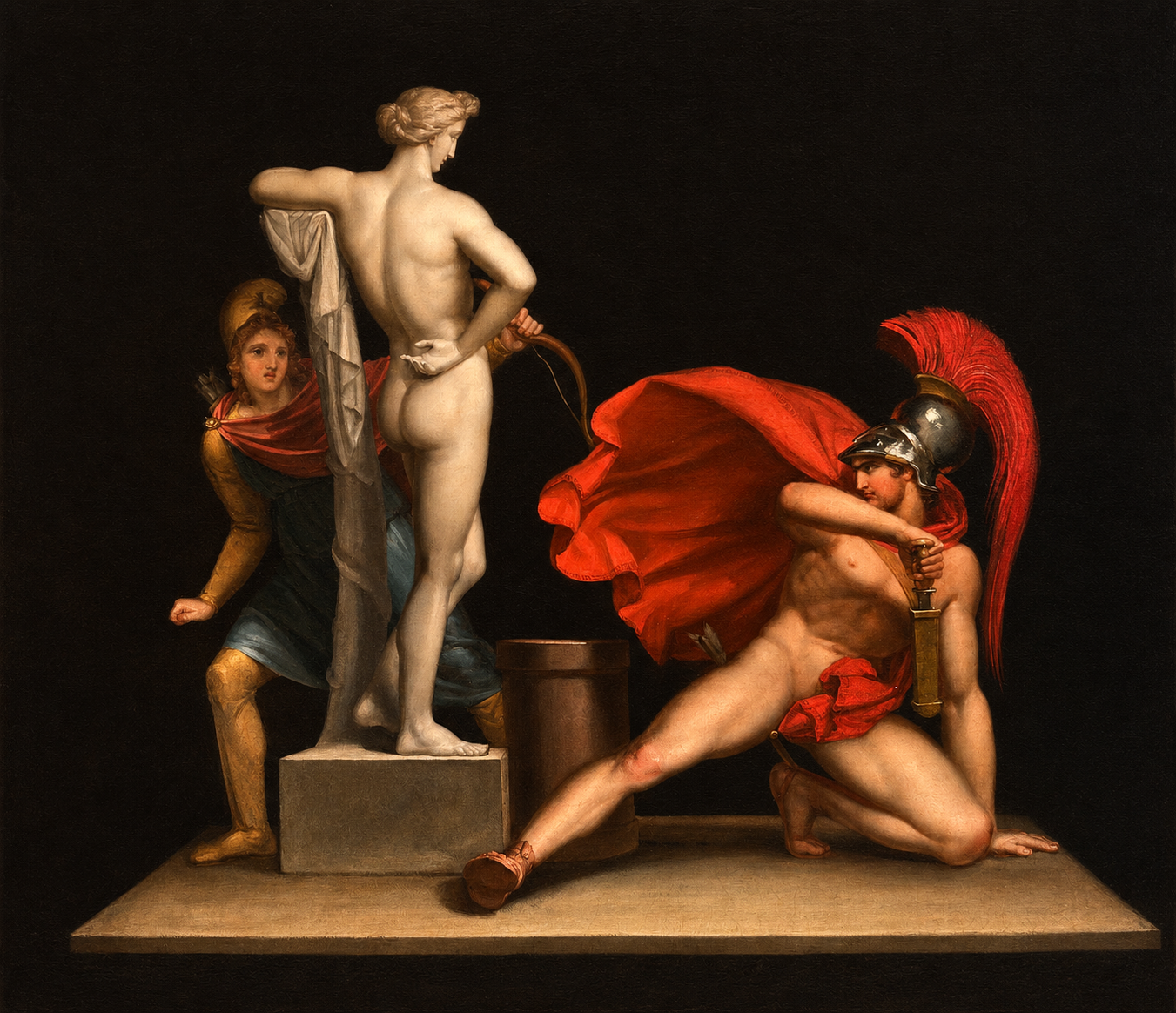

Circle of Angelica Kauffman
The Death of Achilles
Oil on canvas
Image size: 24 x 20 1/8 inches (61 x 51 cm)
Contemporary hand-carved giltwood frame
Provenance:
Private Estate
Christie’s, Hawkins Sale, 1963
This theatrical work depicts the scene from classical mythology where the Greek hero Achilles is killed by an arrow by the Trojan prince Paris. Achilles' death is not described by Homer in either the Illiad or the Odyssey, leading to several different accounts of the hero's demise. This work combines elements from several versions, most likely taking inspiration from Ovid’s Metamorphoses and Seneca’s Trojan Women. In these tellings Achilles agrees to marry Polyxena, a daughter of the Trojan King Priam to end the Trojan war. However, the promise of marriage is a trap and Polyxena's brother hides in the temple of Apollo where Achilles had planned to meet the princess. Paris, informed of his opponent's one weakness by his sister, to whom Achilles had confided, fells the hero with an arrow to his heel, thus killing him.
The painting depicts Achilles in a half crouched position, one hand drawing his sword, ready to face his ambusher. His eyes locked on Paris, he is unaware that the fatal arrow is already embedded in his left ankle. Paris, bow in hand and quiver on his back, hides behind a sculpture of Apollo, in the god of the temple in which the ambush takes place. Some accounts describe how Apollo intervened, guiding Paris' arrow straight and true, ensuring it met it's mark.
The drama of the scene is heightened by the artist's use of chiaroscuro, the red of Achilles' cape and plumage and the white of the marble Apollo particularly contrasting the darkness of the background. The figures appear to almost be placed on a pedestal, further intensifying the drama.
Angelica Kauffman
Born in 1741, Maria Anna Angelika Kauffmann (known in English as Angelica Kauffman) was a Swiss history painter who forged a successful career in London and Rome. He father was a skilled Austrian muralist and painter who trained Angelica to work as his assistant. Travelling often for her father's work, the child prodigy Angelica rapidly acquired four languages: German, Italian, French and English.
A talented singer, Angelica was forced to choose between a career opera and art, choosing art and, by the age of twelve, had already gained a reputation with bishops and nobles sitting for her.
Kauffman and her family moved to Florence in 1762 and it was here that she discovered Neoclassical painting, a style in which she worked throughout her career. Thanks to her fluency in so many languages she gained a number of patrons, including English visitors in Rome, prompting her move to London in 1766. Whilst in London she became firm friends with artist Sir Joshua Reynolds and, along with Mary Moser, became on of two female painters among the founding members of the Royal Academy of Art in 1768.
From 1769 until 1782, Kauffman was an annual exhibitor with the Royal Academy, sending as many as seven pictures, generally on classical or allegorical subjects. These subjects belonged to the History painting genre, considered the most elite and lucrative category of academic painting at this time and generally off-limits to a female painter. Studying the works by the likes of Titian and Raphael as well as engravings, drawings and plaster casts, Kauffman was able to overcome her exclusion from formal training and learned to depict male anatomy.
Kauffma left London for Rome and died in 1807. By the time she passed away she had gained such a reputation as an artist the Neoclassical sculptor Antonio Canova directed her funeral, with the entire Academy of St Luke followed her to her tomb in Sant'Andrea delle Fratte, carrying two of her best pictures.