

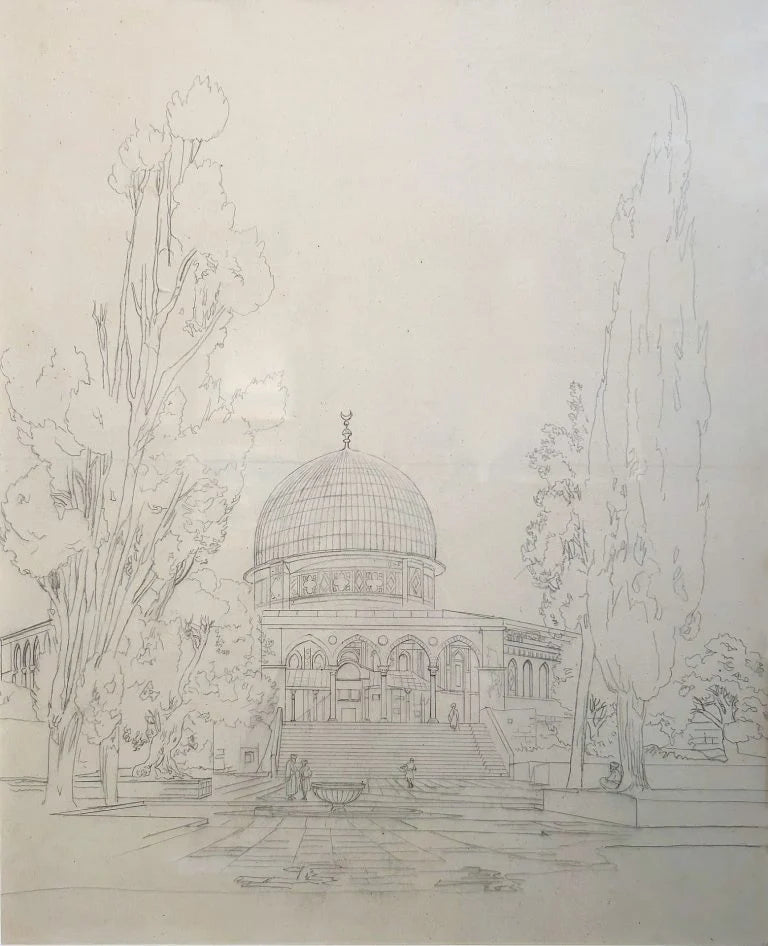

Carl Friedrich Heinrich Werner
The Dome of the Rock
Graphite on paper
Image size: 17 1/4 x 14 inches (44 x 35.5 cm)
Handmade gilt frame
Carl Friedrich Heinrich Werner
Carl Friedrich Heinrich Werner was born in Weimar in 1808, the son of a piano teacher and a singer. He studied both painting and architecture in his youth, before deciding that the former was his true vocation. It was Werner’s depictions of architectural monuments that first brought him recognition. He exhibited in Dresden, and this attracted the attention of the Director of the Academy of Fine Arts and the subsequent award of a travelling scholarship. Encouraged by Goethe, Werner decided to go to Italy. There he spent the next twenty years honing his skills in Rome, Venice, Bologna and Florence.
It was not until 1852 that Werner made his first trip to the Orient, visiting the Holy Land and Egypt. In 1864 he visited Egypt again, travelling the whole length of the Nile. On his return he also visited Jaffa, Jerusalem, Bethlehem, Hebron, Beirut and Damascus, taking detailed sketches for his future compositions. He totally immersed himself into the society, and his works certainly capture the vitality and excitement of the everyday moment. Werner sketched and then painted mostly architectural and landscape scenes, usually in watercolour although he is known to have painted a small number of oils. His historically interesting works are remarkable for their realism and precision of detail. He was also skillful in his depiction of light.
Some of his best works are those of Jerusalem, particularly the Dome of the Rock which, unusually, he depicted from the inside – most travellers tended to paint it from a distance. It was impressive that Werner was inside at all since most non-Muslims were not allowed to enter the sanctuary. Werner exhibited regularly throughout his career; from 1858 at the Berlin Artists Society, from 1861 at the Berlin Academy and from 1870 at the Dresden Academy.
He also exhibited in London from 1860 until 1878, once at the Royal Academy and frequently at the New Watercolour Society, of which he was an associate and later a member. In addition he was a member of the Venice Academy and exhibited his works in Italy. His paintings can be found in several major European galleries and museums, including the V&A, the Venice Museum and the National Gallery in Berlin. In 1882, at the age of 74 Werner became a watercolour professor at Leipzig Fine Arts. In 1891 he returned to Rome. He died two years later in Leipzig aged 85.
This painting is imbued with a true sense of realism, informed by Werner’s extensive experience of travelling throughout Egypt. Although painted back at his studio, Werner would have utilised his drawing studies as reference. His accuracy is prominent in the detailed depiction of a range of architectural motifs - from exaggerated horseshoe archways, to ornamented stone panels. The deep red shades of the rugs provide a splash of colour against the sandy palette of the remainder of the painting, and yet do not impose upon the composition. Instead, they provide a natural frame for the three figures in the centre of the painting.
As well as demonstrating Werner’s knowledge of Middle Eastern architecture, this painting also indicates his deep understanding of Egyptian cultural customs. The subject matter depicts a scene in a bazaar, with an older gentleman surveying the quality of a rug offered by a merchant. This was likely a customary experience that Werner would have been privy to on multiple occasions, given how ingrained textiles and bazaar systems are within Egyptian and Ottoman culture. Overall, the painting is a beautiful representation of Werner’s adoration of the Egyptian country, its people, and its culture.