

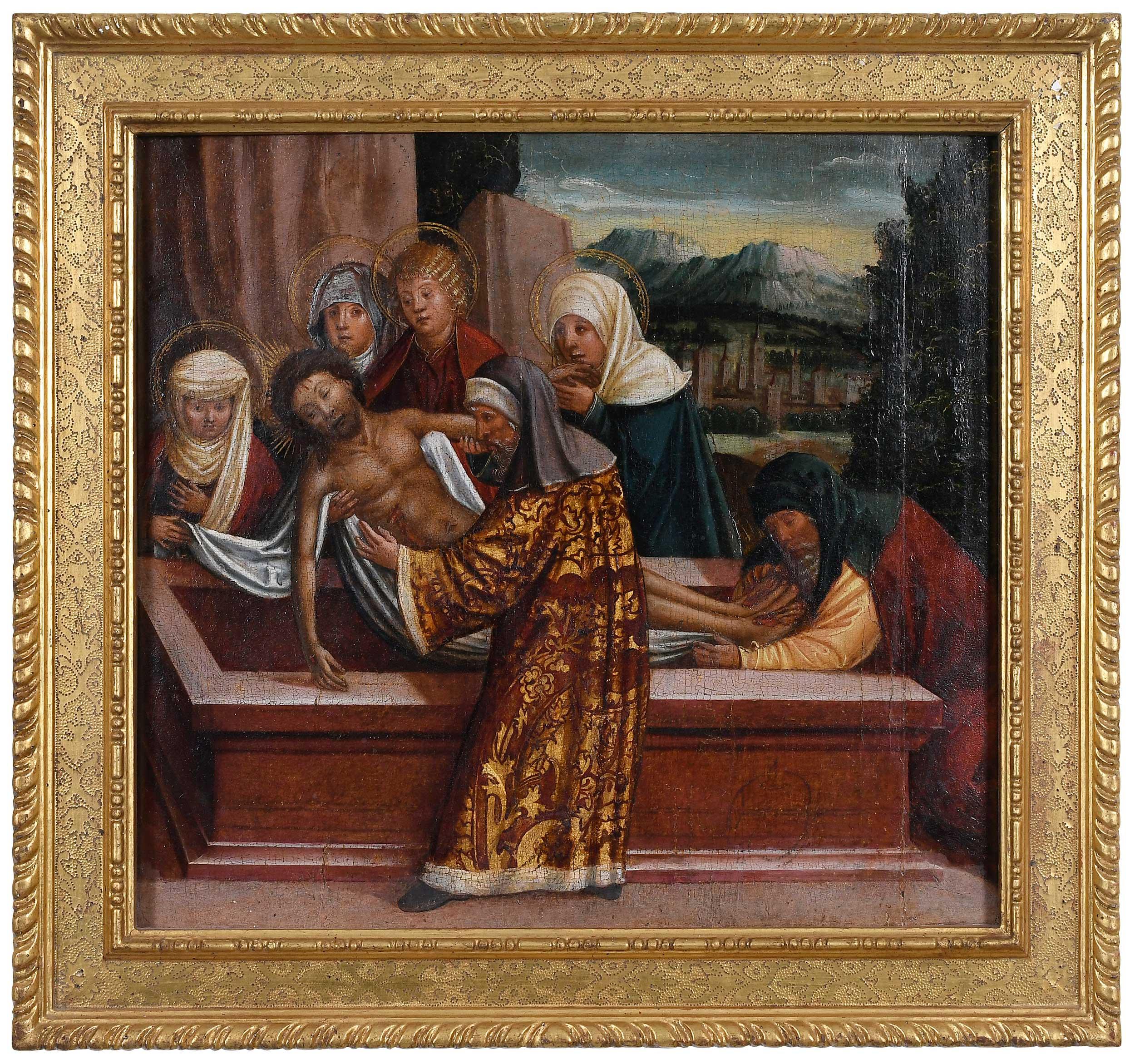

15th Century Italian School
The Entombment of Christ
Tempera on panel
Image size: 18 x 19 3/4 inches (45.7 x 50.2 cm)
Carved and punched gilt wood frame
Provenance:
The Estate of Dr J Clayton Davie
The Entombment of Christ was one of the most important scenes in Italian religious art, characterised by its distinct pictorial language and its focus on the emotions of those involved. As is common in other, similar paintings of the time, this particular Entombment scene takes place outside, with a walled city and two mountains visible in the background.
The figures supporting the inert body of Christ are those most strongly associated with the Entombment: Mary Magdalene holds part of the shroud close to Jesus’ head, her other hand pressed closely to her heart; Mary of Bethany stands beside her, her gaze directly addressing a viewer and involving them in the scene; John the Evangelist, the beloved disciple, seems unable to tear his gaze away from the pitiful scene in front of him as he helps lower Jesus’ body into the sarcophagus
The Virgin Mary cradles her son with both arms, reluctant to let go of him, pressing one of his hands to her mouth in a kiss; Joseph of Arimathea stands in the foreground of the painting, clad in his expensive garments, gently supporting Jesus’ body near his wound from the Holy Lance; Nicodemus, despite his age, kneels down to carefully lower Jesus’ bloodied feet into his tomb.
Unlike some scenes of the Entombment, which depict the figures in moments of extreme emotion, the Master of this painting has imbued his work with a considerably more sombre air. The care with which Nicodemus and Joseph of Arimathea handle Jesus’ body portray their respect for him, whilst John the Evangelist’s inability to look away from the body indicates his horror at what is in front of him.
The Virgin Mary’s reaction, unusually subtle, is perhaps the most heartbreaking - one last kiss for her son, stolen at too young of an age in a truly barbaric manner. This gesture reminds the viewer - both modern, and contemporary to the painting - that Jesus was human and was not only the son of God, but the son of a young woman called Mary. Whilst this haunting scene takes place, Mary of Bethany meets the gaze of the viewer, involving them directly in the narrative and appealing to their piety and devotion.
The composition and technique of the painting is also outstanding. The tomb, angled towards the viewer and containing a gaping black hole, is foreshortened to display its receding perspective. The shroud and Jesus’ limp hand cast shadows on the otherwise shiny stone surface, with the Master of this scene depicting areas of illumination in a brilliant white.
The gore of Jesus’ wounds is disturbingly realistic, emphasising the pathos of the scene. The gilded haloes of the figures in the scene are beautiful and delicate, suggesting an artist who was skilled at mordant gilding. The gold haloes mirror the gold of Joseph of Arimathea’s cloak, a garment that displays the figure’s wealth. Despite its lavishness, the artist has ensured that it does not overshadow the scene by matching the colour of the garment to the sarcophagus and the clothes of Nicodemus.
The yellow sleeve of Nicodemus’ tunic - with magnificent folds around the elbow - provides a visual buffer to the gold of Joseph of Arimathea’s cloak. Through these careful choices, the Master of this work has ensured that the scene retains its sombreness and sense of piety, whilst also remaining aesthetically pleasing.