

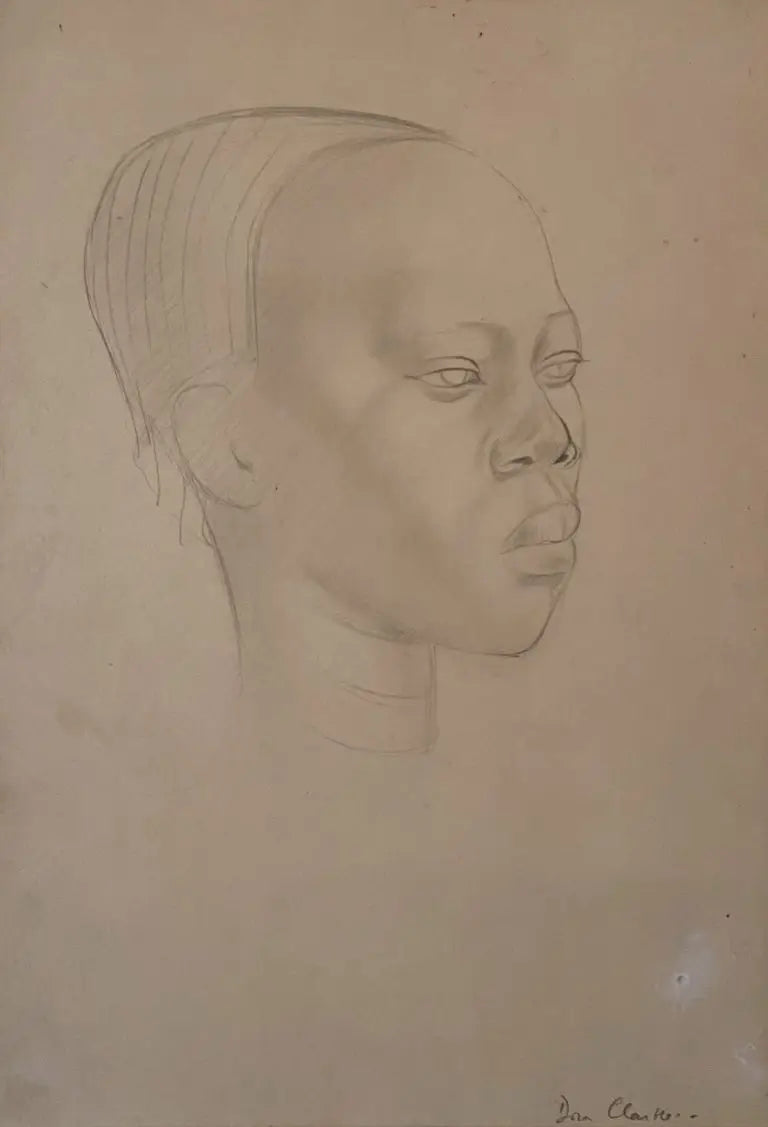

Dora Thacker Clarke
The Gaze
Graphite on paper, signed bottom right
Image size: 13 x 8 3/4 inches (33 x 22.25 cm)
Original frame
In the late 1920s, Dora Thacker Clarke embarked on a year-long tour around Kenya to gain insight into African culture, having become passionate about the continent’s art during her studies at the Slade School. Clarke campaigned for African art to be viewed for its artistic merit, rather than being confined to ethnographic and anthropological studies - this was not a widespread view at the time, but there was growing interest in non-Western art spreading throughout Europe.
During her travels in Kenya, Clarke completed a number of drawings and sketches in-situ, in order to better inform the realism of her sculpted heads back in her studio in London. It is likely, therefore, that this sketch was one such study. The extensive level of detail afforded to the facial features of the sitter in comparison to her hair demonstrate that this was Clarke’s focus for this particular study, and pay testament to Clarke’s skills at observational drawing. She has captured the contours of light across the sitter’s face, including areas of shadow around her nose and brow. With such a sympathetic and detailed representation, one can only imagine how impressed the sitter would have been upon viewing her likeness, as depicted by Clarke.
Dora Thacker Clarke
Dora Thacker Clarke
Dora Thacker Clarke, later Dora Middleton, was a British sculptor and wood carver who also wrote about and promoted African art.
Clarke was born in Harrow in Middlesex. Her father, Joseph Thacker Clarke, was an American architect. Clarke won a scholarship that allowed her to attend the Slade School of Fine Art. Aged only fifteen, Clarke initially studied at the Slade on a part-time basis for three days each week throughout 1910 and 1911 but during 1915 and 1916 she studied sculpture there as a full-time student, under Henry Tonks, George Frampton, and J Harvard Thomas.
Clarke first exhibited at the Royal Academy in 1923 and continued to do so until 1959. She was part of the inaugural Exhibition of Living British Artists in Leeds in 1927. In the early 1930s she was a regular exhibitor in group shows at the Goupil Gallery and in March 1937 had her first solo show at the French Gallery. She also exhibited at the Paris Salon and with the Royal Society of British Artists, as well as with the Women’s International Art Club.
Clarke’s works included bronze castings, memorials and wood sculptures. For example she was commissioned to sculpt the posthumous portrait bust of Sir Walter Morley Fletcher. The most notable of her memorials is the panel and medallion tribute to Joseph Conrad at Bishopsbourne in Kent, which was unveiled in 1927.
Clarke also wrote about, and promoted African art and spent a year, between 1927 and 1928 in Kenya, where she lived with local communities and tribes to learn about their cultures. She made many drawings during her travels, which she used as the bases for her wood carvings and bronzes of African heads when she returned to London. Wood carving became her technique of choice, often working with hardwoods and, on occasion, sperm whale teeth. In the mid 1930s, Clarke wrote an article for the Journal of the Royal African Society, advocating for the artistic - and not ethnographic - recognition of Western African sculpture
Clarke married Admiral Gervase B Middleton in 1938 but rarely exhibited work under her married name. Just before the outbreak of war, Clarke featured in a number of BBC documentaries, recounting her sculptural techniques to the British public. During World War II, Clarke was commissioned by the War Artists’ Advisory Committee to produce a portrait medallion depicting a serviceman who had been awarded the George Cross. This proved to be the only portrait medallion acquired for the WAAC collection.
Sculptures by Clarke are held in various museums, including the Manchester Art Gallery and the Ashmolean Museum, the latter of which also holds a 1936 portrait of her by Orovida Camille Pissarro.