Skip to product information
1 of 1

Evan Charlton

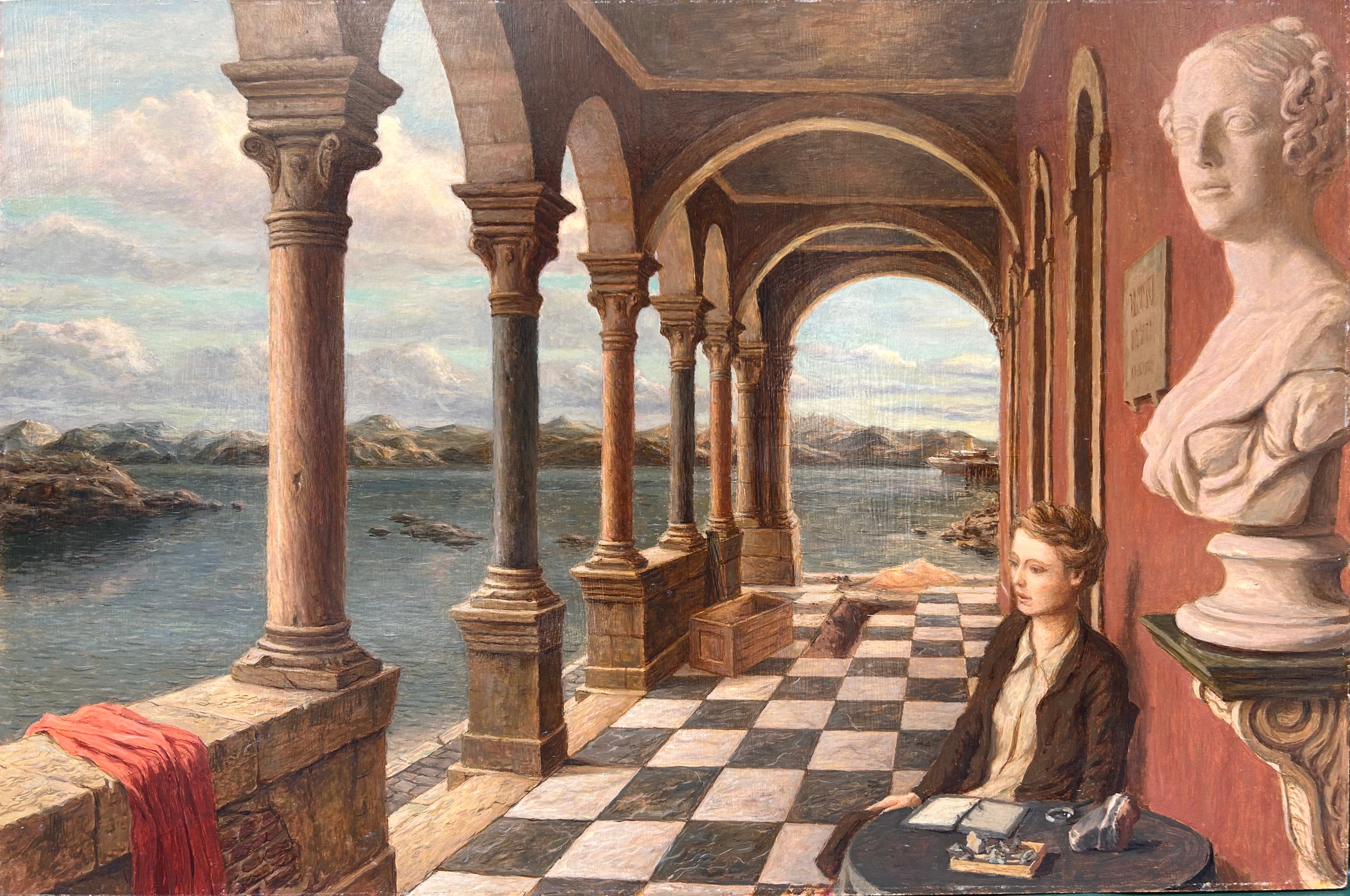
The Geologist

1904 - 1984

Oil on board, signed and dated 1968 verso
Image size: 23 x 36 inches (58.5 x 92 cm)
Original gilt frame

This work was painted in 1968, shortly after Charlton had retired from the Civil Service and embarked upon a full-time career as an artist. The work demonstrates Charlton’s Old Master inspiration, with motifs taken from classical antiquity, and the dream-like quality of the subject matter aligns the work with the British Surrealist movement.

As is typical of Charlton’s works, the painting is deeply realistic. There is an immense attention to detail on display, particularly with regard to the texture of the marble floor and stone pillars. The sitter - prominent and revolutionary geologist Dr. Nancy Kirk - sits quietly at a table, examining graptolite fossils whilst gazing out over an imagined and immensely detailed mountainous land.

Dr. Nancy Kirk
Born in 1916, Nancy Kirk studied Geology at Newnham College in Cambridge and was the protegee of O. T. Jones. In 1939, a time where women could not hold degrees, she defied the odds and expectations of her gender by receiving multiple research scholarships and outstandingly high grades. During the Second World War, she worked at the Royal Ordnance Factory, before returning to her studies and completing her PhD in 1949.


Kirk briefly worked at the University of Birmingham before moving to Breconshire and Radnorshire, where she dedicated herself to researching the marine invertebrate species of graptolites. She lectured at Aberystwyth University from the early 1950s and well into the 1980s. Her ideas were controversial and revolutionary at the time, offering a view of graptolite evolution that was pioneering and at odds with what had been suggested previously.

On a personal level, Kirk was remembered fondly for her generosity and the genuine care she showed for her students. She was an avid collector of art, and produced a number of pottery pieces. After her death in 2005, a viewpoint at the northernmost point of the Pant Da Nature Reserve was named after her.

Evan Charlton
Evan Charlton was born in London in 1904, with Welsh heritage from his maternal family. He initially studied Chemistry at University College London and qualified for the Olympic selection in fencing. His first job was working for the local council, but he was considering becoming a teacher. Whilst he was a hobbyist painter, Charlton’s early life was hardly typical of most artists.

His brother George, however, was a teacher at the Slade School of Art. George invited Evan to spend a summer painting and sketching at the Slade, where one of his works won the Slade Prize, which enrolled him in a course at the college. He studied at the Slade for three years under Tonks, Steer and Schwabe.

Charlton then embarked upon a career in teaching, first in the West of England College of Art in Bristol, and then as the Head of the Cardiff School of Art in the late 1930s. When the Second World War broke out, Charlton worked as a war artist and painted industrial scenes and portraits. At the end of the war, Charlton was appointed Her Majesty’s Inspector of Art for Wales, and was promoted in 1962 to the Staff Inspector of Art in England and Wales.

After his retirement from Inspector of Art in 1964, Charlton began to paint full-time, contributing to a number of exhibitions at the Royal West of England Academy, the Welsh Arts Council, the New English Art Club, the Welsh Gallery, the National Library of Wales. His works were noted for their realism in a time of growing abstraction in art, and he was strongly associated with the British Surrealist school. Due to the meticulous detail and extremely fine feathery brushwork of his mature work, he completed only three or four paintings a year, ensuring that the total number of his works is very small. After his death in 1984, a memorial exhibition was held at the National Museum of Wales.

Museums
Glynn Vivian Art Gallery in Swansea, National Museum of Wales,Tate Britain, Welsh Arts Council, Imperial War Museum, University of Wales Institute of Science and Technology, Newport Museum and Art Gallery, National Library of Wales and Contemporary Art Society for Wales.

View full details