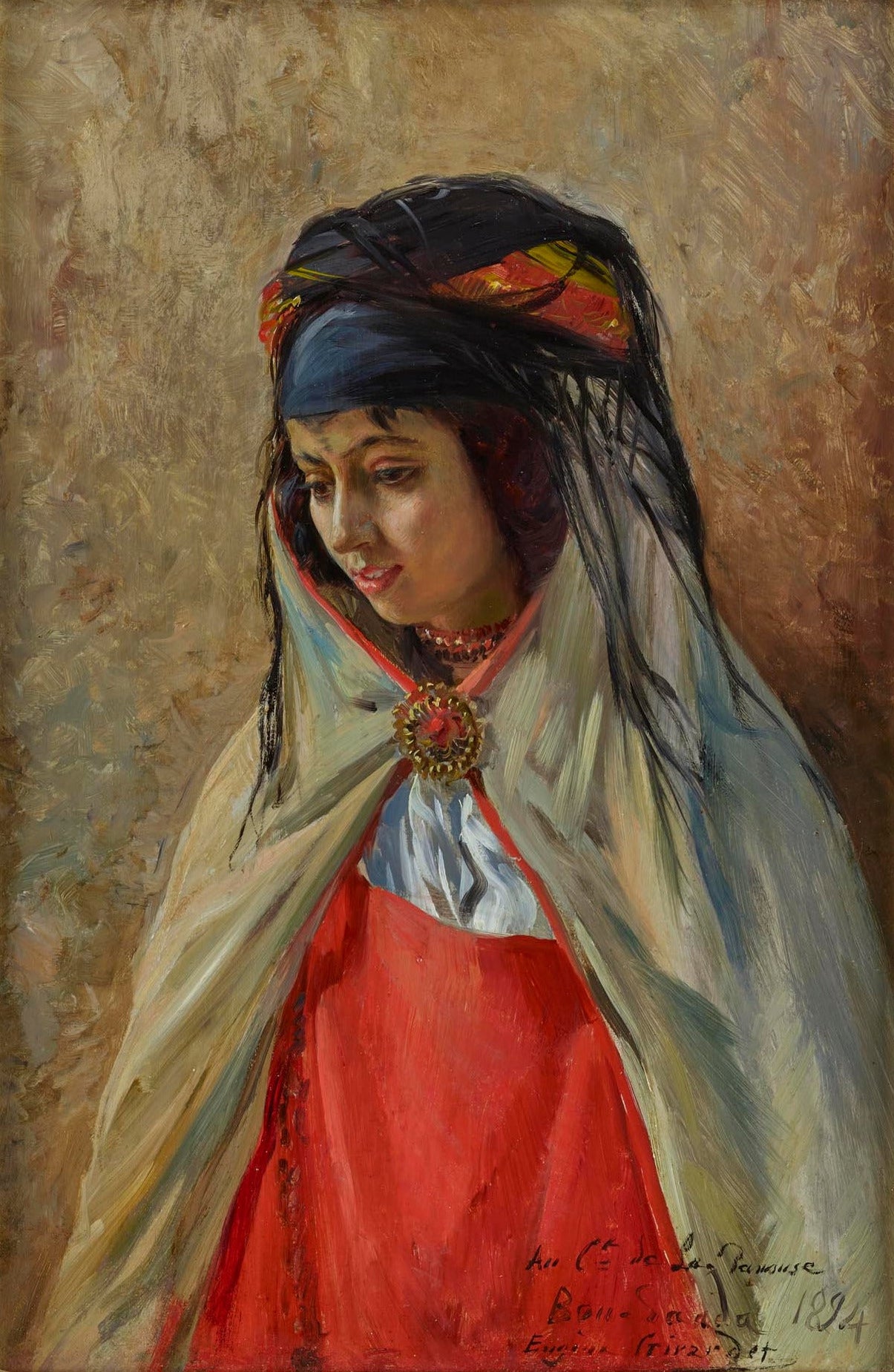
Eugène Alexis Girardet
The Gold Brooch
Oil on panel, signed, dated and inscribed ‘au Comte de la Panouse, Bou Saada, 1894’ lower right
Image size: 13 x 8 1/4 inches (33 x 21 cm)
Ornate hand made Orientalist Gilt frame
Provenance:
Commissioned by Louis de La Panouse (1863-1944)
On his later visits to Algeria, Girardet visited oases towns off of the beaten path in an attempt to gain a more authentic perspective on Algerian culture, away from the colonised cities. He found this authenticity in places such as Bou Saada, where this remarkable portrait was painted. The sitter is a member of the Ouled Naïl tribe, depicting her in cultural dress.
The Ouled Naïl tribe were popular with Orientalist artists and Western consumers, specifically their oft-photographed and painted dancing women. It was incorrectly assumed that these dancers were engaging in promiscuity, but the Naïliyat women dancers were revered amongst their people. Seasonally, Naïliyat dancers would travel to larger cities and towns to perform as professional dancers and earn an income. They would return with gold and silver, which would either be made into jewellery or put aside for a marriage dowry. Amongst the Ouled Naïl, dancing was a respectable profession, and mothers would teach their daughters how to perform, transforming it into a tradition.
The heavily ornamented costume and sensuous nature of the Naïliyat dancers was immensely popular amongst the French, who became fascinated with the exoticism that the dance represented for them. This portrait demonstrates no such exoticism and instead, as is Girardet’s hallmark, depicts a proud Naïliyat dancer, wearing the titular ‘gold brooch’ that is likely one of her earnings from her dancing. The painting is an outstanding and unique depiction of a misunderstood cultural practice from tribal Algeria, demonstrating Girardet’s appreciation of Northern Africa as well as his masterful manipulation of colour with regard to folded fabric and flesh tones.
Euguene Alexis Girardet
A child prodigy, Girardet was already selling his paintings at seventeen. His artistic career had begun at home under the training of his father. He later went on to study at L’Ecole des Beaux-Arts under Jean-Léon Gérôme. It was Gérôme who encouraged Girardet to travel to the Orient although he had already acquired a fascination for this area from listening to his uncle’s tales.
In 1874 Girardet visited Morocco and Algeria. He made several more trips to North Africa during the 1870s, including a visit to Tunisia in 1877. However, it was Algeria that most attracted the artist; he preferred the southern towns such as El-Kantara, Biskra and Bou-Saada. It was in Bou-Saada that he met the fellow Orientalist Etienne Dinet.
He returned seven more times, not just to collect studies for his paintings, but to experience their way of life at first hand. He loved the landscape and the people, which were still free from French colonial influence.
From 1874 he exhibited in Munich, Berlin and the Paris Salons. From the mid-1880s his work was also frequently exhibited in Geneva, Zürich and London.
This stunning portrait depicts a woman from Bou-Saada, possibly an Oulud Nail dancer. The painting glows with light, it pours across her face, revealing her flesh tones and creating shadows. The stunning black headdress contrasts well with the red of her dress.
Museums
Algiers, Bâle, Geneva, Paris, Nantes, Saintes and Zurich