Glyn Warren Philpot
The Judgement of Paris
Oil on canvas, initialled lower right
Image size: 45 1/2 x 35 inches (111.5 x 90 cm)
Period Gilt frame
Exhibited:
Leicester Galleries, June 1932, No. 13
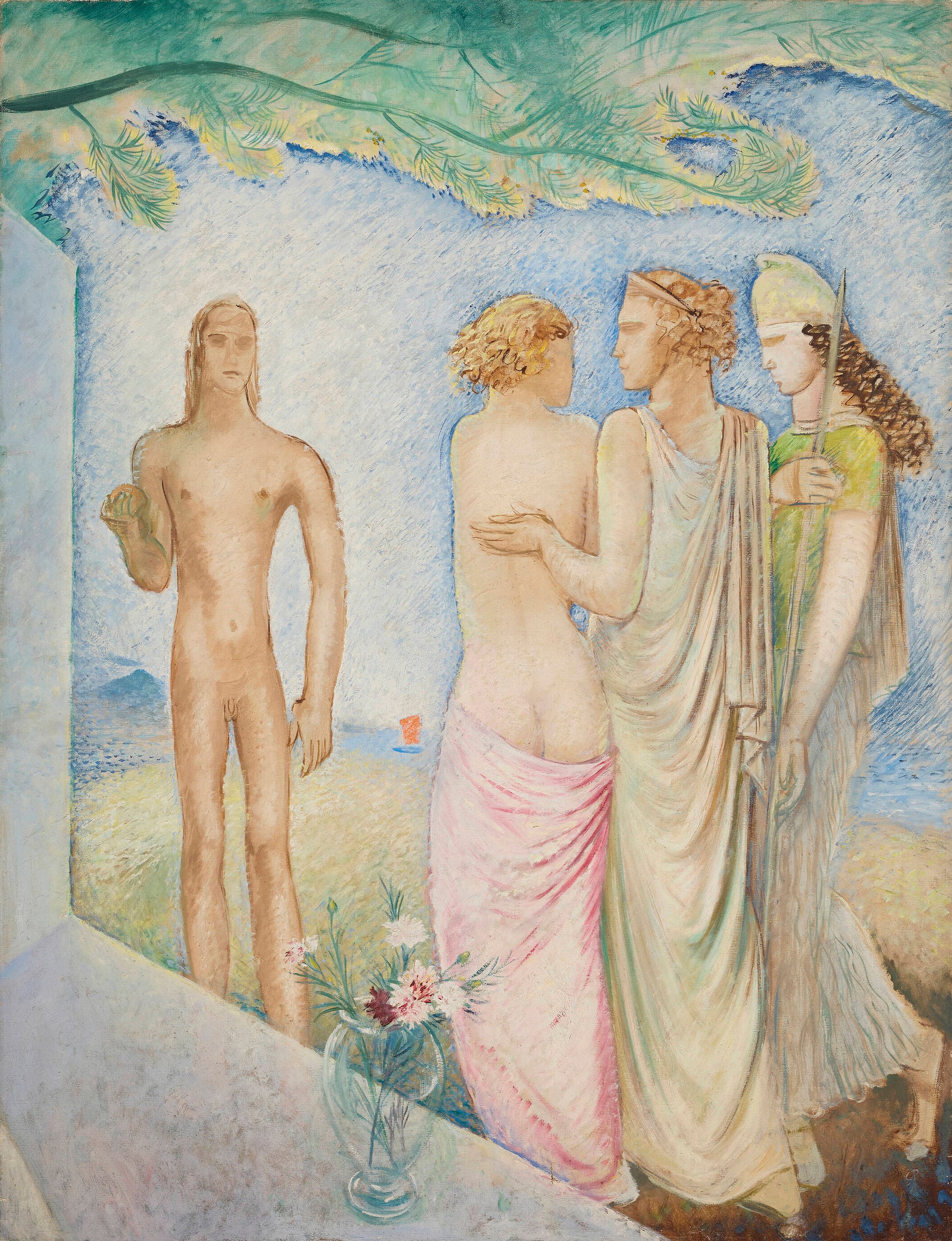
This splendid masterpiece by Philpot depicts his lover and longtime partner Vivian Forbes (1891-1937) as Paris. According to Philpot's record books, he painted this work in Paris in 1931-2.
It depicts the scene from classical Greek mythology where Paris is tasked with choosing the fairest goddess among Aphrodite, Hera and Athena. Paris chose Aphrodite for which she rewarded him with the love of Helen, leading to her abduction and subsequently the Trojan War. Paris stands before the three goddesses holding the golden apple he was to present to Aphrodite. Aphrodite, Hera and Athena face away from the viewer, towards Paris, their intertwined poses reminiscent of depictions of the three graces. Their costumes identify them- Athena is shown with her helmet and spear, the traditionally nude Aphrodite is half-covered by a pink robe and Hera, wife of Zeus, stands between them. The canvas is framed by tree branches above and a wall below and to the left of the canvas, giving the effect of the viewer being a separate observer, rather than within the scene themselves. Philpot uses a pallet of light pastels to capture the bright Greek sunshine in which the scene takes place.
This work reflects Philpot’s move towards modernism, which occurred after 1930 when he moved to Paris. Tired of painting society portraits, he turned to more mythological and queer themes in his works. Particular attention is paid to the goddess’ drapery, the folds of the different colours and textures are beautifully rendered. The eye is drawn to a ship at sea in the background with a bright red sail, contrasting the surrounding blue tones, and possibly foreshadowing the abduction of Helen, the face that ‘launched a thousand ships’ in the Trojan War.
Glyn Warren Philpot RA (1884-1937)
Glyn Warren Philpot was a British painter and sculptor.
His works are an important contribution to the sensitive representation of Black sitters from the 1910s to 1930s, and also explore both queer and religious subjects. Born in Clapham, Philpot grew up in Herne, Kent before studying at the Lambeth School of Art (now City and Guilds of London Art School) in 1900 followed by the Académie Julian in Paris. He first exhibited at the Royal Academy in 1904 and was elected as a member in 1923. He was a founding member of the National Portrait Gallery in 1911.
Philpot was a highly sought-after society portraitist and these works earned him an income which allowed him to travel to France, Italy, America and North Africa and continue to paint subject pictures. These works were more modern in style- flatter and more stylised than his earlier works and reflect Philpot’s inner world and its contradictions- he was a homosexual but converted to Catholicism. His interest in the male nude and portraits of young men thought to be of friends, models and lovers, are believed to show his gradual acceptance of his sexuality. Philpot was in a relationship with fellow artist Vivian Forbes (1891-1937) from 1923 until 1935. A loving cup held by Brighton Museum serves as a testament to their relationship, as does Forbes’ suicide the day after Philpot’s funeral in 1937.
Philpot died from a stroke in 1937. He is buried in a pink granite tomb in St Peter’s Churchyard in West London.