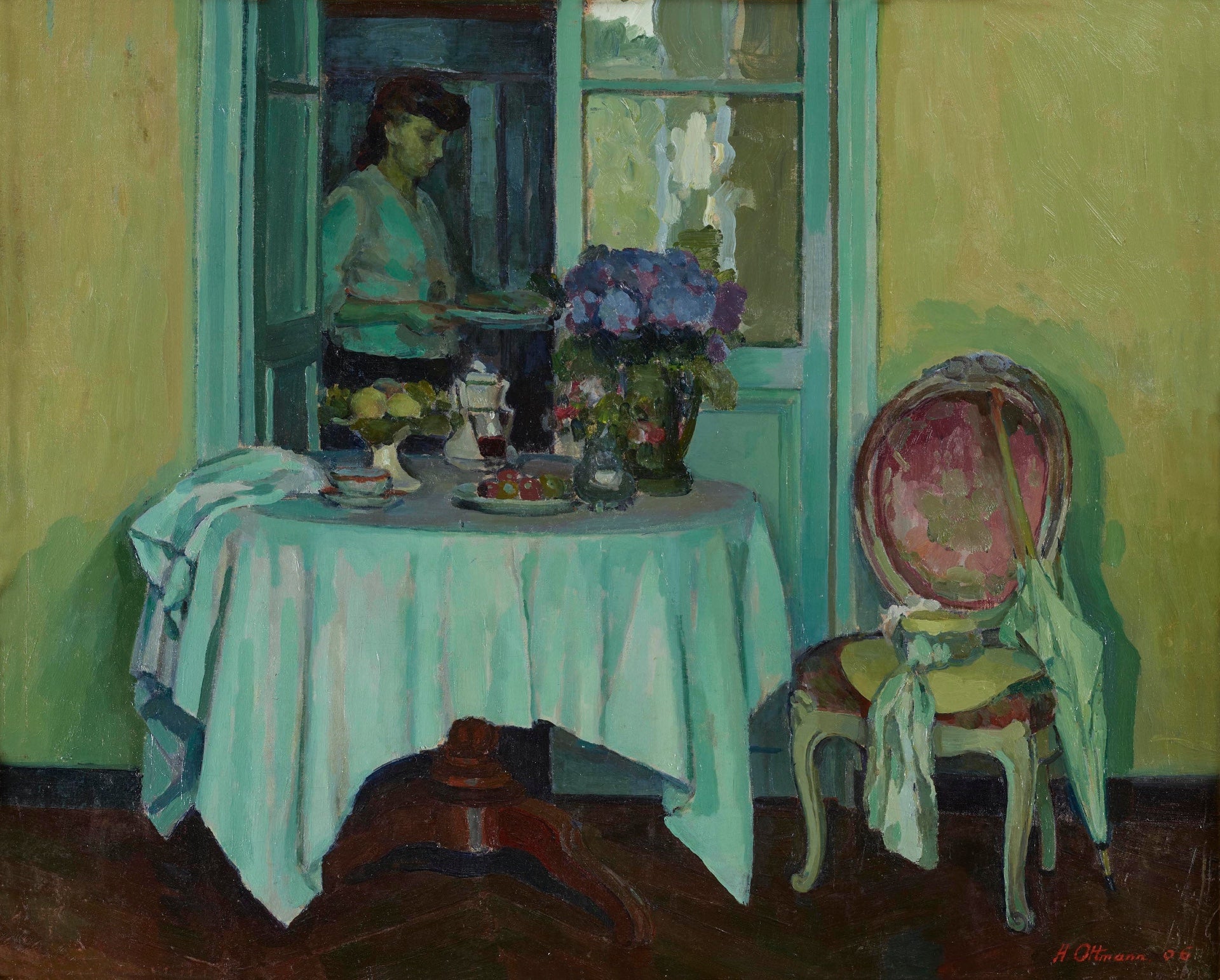
Henri Ottmann
Le Guéridon (The Pedestal Table)
Oil on canvas, signed lower right and dated 1906
Image size: 25 1/4 x 31 1/2 inches (64.4 x 80.2 cm)
Provenance
Bernard Toublanc-Michel Collection
Literature
Henry Ottmann Catalogue Raisonné, Bernard Toublanc-Michel, 2020, Lelivredart, p.70
This intimate painting depicts a quotidian scene of a woman serving a meal on a table laden with flower vases, fruit bowls, and a coffee pot. The cluster of items on the table, as well as the parasol and hat on the nearby chair, give the impression of a carefully formulated still life, but this atmosphere is offset by the sense of movement that stems from the turning posture of the woman.
The diverse range of brushstrokes serve to emphasise this notion of capturing an instant in time - less detailed brushwork is used for the doors, the woman and the walls, whilst more meticulous detailing is used for the folds of the tablecloth and the items on the tabletop. This has the effect of recreating how the field of vision is only able to focus on one point at a time. Coupled with the glancing reflections of the chair in the polished floor, it furthers the notion that this image has caught a single instant - the woman will continue to turn, the tablecloth will flutter with a gentle breeze, the reflection will change with the light, and the viewer’s focal point will change.
It is this sense of the instantaneous that Impressionism sought to create. There is a noticeable Impressionist slant on the colouration of the image, with a vibrancy that veers into the realm of the non-naturalistic. Take, for example, the brightness of the purple flowers and the yellow lemons on the table - these are not necessarily diligent representations of the colours of these objects, but instead function as an emotive ideal of what a purple flower or a yellow lemon should look like. Ottmann further toys with colour, contrasting blue undertones present in the tablecloth, parasol and doors with the yellow hue of the walls. It is evident that colour was a meaningful tool for Ottmann, rather than for realism, demonstrating his alignment with Post-Impressionist approaches to colour.
The woman in this image is believed to be Ottmann’s wife Marianne, and it adds an endearing element to the image, insofar as these items belong to the artist and his beloved wife.
Henri Ottmann
Born in Ancenis in Loire-Atlantique in 1877, Ottmann began his artistic career as a painter and printmaker in Brussels at the beginning of the 20th century. He began his studies in 1896 at the Ecole des Beaux Arts in Paris, but was interrupted the following year when mandatory military service in the 64th Infantry Regiment forced Ottmann to return to Ancenis. Abhorring military life, Ottmann faked his own drowning in the Loire. Whilst on the run, he survived by painting and selling unsigned work. It was also during this fugitive period that he met and married Marianne Capron, with the two of them fleeing to Belgium. It was in Brussels that Ottmann’s first exhibition took place, at the Salon La Libre Esthetique in 1904.
Shortly after this, Ottmann and his wife did return to France, where he subsequently participated in prestigious exhibitions such as the Salon des Independants in Paris from 1905, the Salon d’Automne, the Salon Societe Nationale des Beaux-Arts and the Salon des Tuileries.
Despite this success at the Salons, Ottmann’s early career was marked by extreme financial difficulties. As a result, his formative years as an artist were spent painting works that appealed to collectors and commercial galleries, rather than developing his own distinct style. As he gained more success, this individual style did develop, particularly in relation to still life paintings which, alongside nude paintings, are the subject matter Ottmann is most renowned for.
Ottmann’s oeuvre before the First World War was heavily influenced by the French Impressionist movement, particularly the works of Renoir, and he often exhibited within this artistic circle of Impressionists, Post-Impressionists, and Fauves. In 1911 and 1912, Ottmann exhibited at the Artiste de la Société Moderne at the Gallery of the French art dealer Paul Durand-Ruel. Durand-Ruel represented many prominent French Impressionist painters, including Armand Guillaumin and Henri Lebasque. In 1912, he also exhibited at the Galerie of Eugene Druet, a French photographer and art dealer whose gallery had exhibited works from Georges Pissarro, Charles Camoin, Albert Marquet, Maurice Denis and Paul Cezanne.
At the outbreak of the war, Ottmann was registered as a conscientious objector. Instead of a combatant role, he worked as a nurse for a military hospital in Ancenis - intriguingly, many of his fellow nurses were his portrait clients and patrons. During the years of conflict, he continued to produce art and hosted an exhibition at Druet’s gallery in 1917.
From 1919, Ottmann was involved in creating woodcut illustrations for the ‘Drawings and Signed Wood’ section in the Nantes-based literary and artistic magazine La Gerbe. These illustrations were displayed among others by Impressionist artists such as Paul Signac and Henriette Tirman. In the early 1920s, Ottmann exhibited at the Marcel Bernheim Gallery and the Exposition du Cercle Artistique de Bruzelles, with the latter exhibition displaying his works alongside those of Charles Guerin, Henri Matisse, Paul-Abert Besnard and Andre Lhote. Ottmann continued to exhibit to great success, enjoying shows at L. Dru and La Palette Francaise in 1926, and the Galerie Armand Drouand in 1927. His works were even exhibited as far away as Beirut, New York, Detroit, Buenos Aires, and Tokyo.
Tragically, Ottmann’s life was cut short in a car accident in Vermon in 1927. Driving to an exhibition of his works in Rouen, a burst tire caused his car to roll over in which Ottmann suffered a fractured skull and spine. After being transported in a coma to a clinic in Vernon, Ottmann tragically passed from his injuries at the young age of 49 years old. If Ottmann had not been involved in this tragedy, it is likely that his artworks and distinct style would have earned him a deservedly high reputation.
Nonetheless, Ottmann’s works can be found in many French Museums, including the Modern Museum and the Luxembourg Museum in Paris. A number of his works were destroyed during the Second World War, particularly his works in collections in Berlin, Hamburg and Nagasaki. Subsequently, the conflicts in the Middle East destroyed a large portion of Ottmann’s oeuvre, held in Beirut by collector Mr Charles Corm. Ottmann’s surviving works are largely in private collections, and are very rarely seen or sold.