Frederic Leighton
The Sluggard
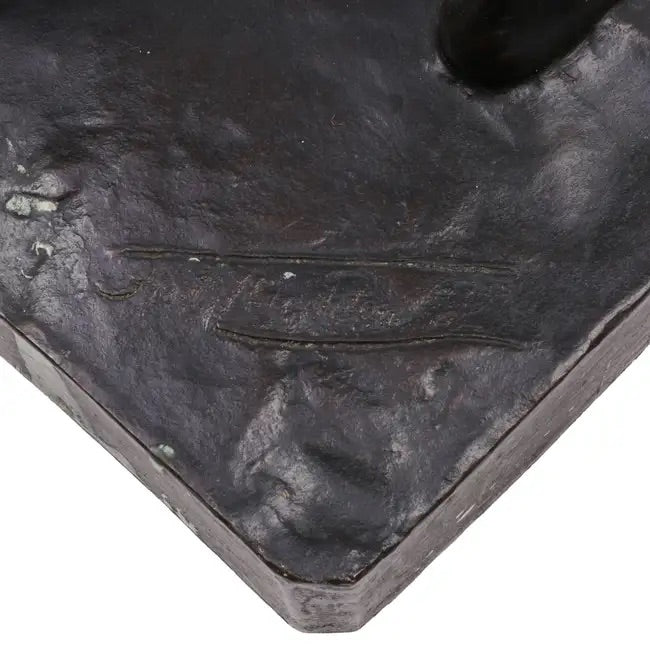
Bronze, signed 'Fred Leighton' back corner, titled on base
Dimensions: 20 1/2 inches in height
Provenance:
By repute, The John Schaeffer Collection, Sydney, Australia
Nevill Keating Tollemache Ltd, London
The Collection of Roger S. Wieck and Jean-Francois Vilain: Sold to Benefit The Morgan Library & Museum
Literature
Joanna Barnes, Leigton and his Sculptural Legacy: British Sculpture 1875-1930 (London: Joanna Barnes Fine Arts, 1996), p. 50.
Stephen Jones, Christopher Newall, et al, Frederic, Lord Leighton: Eminent Victorian Artist, exh. cat. (London: Royal Academy of Arts, Harry N. Abrams, 1996).
B. Read, Leighton as a Sculptor: Releasing Sculpture from Convention (London: Apollo, 1996), another cast.
Michael Forrest, Art Bronzes (Pennsylvania: Schiffer Publications Ltd, 1988), pp. 8, 22.
Susan Beattie, The New Sculpture (London: Yale University Press, 1983), pp. 149, 190-191.
Richard and Leonee Ormond, Leighton (London: Yale Universtiy Press, 1975), another cast.
Nikolaus Pevsner (foreword), British Sculpture 1850-1914 [A Loan Exhibition of Sculpture and Medals Sponsored by The Victorian Society - 30th September - 30th October, 1968] (London: Fine Arts Society, 1968), another version, p. 27.
Algernon Graves, The Royal Academy of Arts: A Complete Dictionary of Contributors and their Work from its Foundation in 1769 to 1904 (London: Henry Graves & Co. Ltd. and George Bell and Sons, 1905-06), p.32.
Edmund Gosse, 'The New Sculpture, 1879-1894', The Art Journal (1894), p. 281.
In 1886, Leighton exhibited the original casting for The Sluggard at the Royal Academy to great acclaim. The bronze was originally executed in 1882 under the title ‘Athlete Awakening from Sleeping’, with the stretching pose being based off of model Gaetano Valona’s stretched posture after a day of sitting for Leighton. The languid contrapposto stance contrasts with the tense muscles of the model, hinting simultaneously at grace and restrained power in a representation of the ideal athletic male nude. The work was noted for taking its inspiration from sculpture of antiquity and the Renaissance, but the subject matter and overall style was pioneering. As a result, Leighton’s new sculpture was perceived as harkening in a new era of British sculpture, known aptly as ‘New Sculpture’.
In 1889, Leighton exhibited The Sluggard at the Exposition Universelle in Paris and earned a medal of honour, beginning an era of critical acclaim and commercial success for the bronze. In 1890, Arthur Leslie Collie bought the rights to market the model and created smaller-scale bronze editions in collaboration with the Singer & Sons foundry. Although Collie left the collaboration in 1906, Singer & Sons continued to produce such editions until at least 1914. Editions without the foundry mark do exist, but debate remains as to whether they were produced before or after the involvement of Singer & Sons, with Nicholas Penny noting that many other editions were produced in the 1890s, 1920s and 1930s.
These small-scale casts ensured that The Sluggard became one of the most popular British sculptures of the 19th century, with many private collections and notable museums (such as The Metropolitan Museum of Art and the Ashmolean) all holding a cast within their collection. A full-size bronze cast is in the Tate Gallery collection, whilst a full-size plaster version is held by the Royal Academy. As if to solidify the importance of The Sluggard to Leighton’s legacy, a cast of it is also featured on Leighton’s tomb in St Paul’s, held by the allegorical figure of Sculpture who flanks an effigy of Leighton.
Lord Frederic Leighton
Leighton was born in Scarborough, Yorkshire, in 1830 and although he was not part of the peerage at birth, came from a wealthy family that funded his early artistic career. He spent his childhood travelling in Europe and studied in Florence, Frankfurt and Paris - in the latter location, Leighton became acquainted with Ingres, Delacroix, Millet and Corot. From Paris, Leighton made a sojourn to Algeria, which undoubtedly inspired his adoration for islamic aesthetics.
At the age of 29, Leighton settled in London at Leighton House in Holland Park, and began to gain success for his unique artistic aesthetic that stemmed from his exposure to Old Master and European artworks. Almost immediately, Leighton became an associate at the Royal Academy and was a member of the Pre-Raphaelite Brotherhood. The love for travel that stemmed from his childhood never diminished, and Leighton is known to have visited Austria, Egypt, France, Greece, Algeria, Spain, Lebanon, Syria, Germany, Italy, the Netherlands, Turkey, Switzerland and Morocco. Leighton also volunteered with the 38th Middlesex Rifle Volunteer Corps (later known as the Artists Rifles) and was noted for his keen leadership skills, with fellow artist James Whistler noting Leighton as "Colonel of the Royal Academy and the President of the Artists Rifles – aye, and he paints a little!".
In 1877, Leighton’s sculpture Athlete Wrestling with a Python was considered supreme and representative of a renaissance in British sculpture, coining a new term ‘New Sculpture’. Across his career, Leighton only produced three sculptures - the remaining two being The Sluggard and Needless Alarms. Despite the small size of his sculptural oeuvre, Leighton’s works held immense influence over his successors, including Hamo Thornycroft and Alfred Gilbert.
Best known for his paintings, Leighton worked within the Aesthetic movement and his works often depicted scenes from literature, mythology, allegories and the Bible. Queen Victoria bought his first painting in 1855, paving the way for Leighton’s appointment as President of the Royal Academy in 1878, a position that he held until his death in 1896. He also served on advisory boards for the National Portrait Gallery, the British Museum, and the Sir John Soane Museum. Leighton was Knighted in 1878 and was also the first artist to be awarded a peerage, becoming Baron Leighton of Stretton. Only a day after his ennoblement, Leighton passed away, childless and unmarried. As a result, Leighton is the bearer of the shortest-lived hereditary peerage in British history. He is buried in St Paul’s Cathedral, London, and the Artist Rifles formed a guard of honour for his funeral. Posthumously, his works represented Britain in the 1900 Great Exhibition in Paris.
Leighton House in Holland Park is now a museum that encapsulates his unique blend of Islamic, Renaissance and Byzantine influences. He is often considered a critical figure in Victorian and wider British art, with his paintings and sculptures held in major museums across the world, including The National Gallery, The Met, The Tate, and the Museum of Fine Arts in Boston.