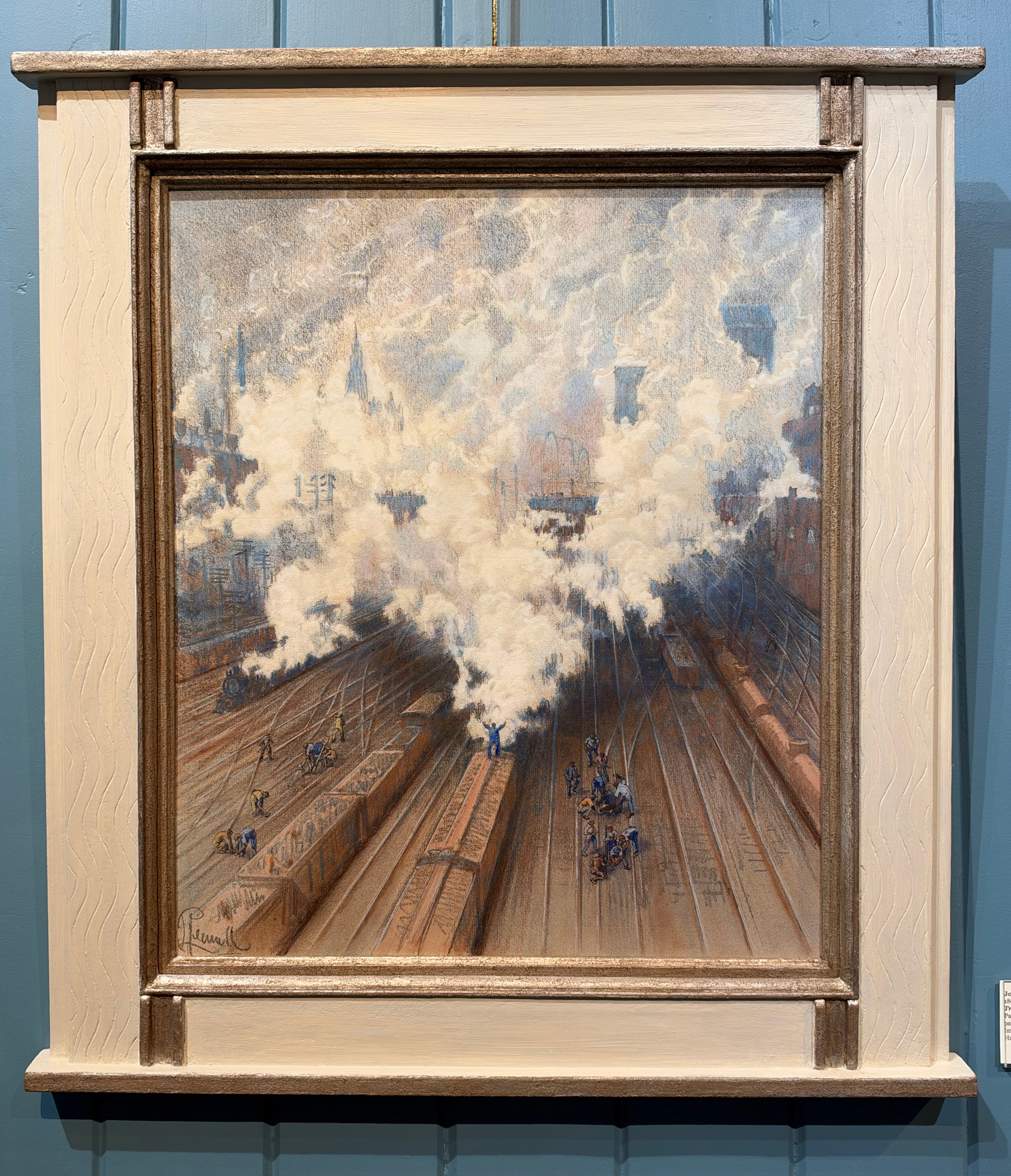
Joseph Pennell
Train Yard, St. Louis, 1919
Pastel and gouache on cream laid paper, signed lower left
Image size: 16 1/2 x 19 2/3 inches (41.9 x 49.9 cm)
Hand-made Art Deco frame
Even within this single work, it is clear to see why Joseph Pennell was hailed as one of the most important artists of industrial scenes in the late 19th and early 20th century. The work captures a bustling station in St. Louis, Missouri, with freight trains arriving into the station and diminutive figures working on the tracks. In the background, early skyscrapers peek out from behind thick clouds of thick, tangible white smoke.
Pennell rejected the painterly tradition and instead focused on working with pastels and gouache, with this work demonstrating his supremity over the medium. This is a very rare example of a full-colour, original artwork by Pennell. The scene epitomises the American industrial era, its new and innovative inventions, and the hard work of ordinary men that ensured such rapid economic progress.
Joseph Pennell
Joseph Pennell was born in Philadelphia, Pennsylvania in 1857 to Quaker parents. At school he was known to be a loner, and upon leaving education, Pennel worked for the Philadelphia and Reading Coal and Iron Company. His application to Pennsylvania Academy of the Fine Arts was rejected, so he took up night classes at the Museum and School of Industrial Art instead.
After Pennell was expelled for ‘trying to start a student mutiny’, his former professor enabled him to gain entry to the Academy of Fine Arts. He excelled in the graphic arts more so than painting, and opened his own studio in 1880. Much like many of his contemporaries, Pennell left America for Europe and London in particular, where he taught at the Slade School and exhibited at the 1900 Exposition Universelle, winning a gold medal.
Pennell is known to have made over 4700 prints of industrial scenes in America, South America, Europe and England, largely commissioned by magazines and publishing companies. His largest commission was received in 1884 by Century Magazine, to produce drawings of London and Italy, and cathedrals in France and England. Alongside his wife, the journalist Elizabeth Robins Pennell, Pennell moved permanently to London and became close with a number of high-society writers and artists. The most important of these was undeniably James McNeill Whistler - when Whistler moved his studio to Paris in 1892, Pennell followed the year after and spent a considerable amount of time working with Whistler. In fact, Pennell and his wife even wrote Whistler’s 1908 biography.
After the outbreak of WW1, Pennell obtained permission from British Prime Minister David Lloyd George to record the munitions factors in the North of England, but was received with hostility by the locals. Nonetheless, the lithographs were published and reached the attention of the French Minister of Munitions, who requested that Pennell illustrate the war in Verdun from the frontlines. He found the war barbaric and returned to England, and then to his home country of America. Here, he produced one of the most iconic American war posters - That Liberty Shall Not Perish.
Pennell commenced teaching at the Art Students League, working there right up until he died. He caught the flu and died in April 1926. He has been called the ‘Dean of American Printmaking’ and is credited with spurring the medium’s revival in the early 20th century. Mount Pennell in Utah is named after him.